

***********

Dean CONRADO F. BENITEZ
Claim to Fame: Dean of the College of U.P. Liberal Arts, Statesman, Constitutionalist, Civic Leader
Sporting Credentials:
Varsity Swimming Team
and Captain of the Water Polo Team, University of Chicago
Dean Conrado
F. Benitez (b.Nov. 26, 1889/d.Jan. 4,1971) took up the sports of swimming while
growing up in Pagsanjan, learning the fundamentals in the famed rapids of his
town. When he studied at the Philippine Normal College, he briefly took up
baseball but gave this up when he became a government “pensionado” in 1911. Sent
to the University of Chicago, Benitez rediscovered his love of swimming. One of
his good friends in the university was Johnny Weismuller (future Olympic
swimming champ and filmdom’s “Tarzan”) who practiced with him at the university
pool. He became so good that he qualified for the university’s swimming team,
and earning letters in the sport. Simultaneously, Benitez also captained the
school’s water polo team. Upon his return to the Philippines in 1913, Benitez
organized the swimming team for that year’s Far Eastern Games. He trained
mostly Muslim swimmers who went on to beat the Japanese and Chinese teams for
the Gold. The Philippine Women’s University,
that school that his wife, Francisca Tirona-Benitez founded, holds the
distinction as being the first exclusive girls’ school to have a pool. In 1957.
Benitez was honored by the University of Chicago as one of its outstanding alumni,
for his meritorious contribution to campus sports.

LOU SALVADOR SR.
Claim to Fame: Actor, “Master Showman” of Philippine Showbiz, patriarch of Salvador
showbiz clan that includes Lou Salvador Sr., Leroy Salvador, Philip Salvador,
Alona Alegre, and Maja Salvador.
Sporting Credentials:
Philippine Basketball
Team, Far East Games 1921, 1923, 1925
Meralco Basketball
Team, Winner, 1932 National Open
Championship
Before the
movies, Lou Salvador was an ace basketball player who once ahot 116 points in a
single game. This, he achieved in the 1923 Far East Games in Osaka, Japan where
he was part of the Philippine basketball team. He had also represented the
country in the 1921 and 1925 edition of the premiere Asiatic games. A member
of the Jose Rizal College and the Meralco team that won the National
Open Championships in 1932, Salvador was a skilled player, who would loop the
ball into his own ring from the opposite goal, and was hailed as “the greatest
forward the country has ever produced.” Salvador tried his hand in “bodabil” as
the character Chipipoy and Ivan Ludor, and made a successful move to movies. He
appeared in such classic films as “Genghis Khan”.
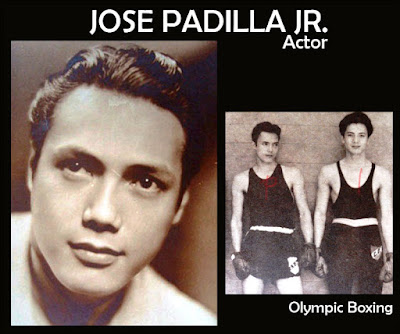

JOSE PADILLA JR.
Claim to Fame: Pre-war Matinee Idol
Sporting Credentials:
Philippine Boxing
Team, 1932 & 1936 Olympics
Born to a
showbiz family, Jose “Pempe” Padilla (b. Jul. 16, 1911/d. Jun. 18, 1978) made
his first film in 1931. The next year, the avid pugilist represented the Philippines
as a lightweight boxer during the 1932 Summer Olympics in Los Angeles, but was
eliminated in the first round. Upon his return, he resumed acting in films, taking
second lead to Don Danon in the immensely successful movie, Dr. Kuba, shown in
1933. He took time off again to compete in the 1936 Berlin Olympics, but lost
again. Padilla then devoted his time to movie making, often paired with wife
Arsenia Francisco, Carmen Rosales and Rosa del Rosario—superstars of their day.

AMANDA & LUZ ABAD SANTOS
Claim to Fame: Daughters of justice and patriot Jose Abad Santos
Sporting Credentials:
Member, Philippine
Women’s Swimming Team, 1934 Far Eastern Games
All the
four daughters of Justice Jose Abad Santos with Amada Teopaco were all enrolled
at the Philippine Women’s University, where they all became varsity swimmers.
Amanda and Luz, however, were at the top of their game. In an open call to
determine the delegates to the 1934 Far Eastern Games, the teen sisters joined
and successfully passed the qualifying races. Both Amanda and Luz were fielded
to compete in the women’s 50-meter freestyle and 100-meter backstroke events.
In later years, Amanda would wed businessman Antonio Paterno Madrigal. A
daughter, Jamby Madrigal, became a Philippine senator.

AMBROSIO PADILLA
Claim to Fame:
3-Term Senator of the Philippines
(1957, 1963, 1969); Lawyer (3rd place at the Bar Exams), ; Educator,
Author of Law Books, ; Vice Chairman of the Constitutional Commission that
drafted the 1987 Constitution.
Sporting Credentials:
Captain, Philippine
Basketball Team, 1936 Berlin World Olympics (5th placer)
The
brilliant Ateneo sportsman—Ambrosio Bibby Padilla (b. 7 Dec. 1910)/d. ) proved
in his lifetime that sports and academics can, indeed, mix. Graduating from Ateneo with Summa Cum Laude
honors, he moved to U.P. for his Law degree, and finished as Salutatorian. On
the side, “Paddy”, as he was called, was excelling in sports. His basketball
skills earned him a berth in the national basketball team that went to the 1936
Berlin Olympics. As captain and playing coach, Padilla steered the Philippines
to a 5th place finish, the best finish ever achieved by the country,
losing only once to the United States team. After his sporting days were over,
Padilla actively supported the government sports program., serving as President
of the Philippine Amateur Athletic Federation (PAAF), President Emeritus of the
Asean Basketball Confederation (ABC), and Chairman of the National Olympic
Committee (NOC).

CESAR RAMIREZ
Claim to Fame: Actor,
known for his role “Bernardo Carpio”.
Sporting Credentials:
Bodybuilding, Mr.
Luzon 1951
Arlen
Quindoy Aguilar (b.1929 d. 18 Jul. 2003) was an avid student of physical
culture, an interest cultivated while with the U.S, Fire Service. In 1951, he
joined the bodybuilding contest of Mr. Philippines. The well-built 22 year old did well, garnering runner-up Mr.
Luzon honors to eventual winner, Jesus Ramos (who also became a movie star via
the “Og” films). Sampaguita Pictures took a second look at Aguilar, who had
previously appeared as an “extra” in a
handful of their films. He was re-christened as Cesar Ramirez, and was launched
in the movie, “Bernardo Carpio”, the legendary figure known for his great
strength, trapped between the mountains of Montalban. Ramirez was paired off
with the voluptuous Alicia Vergel, who would become his wife and give him 2
children: Ace York and Beverly. Ramirez’s star would rise in the next few
years, with films that allowed him to show off his muscled physique: Tres
Muskiteros, Palasig, Dumagit, Ukkala,
Madam X, Aliping Maharlika,
Ramir, and Lupang Kayumanggi. In
1975, he migrated to the U.S. only to return to the Philippines in 2001.
Already afflicted with Parkinson’s disease, Ramirez died of cardiac arrest in
2003.

FREDDIE ELIZALDE.
Claim to Fame: Media Magnate, Executive
Officer of Manila Broadcasting Co., husband of Lisa Macuja
Sporting Background:
Member, 1960
Philippine Olympic Team, Swimming
Medallist, 1958 Asian
Games
Son of the
the Philippine Patron of Sports, Manolo Elizalde, the younger Elizalde (b. 17Aug. 1940), was a Harvard collegiate swimmer in the U.S.
when he was chosen as part of the Philippine team , at the 1958 Asian Games.
With teammates Rodolfo Agustin, Jacinto Cayco and Dakula Arabani, Elizalde won
a Silver medal in the 4 x100 individual medley and a Bronze in the 200 m.
butterfly. He reached top form in 1960 when he won the Eastern Collegiate
crowns in the U.S. at the 100 m. (1:02.6
secs). and 200 m. butterfly events and with his Harvard mates won the medley
relay against a fast field. He earned an All-American rating in Swimming.
Freddie would have been a medal threat
in the 200 m. butterfly race (he was clocking in at 2 mins, 20 secs.) at
the 1960 Rome Olympics had it not been for a fractured hand that he suffered
that almost kept him off the Philippine Olympic squad. Nevertheless, he managed
to race in the 100 m.freestyle event and the 4x100 m. IM.

ADOLFO FELICIANO JR., Dancer
Claim to Fame: TV Dance Host
Sporting Credentials:
1954 Asian Game Gold
Medalist, 3-Time Olympic shooter
On 29
October 1961, the pioneering dance show --“Dancetime with Chito” hit the
Philippine airwaves for the first time. Adolfo “Chito” Feliciano and his group
danced their way to national fame with their energetic cha-cha, rhumba, samba,
ballroom and signature Latin dances. But the nimble dancer was also a
world-class athlete. At the University of the Philippines where he was a Fine
Arts major, Feliciano tried out for the U.P. six-man shooting team. When the
trials were over, he was ranked no. 1 in a field of 80 students. In the next
2 years, he became so adept with the 3-position rifle event. He qualified for
the quadrennial Asian Games, held in Manila in 1954. Entered in the small bore
rifle, 3-position, Chito won a Gold. In fact, of the 15 Gold medals won by the
Philippines, the shooting team garnered 4. Upon his return, he was offered by
Channel 7 to do a program—a dance show!! Not everybody knew that Feliciano also
loved social dancing, and the TV show, which he hosted until 1964, made him a
household name. His last stint
was at the 1968 Mexico Olympics. After his sporting and TV days were over, he put his sharpshooting
expertise to good use by joining the Philippine Navy as head of the Sniper
Training Unit. He died in 1972,during a military exercise.

ROMY DIAZ
Claim to Fame:
Movie Actor, playing character and
villain roles.
Sporting Credentials:
Professional
Basketball Ace
The actor
you love to hate was regarded as one of the shotmakers in the varsity league
when he was still with the FEU (Far Eastern University) Tamaraws. In his UAAP
games, he made an average of 25 points per game. His record was 44 points in 25
minutes of play. Diaz made his professional debut with the Floro Redmanizers at
the popular 1962 Manila Industrial and Commercial Athletic Association (MICAA)
cage tournament (pre-cursor of the PBA), where he made 17 pints against the YCO
team.
ARTURO MACAPAGAL,
Claim to Fame: Presidential Son (Diosdado
Macapagal with Purita dela Rosa)
Sporting Credentials
2-Time Olympic Shooter
The
presidential son, Arturo dela Rosa Macapagal ( b. 14 Sep. 1942/d. 11 Aug 2015)
was an accomplished shooter who competed in 2 summer Olympics. Gloria
Macapagal-Arroyo is his half-sister. He started competitive shooting as a
hobby, and became an expert marksman. At the 1972 Olympics in Germany, Macapagal established a national record for
free pistol, a record that stood for 21
years, the longest in the country's shooting history. For that feat, he was
named the All-Around Filipino Sports Awardee by the Philippine Sportwriters
Association in 1973 and 1974. He was chosen as the "Most Outstanding
Shooter of the Decade" by the Philippine Olympic Committee in 1980.
Macapagal also led the Philippine National Shooting Association for many years
and also served the Philippine Olympians Association as president.
SOURCES:
Ambrosio Padilla: https://www.senate.gov.ph/senators/former_senators/ambrosio_padilla.htm
Conrado Benitez: Ablaza,Elias L., “Saving a Sinking Sport”, The Sunday Times Magazine, 15 Jan. 1967 issue,pp. 38.
Jose Padilla Jr.: Graphic Magazine 1933, Wikimedia.com
Amanda Abad Santos: Graphic magazine, 1934
Lou Salvador: Garcia, Jessie B., A Movie Album Quiz Book, Erehwon Books and Magazines, Iloilo City. Dec. 2004, pp. 224-225
Cesar Ramirez: “Bernardo Carpio ng Sampaguita”, Literary Song-Movie Magazine, May 1951 issue, pp. 46-47.
Freddie Elizalde: The Elizalde Family, https://philippines.mom-rsf.org/en/owners/individual-owners/detail/owner/owner/show/the-elizalde-family/
Romy Diaz: Variety Magazine, 1962
Chito Feliciano: www.viewsfromthepampang.com
Arturo Macapagal: The Sunday Times Magazine, 1972 Olympic issue


