Showing posts with label Philippines. Show all posts

Saturday, May 11, 2024

85. GEORGE REY URBANO: A Filipino Trailblazer in International Professional Wrestling

GEORGE REY URBANO. For over 3 decades, this trailblazing Philippine-born wrestler made waves in the American wrestling circuit as Rey Urbano, Tokyo Tom, Taro Sakuro, and his most famous wrestling persona—the Great Kabooki.

Wrestling has always had a worldwide audience, ever since the National Wrestling Alliance (NWA), was founded in 1948 as a governing body for professional wrestling. Based in America, NWA began promoting brawling matches on television back in the early 1950s.  By 1961, canned wrestling programs (Men’s and Women’s) were seen regularly on late-night Philippine TV over DZBB Channel 7.

Curiously, Filipinos did not catch on to wrestling despite their love for contact sports, preferring boxing instead. After all, the boxing world included many Filipino champions—Pancho Villa, Ceferino Garcia, father and son Cely and Anthony Villanueva, Flash Elorde, among others-- fighting figures of our national pride. They were the best reasons to root for the sport—not alien names like Bobo Brazil, Gorgeous George, Killer Kowalski, and the Fabulous Moolah.

Not until the mid-1980s that Filipinos took a second look at wrestling. By then, the World Wrestling Federation (WWF) took command of the sports, booking champions and producing big wrestling events, beamed on cable TV from huge venues like Madison Square Garden and Shea Stadium.

SMACKDOWN SOUVENIR. A 1950s fight program from the first golden age of American wrestling features a match between Rey Urbano of Manila versus Axel Cadier from Sweden.

WWF signed up and headlined wrestlers Hulk Hogan, André the Giant, Roddy Piper and Bret Hart, in shows like WWF Superstar, set amidst music, lights and much theatrics. Merchandising gimmicks were launched for its pool of talents, spawning action figures, video games and toys. When the programs went into syndication, they were lapped up by a mainstream audience who found new heroes to idolize.

The entry of Filipino-American grapplers further fueled the Filipinos’ crazy fascination, and later, obsession, with wrestling. There was Dave Batista (David Michael Bautista), a hulking 6’6” wrestler who was snapped up by WWF (now World Wrestling Entertainment or WWE) in 2000.  Now retired, Batista remains visible in action films like “Riddick”,  “Guardians of the Galaxy”, and “Avengers: End Game”.

Benny Cuntapay (B.Boy), has also successfully fought in the All-Pro and Combat Zone Wrestling. While T. J. Perkins, who used to fight as “Pinoy Boy”,  won the inaugural WWE Cruiserweight Championship in 2016. Recently, Fil-Am Michael Paris (aka DJZ), 2-time Impact X Division Champion, was reported in March 2019 to being squired by WWE.

REY OF LIGHT.  Rey Urbano resplendent in a Philippine Muslim costume. Photo by Libnan Ayoub, 100 Years of Professional Wrestling in Australia via Online World of Wrestling.

The extraordinary feats and skills of these world-class Filipino matmen, however, were foreshadowed not too long ago by a Manila-born strongman who blazed trails by breaking into the competitive world of international wrestling—in his time, the only professional wrestler in all of the Philippines: GEORGE REY URBANO.

FATHER JUAN. Rey’s father was born in Samar and became an inventor, the first Filipino to own a U.S. patent for a fountain pen and pencil that can write in the dark. He later entered the movies business back in the Philippines.

Born in Manila on 25 Apr. 1924 to Juan and Sixta Urbano, Rey had quite a comfortable life. His father was a successful inventor and businessman, the cousin of famed movie director and actor, Manuel Urbano (screen name: Manuel Conde), who had made waves in Venice in 1952 with his opus, “Genghis Khan”.

COMING  TO AMERICA. As a student of the San Francisco City College, Rey Urbano (on the right) was a valuable member of the school’ football team in 1948. Photo courtesy of The Guardsman via RECON MAGAZINE, March-April 2017 issue. Used with permission.

Four year old George Rey,  his older 3 siblings (Belen, Marina, Isidro) and their mother Sixta moved to America in 1928, to follow Juan, who had  gone there ahead to set up a manufacturing business. Sixta boosted the family income by selling jewelry pieces. The children went to schools in the San Francisco area where they had settled.

Things were going well for the family, until tragedy struck in 1939 with the death of their mother. Rey was only 15 then, still a student at the San Francisco Polytechnic High School. To make things worse, his father Juan decided to return to the Philippines to look for business opportunities in the field of movie production—an obvious influence from his showbiz cousin whose career was about to peak.

Left in the U.S. in the care of relatives, Rey immersed himself in football and judo. The war in his native Philippines cut short his college dreams, and so, at age 19, like his brother Isidro before him, he joined the 1st Filipino Infantry Regiment in early 1943.

REMEMBER THIS ALAMO SCOUT. 19 year old Rey Urbano, Rey Urbano, as a member of the 1st Filipino Infantry Regiment in 1943. He and his brother would also sign up as volunteers of the Alamo Scouts. Used with permission from RECON MAGAZINE, March-April 2017 issue.

The 2 brothers would later volunteer to become Alamo Scouts, an elite reconnaissance unit that saw action in the jungles of  New Guinea. The next year, Rey and Isidro were deployed to the Philippines as part of the Allied landing forces.

When the war ended, the young veteran left his military career to go back to school. He entered San Francisco City College in 1947 which had an excellent football program. Though a bit underheight for the sport (he was 5’9”, 200 pounds), Rey became an outstanding player of the 1948 team, which snagged a mythical national junior college championship.

To build his stamina and strength on the gridiron, he took to an alternate sport he had also been avidly indulging in: wrestling. He underwent intense training in the school put up by the acclaimed Filipino wrestler Pantaleon Manlapig, who had previously held many Pacific Coast titles, under the name Tony Aguinaldo in the 1940s.

MENTORED BY MANLAPIG. Rey Urbano trained under Filipino wrestling legend, Pantaleon Catanghal Manlapig, who fought in Hawaii under the name Tony Aguinaldo. He held the Pacific Coast title in the 1940s for several times.

Rey was instantly hooked. He came to master many fighting styles and techniques—Greco-Roman, Sumo, catch-as-catch-can styles.  Bitten by the wrestling bug, he passed up a football scholarship from the University of Southern California,  ignored his father’s pleading to return to the Philippines and be a movie star, and instead, chose to focus on a new goal: to become a professional wrestler.

STRIKING A FIGHTER’S POSE. Rey Urbano in his first official photo as a professional wrestler, taken in 1950. Photo courtesy of L.A. Public Library via RECON MAGAZINE, March-April 2017 issue. Used with permission.

He debuted in a match held in Honolulu, Hawaii on 23 April 1950, using his real name, “Rey Urbano”, defeating Chico Garcia in his very first professional outing . The Ogden Standard-Examiner in Utah was effusive in its review of Rey’s performance: "Rey Urbano came here recently from the Philippines and has impressed with his ability under all kinds of fire… The Islander uses the side of his hand in a cutting manner not unlike the chopping knife he used at home in the sugar cane fields. It is both legal and effective."

Rey was on his way. The next year, Rey was billed in a match at the Los Angeles Olympic Coliseum, capturing the attention of the nearly ten thousand screaming wrestling fans that crammed the venue. The one sad setback he experienced was the death of his brother, Isidro, who was killed in action in the Korean War of 1952.

Though he found steady work throughout the west and southwest in the next few years, Rey realized that the crowd drawers of wrestling bouts were not the favorites like him, but the villains of the ring. In fact, they also brought in the big bucks!  Rey, thus, in a complete turn-around, shed his clean, good boy image to assume a villainous wrestling persona.

TURNING JAPANESE. Rey Urbano made a major career shift by becoming a wrestling villain in the person of  “Taro Sakuro”, a name he used from the late 50s and 60s. Photo courtesy of RECON MAGAZINE, March-April 2017 issue. Used with permission.

As it was just a few years after the terrible War in which the Japanese earned a reputation as heinous villains for their war crimes, Rey chose to be known as “Taro Sakuro”. In 1959, in his first fight in Tennessee, the bearded “Japanese” hulk in a short robe and wooden sandals, ascended the ring and struck fear with his evil eye gaze and calm, but fearful exterior. But most of all, his behavior and fighting tricks disgusted the crowd—which he had hoped would happen—a despicable anti-hero that the audience loved to hate.

Rey enjoyed immense success with his new wrestling character. In  1962, he won the NWA Southern Junior Heavyweight Championship, and, with Oyama Kato, the NWA U.S. Tag Team title. Promoters began matching him  with more popular, more high-profile wrestlers. Needless to say, this move paid off, and he began collecting more susbtantial paychecks. 

 THE TERROR THAT WAS TARO. Rey Urbano as “Taro Sakuro” demolishes Alberto Torres in a 1962 fight. Photo courtesy of Wrestling Revue. Via RECON MAGAZINE, March-April 2017 issue. Used with permission.

As the new bad guy of wrestling, Rey had to deal with the backlash of fans. He survived a shooting, stabbings, and countless verbal and physical attacks. The most serious of all was being spiked on the foot by a woman using her sharp,  stiletto-heeled shoe,  a bloody injury that required surgery. He took all these in stride as occupational hazards that he had come to expect from the job.

Through all these, Rey carried on and retained the Japanese guise that helped  revitalized his career. Appearing in Texas in 1965, he briefly became “Tokyo Tom” and a substitute for “Tokyo Joe”, a convicted wrestler who was banned from the ring. He introduced gimmicks like incorporating over-the-top karate chops and thrusts in his moves that had the audience reacting wildly.

Shortly after the Texas stint, Rey faced another difficult, life-threatening hurdle. He was afflicted with a brain tumor and underwent a crucial operation. Thankfully, the mass was benign. He spent his 5-year long convalescence by going back to the California State University-Hayward  to finish a college degree (Recreational Studies). He found gainful employment at a recreational park where he held P.E. classes and occasionally wrestled to raise funds for his advocacies.

THE GREAT KABOOKI. The most well-known wrestling character conceived by Rey Urbano was a huge, hulking menacing Oriental warrior, a villain that the audience loved to hate. Alex Castro Photo.

Though doctors believed he will never wrestle again, he defied their dire prognostications and returned to the ring in late 1972 in a new incarnation. This time, he transformed himself into a villainous Japanese warrior of unspeakable brutishness, with a fierce-looking face painted for battle, and a name that no one will forget: The Great Kabooki.

He took his Japanese character to heart, dressing in authentic robes, and performing the ceremonial sumo ritual of throwing salt in his fights, which he also used to blind his foes. Everywhere he made an appearance, the Great Kabooki was a daunting figure to behold, inspiring fear and awe. His triumphant rebound was met with roars from the audience, who lapped up his acts and antics on the ring, catapultin him again to national prominence.

THAT KABOOKI FACE. Rey Urbano was the first wrestler to use paint make-up to make his Japanese character more theatrical, and more fearsome.

Rey, as The Great Kabooki, made a surprising comeback and toured the Midwest and the Southwest region. In 1973, he secured a spot in a Detroit promotion starring top wrestling star, The Sheik. He also worked the Great Lakes area, and wrestled in a few International Championship Wrestling shows.  Approaching 50, he still managed to complete 22 matches that year but the tolls of advancing age had begun to show, and he felt it.

To slow down, he accepted a job as a part-time chef in a California restaurant. He also seemed to have inherited his father’s creative genes. He devised “First and Ten”, a football board game and “Knockout”, a boxing game, both for kids. He formed a company—Urbano & Associates—to market these, but they generated little interest, so he eventually sold them off.

THE NAME OF THE GAME.  “First and Ten” was a gameboard developed by Rey Urbano, who inherited his father’s inventive genes.

With failed financial expectations, he returned to wrestling at age 58, reviving his Great Kabooki image. This posed some confusion, however, as by 1981, a younger Japanese wrestler by the name of Mera Akahishi, had started using the same name using the original spelling—the Great Kabuki.

In his 1982-83  farewell tour with ICW in the Midwest,  the Great Kabooki finished 16 matches, including one against the hugely popular Macho Man Randy Savage. His final fight was staged in a high school gym in Illinois. Like a true professional, he fought with his partner, Ratamyus,  in a tag team match and won---this, despite an audience of only 250.

KABOOKI FOR THE KILL. As a wrestling villain, Rey Urbano was jeered and harassed by hostile fans, but he took all these in stride. He entertained fans with his nasty stage demeanor, his tricky karate chops and martial art moves. 

In his twilight years, Rey joined an association of both retired and active wrestlers and boxers known as the Cauliflower Alley Club, which, in 1992 gave him recognition for his valuable contribution to the sport. Though he was married 3 times in his lifetime, Rey had no children; his family consisted of fellow wrestlers with whom he kept in touch regularly in annual reunions.

His fame reached the Philippines, but he was largely overlooked by his countrymen as they were more engrossed with rising boxers who were starting to win world championships in the 60s and 70s.  His occasional trips to his original homeland were more for family visits.

Jun Urbano, the TV funny man known as ‘Mr. Shooli’, remembers meeting his uncle twice. In one of his uncle’s rare homecomings, his family hosted him lunch and was served a specially-large dish of “kare-kare”. He watched him eat until he finished everything off. Then, Rey turned to Jun’s mother, smiled and hollered: “O-kay! Now bring out the main dish!”. His relatives were stunned at his voracious appetite. “Ang laking tao niya! (Such a big man)!”, Jun Urbano recalled.

GOLDEN GEORGE. In his golden years, Rey Urbano became a member of a fraternal wrestling group, and joined wrestling reunions for 15 years.

But Rey Urbano also had a big heart. In his own, quiet  way, he managed to entertain hundreds of wrestling fans for many decades, never mind that he did not attain the great financial success he worked so very hard for.

Described as “an all-around good person”, Rey  made many friends along the way.  In all, he fought a total of 989 matches in his lifetime career under 4 names, and wrestled against revered names like Bobo Brazil, Bruno Sammartino, Randy Savage and Mighty Igor—credentials that are nothing short of impressive.

Rey spent his remaining days in a Las Vegas nursing home, passing away on 16 Oct. 2007 at age 83. He is interred at the Southern Nevada Veterans Cemetery.

Today, wrestling and its related full contact disciplines like mixed martial arts, have a large, loyal Filipino fan base that continues to grow,  thanks to a constant fare of TV wrestling shows: Raw, Smackdown, This Week in WWE,  Bottomline and UFC (Ultimate Fighting Championship), among others.

URBANO LEGEND. George Rey Urbano, (b. 25 Apr. 1924/ d. 16 Oct. 2007)

While Filipinos are currently rooting for Seth Rollins, Finn Bálor, The Miz Becky Lynch and Alexa Bliss, they are also rediscovering their very own Dave Batista,  Brandon Vera, T. J. Perkins,  Michael Paris and Kris Wolf who have become worthy sports icons for legions of Filipino fans. Add to that the name of  George Rey Urbano—the Great Kabooki—a kickass Pinoy came before them, who broke barriers and made history to  become the only Filipino international wrestler in the first golden age of American professional wrestling.

 SOURCES:

Zedric, Lance. By Any Other Name the Story of Alamo Scout George Urbano

RECON MAGAZINE, March-April 2017 issue, pp. 1-8. http://www.alamoscouts.com/news/RECON_MarApr2017_OL_Magazine.pdf

 Pictures used with permission from Mr.Lance Zedric, unless otherwise noted.

 -Clovis News Journal (NM). “Wrestling Star Has Colorful Background.” Dec 17, 1952

-Drason, Dave. Wrestling Revue. 2007.

 -Friend, Percival. Rest in Peace, Reynaldo Urbano, The Original Kabooki. 2007. Wrestling Newsletter by Mark Bujan. http://www.oocities.org/percivalafriend/friend102207.htm

 -Funk, Dory, Jr. on Rey Urbano. As reported by Reported by Adam Martin of WrestleView.com On Thursday, October 18, 2007.

 -The Guardsman Yearbook. City College of San Francisco. 1948-1949.

 -Hurschmann, Bill. He Makes Football Better Game. San Mateo Times. Jul 11, 1977

 -Johnson, Steve. Original Kabooki faced a tough foe. Slam Sports. Oct 11, 2007. http://slam.canoe.com/Slam/Wrestling/2007/10/17/4584657.html

 -Jourdan, Walt and Lee. “From Shoeshine to Star Wars” (The Chronicles of Walt Jourdan).

 -Lamas, Demas. Wild Wonderful Career Recalled. Fremont Argus (CA). Apr 15, 1971. P. 11.

 -Ogden Standard-Examiner. Twin Main Events on Wednesday at Berthana. Dec 16, 1951. P. 12A

 -Online World of Wrestling.http://www.onlineworldofwrestling.com

 -Oxnard Press-Courier (CA). “On the Town with ‘Bud’” Jun 25, 1976.

-Urbano, Rey. www.Wrestlingdata.com

 -Wrestling Revue Magazine. 1963. P. 48. Photo of Taro Sakuro.-The Great Kabooki: http://www.geocities.ws/percivalafriend/friend102207.htm

 -World Wrestling Federation, https://www.encyclopedia.com/media/encyclopedias-almanacs-transcripts-and-maps/world-wrestling-federation

Other Photos:

·       The Great Kabooki close-up photo: https://www.youtube.com/watch?v=PKQ7YXXQ_L4

·       Rey Urbano older photo: Rey Urbano at the 2003 Cauliflower Alley Club reunion in Las Vegas., Photo by Rose Diamond

·       Rey Urbano photo by Libnan Ayoub, 100 Years of Professional Wrestling in Australia via Online World of Wrestling, http://www.onlineworldofwrestling.com/bios/r/rey-urbano/


Monday, April 29, 2024

82. The Coolest Place in Turn-of-the-20th Century Manila: CLARKE’S No 2 Escolta

IMAGE 1: CLARKES’.The first ice cream and refreshment place in the Philippines, 1908.

The first thing that shocked the first Americans who came to occupy our islands  was the sizzling, searing tropical climate that proved to be unbearable for many. An American child visiting turn-of-the-20th century Manila bawled out her discomfort: “It’s not the hotness that I mind so much, mamma, but the wetness of the hotness!”. Another foreigner described the humidity as “heat that blisters and burns, that withers and consumes, that seems to dry the marrow while it boils the flesh”.

Filipinos, of course, had no trouble dealing with the long, sweltering summers they were born in. There were cool dips in river, in nearby bays and falls of which many abound in Manila and its outskirts.

Before the advent of the “ice age” and refrigeration, natives took to drinking juices believed to have cooling effects on the body.  Coconut water was a favorite drink; but since the nut and husk absorbs heat, it was cooled first by immersing the coconut in water, as is true for other fruits. Caimito (star apple), pakwan (watermelon),  certain citrus fruit juices like dalandan, kamias and the leaves of dayaps (lime), have cooling properties as well.

 But Americans were strangers to these fruits. They craved for the cold comforts of their winter, and missed the heat-soothing, ice cold drinks and desserts that were so readily available back home.

The scream for ice cream, heard by Clarke.

Fortune-seeking  businessmen sought to capitalize the need to make life more cool and comfy especially foreign residents by importing ice blocks from New England. These were first shipped to Southeast Asian countries like Hong Kong and the Philippines in the middle of the 19th century.

The arrival of ice in the country opened up a whole new world of opportunities for American entrepreneurs. They quickly became importers, distributors and sellers of newfangled domestic appliances like wooden ice boxes, chests and coolers—precursors of the modern refrigerator. 

IMAGE 2: MEET MET. Metcalfe “Met” A. Clarke. Founder and proprietor of Clarke’s, which he started on a shoestring budget. To augment  his income from the soda parlor, he sublet the second floor to American soldiers as living quarters.

 But another prospector did much better. When Chicago-born Metcalfe A. Clarke learned of the arrival of American soldiers unused to Manila’s suffocating, tropical weather, he leased a space in the west end of fashionable Escolta—Manila’s “Fifth Avenue”--in the public square of Plaza Moraga, at the foot of the Jones Bridge.

 He turned this space into an oasis of refreshment which opened on December 1899: CLARKE’S, regarded as the first ice cream parlor in the Philippines. 

IMAGE 3: CLARKE’S AT 2 ESCOLTA.  Where American expatriates found cold comfort, great food and company.
 Vintage postcard courtesy of Arch. Edward de los Santos, Pinoy Kollektor.

Summer lovin’, had me a blast.

Serving western-style ice cream, confections and breads, CLARKE’S  found immediate patronage not just from thirsty and heat-weary American military men, but also from the expatriate residents of Manila.

Its charming, modern interiors featured American soda parlor wire chairs (“batibot”) that came in adult and children’s sizes. Wood-bladed electric fans hummed from the high ceiling to fan customers as they snacked off dainty Dresden china while attended to white-uniformed Chinese and Filipino waiters.

CLARKE’S ice cream was the delight of Manilans as a new century unfolded. One summer, the soda parlor served pink ice cream made from evaporated milk in tin cans. The ice cream proved to be an irresistible hit. Patrons who have tasted the frozen novelty swear it’s the best-tasting flavor in the Far East. Classic flavors like vanilla, chocolate, strawberry were also available,  providing instant relief by cooling the senses.

IMAGE 4 AS AMERICAN AS A SODA PARLOR. Patrons, mostly businessmen, tourists and locals, 
chill out at Clarke’s with interiors duplicating the classic look of American soda parlors—right down
to the “batibot” chairs, ceiling fans, and soda jerks in uniforms.

Ice cream and pastries and candies. Oh my!

The leading “salon de refrescos” of the Orient--as CLARKE’S was known—also served an assortment of breads and pastries, stick candies, lollipops and chocolates. With money flowing in,  Clarke put up a lucrative bakery and confectionary factory in the Sta. Cruz district, to heed the clamor for genuine, wholesome and clean breads and sweets.

For Americans in Manila, local breads will not do. “The bad kind of bread comes from the Chinos and the native pest houses”, a concerned writer once noted. “And I have noticed with disgust young American children sucking native sugared  perils in the shape of cakes made the Lord only knows in what filthy fashion”. 

IMAGE 5: BREAKING BREAD. The Clarke’s Bakery and Confectionary Factory, 
housed in a 3-storey building on Calle Obando, Sta. Cruz. Operations 
were ran by American experts who supervised a coterie of Filipino bakers.

 On the other hand, “good bread” could be had at CLARKE’S. Clarke took his company motto to heart:  “Cleanliness is next to godliness”. He guaranteed, “You could eat your lunch off the floor of the bakery”. The staff of Filipinos, supervised by Americans,  were required to bathe and change even before going to work.

 He also equipped his bakery with state-of-the art baking machines such that no human hand touches the dough. The mixing, kneading and shaping processes were all done by these mechanical marvels—and the result was bread of superior purity and wholesome quality. What was more amazing was that the machines could churn out 450 loaves of bread in 7 minutes, enough to feed Manilans many times over!

IMAGE 6: SWEETS FOR MY SWEET. On the third floor, Filipina workers wrap baked goodies and Clarke’s Superior Candies for distribution and sale at the Escolta shop, and also for provincial orders.

 CLARKE’S  baked confections—gingerbreads, cakes, Danish, rolls---were served with aromatic cups of his famous Café Mayon coffee brand. The beans were homegrown in his Indang, Cavite farm, which he, himself, roasted and ground.

Hanging out with chill seekers

While it was true that people originally went to CLARKE’S for its exceptional refreshments, many travelers and tourists hied off to No. 2 Escolta  “to wallow in the atmosphere whose influence will fairly eradicate the “blues”. 


IMAGE 7: DAYDREAMS & ICE CREAMS. The one place in Manila where anybody meets everybody.

A habitué astutely observed: “Notice the happy greeting and smiling faces of the throngs who meet there daily. Do they not seem more intensely pleased with themselves and their fellow man in general, around and about this corner, than at any other place or time? You could not describe it…but you can feel it!”

Indeed, CLARKE’S, in its heyday was “the mecca of epicurean Manila-ites and epicures of many others”.  It was the place to see and to be seen. It was said that to be famous, one had to have his photograph taken in CLARKE’S.

It was in CLARKE’S that a cable was composed during a visit of U.S. Secretary of War William H. Taft’s party, announcing  the engagement of presidential daughter Alice Roosevelt , eldest of Pres. Theodore Roosevelt,  and Nicholas Longworth, a Republican politician. 

IMAGE 8: MATCH MADE IN CLARKE’S. The cable announcing the engagement of Alice Roosevelt with Nicholas Longworth, was composed in Clarke’s. The two were in Manila, part of an American diplomatic mission that travelled to Hawaii, Japan, China, Korea and the Philippines. Picture: Wikimedia commons.

The reason, they say, for the energy of the place is no less than Mr. Met Clarke himself, who, from the very first have been able to invest his employees with that genial “I-really-want-to-please-you” spirit that seems to prevail in the very air.

For all that—and more—Mr. Met Clarke was handsomely rewarded with windfalls of success. He became the first president of the Manila Merchants Association, an organization that unified leading American and Filipino businessmen of their day. Under his helm, the association produced promotional trade books and brochures, supported the great Manila Carnival and addressed labor concerns. 

IMAGE 9. CLARKE AT THE CARNIVAL. The soda parlor shop was replicated in the float of Clarke’s that participated in the first Manila Carnival parade of 1908.

Frozen assets,  business meltdown.

In 1903, Mr. Clarke and a few associates organized the Benguet Consolidated Mining after acquiring some mining claims in Benguet , Mountain Province. He probably felt the need to diversify his business after the Insular Ice Plant was built in 1902 near the Puente Colgante bridge. It would just be a matter of time, he might have thought,  that his pioneering food business would find competition.

Clarke invested heavily in the mining company that began with a simple 3-stamp amalgamation mill. He soon expanded it to include a cyanide and sand leaching plant that he personally financed. A typhoon however flooded the mines and destroyed the plant, even before he could recoup his investment.

IMAGE 10: YOU JUST GOT SERVED. Mr. Met Clarke hobnobbing with visitors and patrons in his famous ice cream shop.

With the entire capital wiped out, Clarke was forced to auction off his ice cream shop business in 1911. His  Philippine ventures gone, Clarke called it quits  and returned to the U.S. where he died sometime later  in California.

Years after his passing, oldtimers would still reminisce about CLARKE’S, a landmark symbol of American influence that came to define the new sophistication of the modernized capital city and its tastes for life’s finer things. 

IMAGE 11: A COOL DINING PLACE. A 1909 Clarke’s trade ad for a souvenir program.

 For a decade,  it became a place of convergence for Manila’s social and business communities—to cool their heels, to discuss and settle issues, or simply to watch the world go by. Indeed, as its advertisements proclaimed—it’s the best known corner in Manila. Because, if you are looking for a friend—you can find him at CLARKE’S!

SOURCES:

Devins, John Bancroft, An Observer in the Philippines, American Tract Society, 1905. p.117

Picture source: The Philippine Magazine, Manila, August 1908 issue.

Alvina, Corazon., Sta, Maria Felice P. Halupi: Essays on Philippine Culture, Capitol Publishing House, Inc., 1989. P. 139,

De los Santos, Edward: http://pinoykollektor.blogspot.com/2013/04/escolta-at-turn-of-century-postcard.html

Clarke’s: http://www.jenniferhallock.com/tag/clarkes/

These Vintage Photos of Binondo, Escolta, and Divisoria Will Remind You of Manila's Glory Days. Spot.ph:

https://www.spot.ph/newsfeatures/the-latest-news-features/72111/photos-pasig-river-binondo-divisoria-escolta-a1806-20171127-lfrm3

Wednesday, April 24, 2024

81. The Car Is Born: EARLY YEARS OF PHILIPPINE MOTORING


Image 1: BABY, YOU CAN DRIVE MY CAR. The Israels, Benito and Adrienne, try their new French-made car on an Alsatian road. The Israels were relatives of the Ullmans, part-Germans who settled in the Philippines as businessmen. Dated 1926.

An index of affluence for Filipino in the days of the American rule was the possession of an automobile. To this day, having a car—next to owning a house—continues to top the list of  goals of every working Pinoy. After all, a car was more than just a functional transportation invention; it was a status symbol, a statement of success to be driven and flaunted on the road.

Image 2: HORSELESS CARRIAGES. Automobiles along the shopping district, Calle Escolta. 1920s.

This obsession with cars is reflected in the current number of vehicles that were registered in the Philippines in 2017, reaching an all-time high of over 10.4 million units. It is inconceivable to think that less than century ago, in 1928, there were only 19,791 automobiles in our islands, mostly concentrated in our cities and major town centers where majority of the good roads and thoroughfares were.


Image 3: CRUISING TAFT. One of the modern macadamized roads built during the American period is Calle Rizal (started in 1899), later renamed Taft Avenue. The avenue provided supreme driving pleasure for the motor enthusiast.

For all the years that Spain ruled the Philippines, it had very little to show when it came to its public works records. The task of road and bridge-building was often undertaken by their missionaries. When the Americans took over, they were aghast at what the natives had to undergo to travel from one town to another. For example, a man living in a sitio some 100 miles from the city had to equip himself with 3 horses to reach Manila, and—due to extreme road conditions-- he could not always be sure that he could reach the city on a living horse!

Eventually, the Americans, through the Bureau of Public Works, embarked on an extensive, national road-building that saw dramatic increase in kilometrage of all classes of roads. By the end of the 1920s, over 12 thousand kilometers of new roads had been added, speeding up the transport of goods and products to key markets, and spurring livelier economic activities. Rich Filipinos began discovering  too, that these new highways were also the perfect avenues on which to display himself and his grand equipage—the automobile.

Image 4: A FORD YOU CAN AFFORD. Ford Model T, 1914 model. The people’s car was so affordable, prices started at $400. Photo: Wikimedia commons.

Nothing  impacted the nation’s mobility , so much as the automobile—the rickety, sputtering, still-imperfect machine that arrived in the final years of the 20th century.  German engineer Karl Benz is credited with developing the first motorcar in his workshop in 1885, which, in a test run,  covered a distance of 1 kilometer at a speed of 15 kph.

The building of a single car, however, took many months; it was left to American Henry Ford to find a way to shorten the process. This, he did, by  introducing a conveyor-belt moving assembly line in 1913, that could put together an automobile  in just 90 minutes, making the production of cars commercially viable. The result of Ford’s breakthrough efforts was the introduction of the affordably-priced Ford’s Model T—“ a car for the multitude”—launching the era of popular motoring around the world.

Image 5: BEFORE THE CAR, WAS THE CARROMATA. Mode of public transport before the advent of cars were horse-drawn carriages of all shapes and sizes called carromatas, calesas, caruajes and quiles.

As an American-ruled territory, the introduction of the automobile to our islands was assured. For their modes of transport, Filipinos were used to riding animal-pulled vehicles—like the caruajes ( also known as “rokabays”, must-haves for prominent Filipinos), quiles, caretons, calesas and, in the rural areas, the wheel-less, sled-like  paragos.

Now, the prospect of owning this modern motorized wonder was becoming a reality.

The first automobile in the country was brought in by the famous “La Estrella del Norte”, a department store founded by the Levy Brothers that started as a watch and jewelry shop in Iloilo. In the early 1900s, the flourishing ‘La Estrella” opened a large branch along Escolta, and diversified its inventory of stocks to include bicycles, phonographs, moving picture machines—the first of their kind to be seen in the country.

Image 6: LA ESTRELLA AUTO PALACE, Dealer of Essex, Hudson, and spectacular Dodge cars. 1929.

The La Estrella car was acquired by a medical doctor of note, Dr. Juan Miciano, a UST physician.  The automobile was a French-made Richard-Brasier, that came all the way from the Paris car manufacturing plant founded by Charles-Henri Brasier  and partner r. On an average, it took a little over 3 months to ship an automobile from Europe or the U.S., to Manila.

Though extremely expensive (over Three Thousand Pesos, roughly $1,540) in the first decade of the 20th century, automobiles found ready buyers, mostly from Manila’s elite set, like Don Benito Legarda who bought a Renault in 1904.

Image 7: CHEVY RUNS DEEP. Lucy Martin, a popular vaudeville dancer who performed in Manila, drove a Chevrolet during her stay in the islands. Late 1920s.

Efficiency in car manufacturing brought prices down significantly, and cars were soon being snapped up through easy installment plans. Vaudeville star dancer Lucy Martin even bought a Chevrolet while performing here in Manila in the late 1920s. Other favorite cars included the Blackhawk, a lower-priced companion car to the Safety Stutz, the speedy Hupmobile, and Chrysler’s De Soto.

Image 8: DRIVE NOW, PAY LATER. Car prices for different models of Chevrolet and Pontiac, from 1929.

 After “La Estrella”, Erlanger and Galinger, a well-known brokerage firm, began selling motor vehicles as well. In 1902, the U.S-made Locomobile was offered for sale by the company, only the second car brand to be made available in the country. Soon, more brands came into the market: Oldsmobile, named after founder and pioneer auto maker Ransom Eli Olds, made its first appearance in Manila in 1906.

Image 9: BACHRACH AND ROLL. The first commercial automobile imports company was the Bachrach Motor Co., founded by Emil Bachrach. 1940 ad.

1907 marked another milestone with the establishment of the first commercial automobile imports in the Philippines by Russian-born American, Emil Bachrach, who had come to the Philippines in 1901 to look for his fortune. His early enterprises included a watch shop, a credit company, and a furniture business that proved to be very successful.

Image  10: 1929 BACHRACH MOTOR CO. AD for DURANT TRUCKS AND NASH CARS.

The visionary, in anticipation of the growth of the automotive industry, opened a new company, Bachrach Motors, and snagged the lucrative Ford Motor franchise, Thus, that same year, the very popular Model T was launched in the Philippines.  It would later add Nash, Packard, Chalmers, Cadillac and Willys Overland in its roster of vehicle brands. Bachrach Motors remained in business for long, fruitful years---supplemented with a Garage and Taxicab Co. and the Rapid Transit Co., the first bus line of Manila. After Bachrach died in 1937, the operations was continued by his family, ceasing only in the mid 1960s.

Image 11: CONVERGENCE POINT. Plaza Goiti (now Plaza Lacson) was a busy meeting point of vehicles—from calesas, streetcars and automobiles. 1920s.

The advent of the automobile—that noisy, but irresistible symbol  of 20th century progress—did not banish the horse overnight. But many Filipinos began transforming their livery stables into spacious garages for their modern vehicles. The plazas of Manila became the convergence points of  caruajes, calesas and now, the automobiles. But in bustling Escolta, touted as Manila’s Fifth Avenue, the spanking new automobile reigned supreme. Daily, Iberian señoritas, well-heeled families and their uniformed chauffeurs, all church-bound to Tondo, Sampaloc and Sta. Cruz would pass by the busy, cosmopolitan street.

IMAGE 12: MACONDRAY & CO. dealer of De Soto cars; FRENCH MOTOR CO., sole agent for the Graham Sedan 1928.

The demand for cars spurred the growth of the automotive industry, and revolutionized commercial transportation in the country. As a result, entrepreneurs cashed in on the auto boom by going into car dealerships  in Manila and beyond. The 1920s and 1930s ushered in the golden age of Philippine motoring, with international car models appearing on our new city avenues and boulevards.

Image 13: BLACKHAWK, named after an Indian chief, was one of the most promoted cars in the Philippines in 1929. It was manufactured by the Stutz Motor Car Company in Indianapolis from 1929 to 1930.

Levy Hermanos, for example, spun off the Estrella Auto Palace from its main “La Estrella” store in Escolta. The car dealership on Gandara St. offered the spectacular Dodge Super 6, Essex and Hudson models in 1929. At its peak,  it carried 21 different car and truck brands, operating fully until the 1950s.

Image 14: LUNETA MOTOR CO. One of the biggest and most popular car dealers in the country, with a big showroom in Escolta. It was known for its posh Chrysler-Plymouth automobiles. 1938.

Luneta Motor Co., in Plaza San Luis, was another famous go-to place for prestige brands like Chrysler-Plymouth, which came on sale in the mid 1920s. In 1937, the company mounted car shows that demonstrated the strength and durability of the car. In 1955, Luneta Motor Co. also undertook distributorship of jeepney bodies made by Francisco Body Builders (soon to become Francisco Motors Corp.), which was then appointed to assemble Ford Consul and Thames trucks for the premiere auto dealer, that was in business until the 1960s.

Image 15: FORD CARS by MANTRADE.  Manila Trading and Supply Co. was into office equipment and rubber products before selling cars. It is now called Nissan-Mantrade. HUPMOBILE, a very popular car model, as advertised by PARSONS HARDWARE CO. 1929 ads.

Along Malecon Drive is located the Manila Trading and Supply Co. (the future Mantrade), which began as a dealer of various branded products---office machines (Remington typewriter), rubber materials (United States Rubber), and later,  automobiles by Ford. In 1920, it focused exclusively on being a Ford dealer, and pre-war branches were put up all  over the country, including a showroom in Escolta.

It reorganized after the war and put up an assembly plant in 1955. The American-owned company would go on to sell Ford brands, like Cortina, Thames, Transit and Taunus.  In the 1960s, ownership was transferred to a group of Filipino businessmen, and continued to lead the way in car dealership. Today, after over 100 years, it is still in operation, known by its new name, Nissan Mantrade.


Image 16: PACIFIC MOTORS, dealer of PONTIAC—“the car you’ll be proud to own”; PACIFIC COMMERCIAL AD, dealer of CHEVROLET SIX, 1929 ad.

 There were a dozen or so other dealers and authorized auto distributors scattered around the city: Macondray & Co. , located in Hidalgo, Quiapo with branches in Iloilo and Cebu, specialized in De Soto;  Pacific Commercial Co. (Plaza Sta. Cruz), distributor of General Motors and all Chevrolet models ; Pacific Motors, distributors of Pontiac, Oakland, Cadillac and La Salle; Manila Motor Co. Inc., in Ongpin (with branches in Baguio and Bacolod); French Motor Co. (Rizal Avenue), Parsons Hardware Co., sales agent of the Hupmobile; and Automotive Sales Co. (along Pinpin St.) which sold Buick automobiles.

Image 17:  FILLER’UP. Print ad for Shell Fuels and Motor Oil, from the Asiatic Petroleum Co. (P.I.) Ltd., and Associated Gasolineand Cycol Motor Oil, from Associated Oil co. 1930s  ad.

With the arrival of automobiles came the rise of gas and service stations. Fuel companies like Shell (through the Asiatic Fuel Co.) and Associated Oil Co. were already around by then, and expanded their product line to include motorcar fuels and oils. Standard Oil. Co, of New York was also supplying filling stations with Socony oil and lubricants.

Image 18: SERVICE WITH A SMILE. A 1920s ad of the Motor Service Co., supplier of car accessories and genuine replacement parts.

Maintenance and auto supplies shop, like the Motor Service Co., Inc, offered tires, tubes, replacement parts and accessories through its Central Auto Supply branch along Avenida, cor Azcarraga St.

Image 19: THREE MEN AND A CAR. Three Filipino dandies take their large car of unknown make to Baguio. 1936.

 From commercial and business use, automobiles soon became “personal transportation” for private owners, as more latest models coming in, equipped for thrill and speed (early cars could not even top 30 mph in the 1900s). Young men from affluent families took their cars out for joyrides and pleasure trips along Dewey, Avenida and Escolta, while making a statement in their streamlined motor on wheels. Spanking-new Studebakers, Roosevelts and Cadillacs lined the streets of Manila, competing for space and attention.

Image 20:  MERCURY RISING. A student shows off his new Mercury, a premium car produced by Ford Motor Co. Late 1940s photo

A maximum speed limit of 8 miles per hour was set within Manila in 1920, which was oftentimes violated by reckless drivers. By then, there were already 8,000 automobiles plying the city roads at all hours.

Image 21: THE ACCIDENTAL TOURIST. The consequence of driving too fast. The driver punctured a tire, swerved in to a ditch and lost control of his car. 1938 photo.

The number of accidents continued to mount however. The most common traffic violation was overspeeding. A 1933 newspaper account observed: “Our motorists have developed a mania for speed, resulting in the inevitable consequence of suffering from accidents and the tragedy of either death or injury of the passengers of the car”. Other reasons include not having the right of way, wrong passing and not making signals when turning.

Image 22: TALLERES DE AUTOMOBILES, or Manila Motor Works, an early auto repair and service shop founded by former mechanic Pedro Reyes in 1928. Photo from Progress Magazine, 1958.

But one man’s car crashes  can be another man’s livelihood. Motor shop repairs were soon being set up, and enjoyed good business, as in the case of the Manila Motor Works. In 1928, Pedro Reyes, a former mechanic of Pacific Commercial Co., and a shop superintendent of Teal Motor Co., founded his Talleres de Automobiles  along Avenida, and grew it to become the nation’s most progressive and reliable auto body repair shop and truck body builder until the 1950s.

 What the early Filipino driver of the 1900s could never know was that, even as more roads, bridges, and highways were built, and more cars rolled into our islands, the capital city, given its design and limits, would one day be bursting at the seams  with a burgeoning post-war population and the continuous migration of people to Manila from the provinces.

Image 23: AVENIDA MADNESS. Bumper-to-bumper traffic along Avenida Rizal, with calesas and automobiles jockeyng for positions on the 4-lane avenue

 By the 1950s, traffic was becoming a concern as public buses, private cars and the new king of the road—jeepneys—vied for space on the road. Today, the car that accelerated our commercial progress is the same machine being blamed for the slowdown  of business activities.

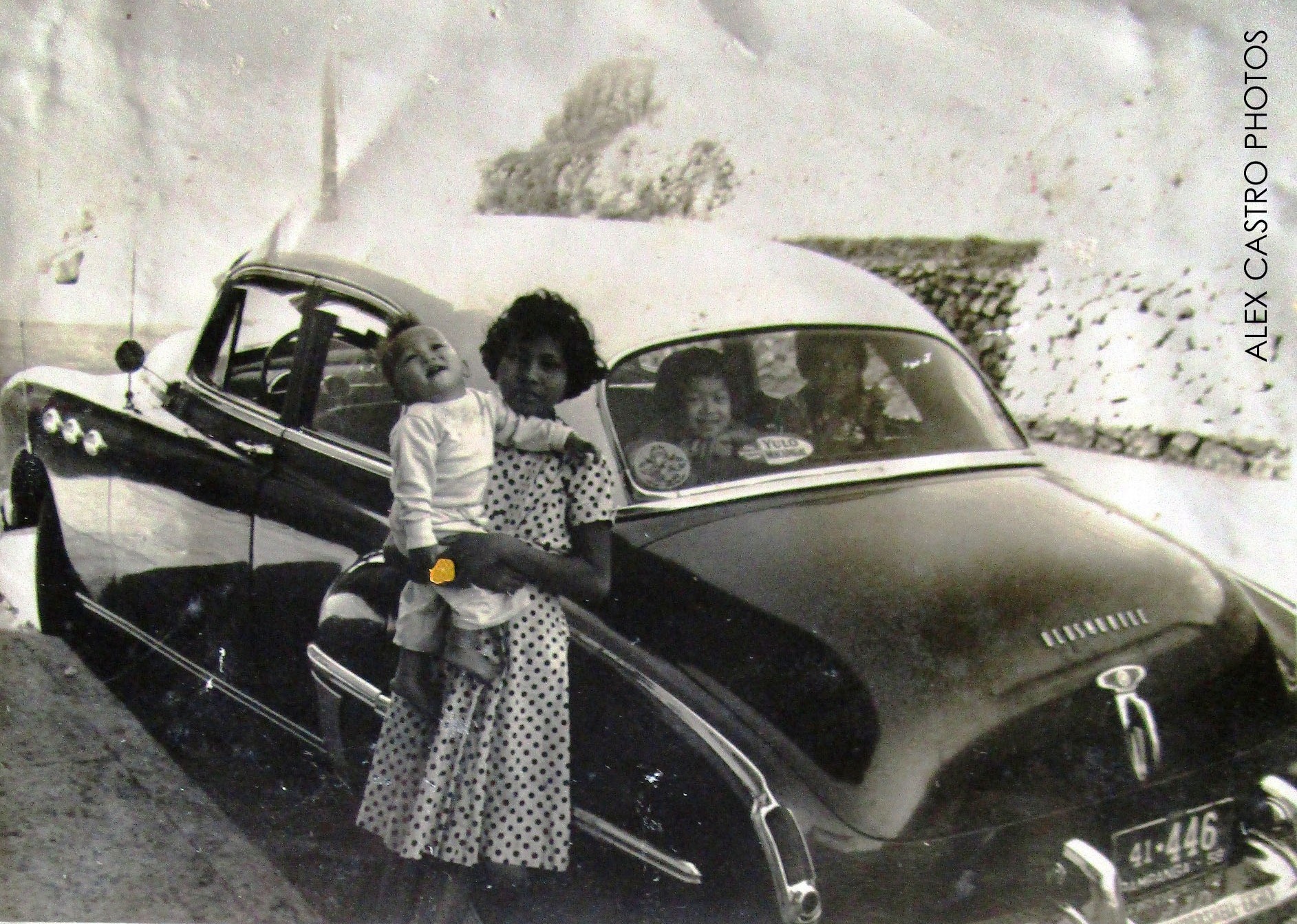
Image 24: IT’S WORTH THE TRIP. Members of a family makes a stopover at Kennon Road in their spacious late 40s model Oldsmobile. The postwar years saw more Filipinos owning cars, and making more trips to other parts of the country, boosting domestic tourism. Photo from 1957.

Still, it could not be denied that the automobile allowed a man his physical freedom never thought possible. Where before, an islander’s only world was his water-locked town, or that rural folks could only visualize the sights and sounds of a city, the car has given him the power to travel like the wind, to extend the boundaries of his experience, to feel the emotions of many regions and many cultures, in effect, to explore his Filipino-ness.

 SOURCES:

Various 1929 Graphic Magazine issues:

“A Bit of Transportation History”. 30 Oct. 1929, p. 8

“Traveling Like the Wind”. 25 Sep. 1929, p. 14

“Evolution of the Automobile”,30 Oct. 1929, p. 10

“Lure of the Highway”, 6 Nov. 1929, p. 44.

 “Motor Car Accidents”, The Sunday Tribune Magazine, 23 April 1933. p. 8

 Reader’s Digest, “The Origins of Everyday Things”, Reader’s Digest Association Ltd., 1998., p.

 Kraus, Michael. Kraus Vera, Family Album for Americans, Ridge Press Inc. 1961, published by Grossett and Dunlap. Pp. 231-247.

 Ragoon, Richard Wilhelm, “How much were cars in PH back in the day?”.posted 9 Feb. 2018. https://www.topgear.com.ph/features/feature-articles/Philippine-cars-cost-history-a52-20180209