Showing posts with label Filipiniana. Show all posts

Tuesday, April 16, 2024

78. AMUSING BRAND NAMES YOU WON’T BELIEVE WERE USED IN THE PHILIPPINES!

What’s in a brand name? A brand name defines and differentiates a product from its competitors in the eyes of the customer. So important are brand names that they can make or break a product—an urban legend has it that a car maker once named its new vehicle “Nova”, not knowing that “no va” meant “not going” in Spanish.

Would you go to a coffee house called “Cargo House” or “Pequod”? Those names by the way, were considered for your now favorite Starbucks. Then, there’s Lithiated Lemon, a lemon-lime drink introduced in 1929. But when renamed 7-Up, sales increased six-fold. On the other hand, there are perfect brand names like “Jollibee”, “Hapee” and “Mr.Clean” that evoke positive images of joy, clean living and fun.

 Before marketing experts offered their brand-naming services, many makers of products just coined their own brand names, resulting in amusing, unusual and sometimes, weird-sounding names.

***********

ANALGINA. Brand Name for : Medicine syrup for rheumatism and headaches

ANALGINA is the name of this cure-all also indicated for diarrhea, neuralgia, cramp, breastache, backache, indigestion and cough. At first impression, it has a name seemingly coined from two delicate parts of the human female anatomy—well, at least that’s how it reads.  But the first part of the brand name is derived from ‘analgesia” , which means “relief from pain”.  With the  suffix added however, ANALGINA, as a brand name, doesn’t evoke anything medicine-y; rather it sounds like a disease!  In 1929, you can buy ANALGINA over-the- counter at Botica Insular along Quesada St. in Manila. Just don’t say the name out loud.


ASEMBLEA FILIPINA. Brand Name for : Local cigarettes

Why would someone name a cigarette brand after the Philippine Assembly (Asemblea Filipina) ? Well, Simeon Roque y Compania,  maker of these “cigarillos” in Betis, Pampanga, just did. In fairness, the inauguration of the Philippine Assembly in 1907 was a major event, as that gave a glimmer of hope to Filipinos for self-rule. To the local cigarette maker maybe, that historic milestone is worth celebrating with a puff of a “cigarillo” stick. The cigarette label of “Asemblea Filipina” cigarettes even contain a short poem in the vernacular, exhorting customers Philippine-made products, not imported ones—and exhortation to nationalism, at a time we needed it most.


ATOMIC / ATOMI-CHLOR. Brand Name for :  Pomade / Pesticide

The atomic age began when the first nuclear bomb was detonated in 1945 that led to the bombing of Hiroshima and Nagasaki  which ended World War II. It also started our fascination with atomic designs and organic forms,  inspired by atoms, missiles and rockets, that found their way in product designs and even in brand names. Such is the case with two different products sold and manufactured locally in the 50s .The first is ATOMIC Solid Brilliantine, a men’s pomade brand available in glass jars. What can this pomade do? Will it split the atoms in your hair?  Will you be positively charged? We may never know as this product had a short shelf life.

Another is ATOMI-CHLOR, a liquid product formulated to rid pet dogs and your lawn of  fleas, ticks and insects. This Chlordane-based product came out in 1951. One is wont to wonder if ATOMI-CHLOR had radioactive properties that killed these pests. But we now know that Chlordane is a chemical compound classified as an organic pollutants hazardous to animals, and even human health. Oops.


BAGONG LITAO. Brand Name for : Local cigarettes

Another strange name for a cigarette brand is “BAGONG LITAO” (Newly-Appeared), locally made and rolled in Pampanga by a certain Martin Torres. Even the front panel illustration is rather odd: it shows 3 Filipina women in baro’t saya—and they are not even smoking.  For cure, BAGONG LITAO is a reference to the new arrival of the product. But wouldn’t the name become obsolete in a year or so? Because by then, it will no longer be new. It will no longer be BAGONG LITAO, right? Hmmm, I need a smoke.


BALATKINIS. Brand Name for: Skin Ointment

Katialis is the most successful and most popular local skin ointment in history, with a formula developed by Dr. Lorenzo C. Reyes. Its name was derived from Kati+ Alis (Itch Away) . But the actual concoction was done by his chemist brother, Manuel, who mixed the ointment at the Locre Laboratorio in San Lazaro, Manila. After a decade, Manuel struck it on his own and developed his own product in  that, like Katialis, promised to eradicate: “galis, buni, pigsa, tagihawa, butlig, anan,pekas alipunga at sugat na maliliit”.  Manuel also named it like Katialis—combining Balat + Kinis to come up with the brand name BALATKINIS  (Smooth Skin).  Launched in 1947, BALATKINIS, the copycat product with a copycat name proved to be short-lived.  


BARRY’S TRICOPHEROUS. Brand name for:  Hair Tonic against baldness, thinning hair and dandruff

BARRY’S TRICOPHEROUS was introduced in the late 1840s by "professor" and former New York wig-maker, Alexander C. Barry. The term “tricopherous” alone  conjures many images—either a serious, incurable disease or the name of an extinct dinosaur. But despite its name, the product did surprisingly well.  Barry exhorted his customers: “Stimulate the skin to healthful action with the Tricopherous, and the torpid vessels, recovering their activity, will annihilate the disease.” Apparently, that worked for many satisfied men. The product contains 97% alcohol, 1.5% castor oil, and 1% tincture of cantharides (Spanish fly), which supposedly help stimulate the scalp’s blood supply.  BARRY’S TRICOPHEROUS is still being produced and sold today by Lanman & Kemp-Barclay & Co.


BLACK PANTHER. Brand Name for: Hair Pomade and Perfume Lotion

Nope, this cosmetic brand was not inspired by Stan Lee’s character, Black Panther, who ruled over the kingdom of Wakanda and who first appeared in comic books in 1966. The cosmetic products BLACK PANTHER Hair predate Stan’s superhero by a good decade, appearing first in the early 1950s. BLACK PANTHER was manufactured by Lander New York, andsold in the Philippines by eter & Co., in Manila. “The slumbering fire of BLACK PANTHER…attacks a man’s heart…attack a woman’s heart…until they merge in a flame of ecstacy”—so goes a line from its print ad, worthy of an Oscar. T’Challa would have approved.


GALISATUM. Brand Name for: Skin Ointment

GALISATUM Lunas Galis was a skin ointment developed by Dr. Carlos Jahrling of Botica Sta. Cruz in the 1930s. Dr. Jahrling was a German pharmacist from Offenbach who opened his own business in Manila.“Galis” was an all-encompassing local  term for any skin conditions. “-Atum” was a suffix that was  commonly used in pharmaceutical products  like “mentholatum”and “petrolatum”.  GALISATUM with Lunas Galis sounds more like an incantation or a Latin spell to improve skin condition, especially when you say it thrice.  But it does relieves prickly heat, chafing, pimples, mange, eczema, dandruff and  maladies with mysterious names like Dhobie’s Itch (another term for Jock’s Itch) and Hongkong Foot (a slang for athlete’s foot), as this ad from 1936 claims.


GAYTOP. Brand Name for: Concentrated Hairdressing and Conditioner

Before gay language became more elaborate, it was okay to for Helene Curtis to dub its latest hair conditioner product.  GAYTOP. Nothing wrong with that--in the late 1950s. Today, GAYTOP sounds so suggestive with its homo-erotic undertones;  it seems to reveal  one’s orientation and preferred sexual role—especially when talked about in a beauty parlor! Indeed, if this product were around today, it will be a “brand that dares not speak its name”.


JAGGING JAGGING. Brand Name for:  Face Powder and Pomade

There really is no reason why a  cosmetic product guaranteed to make you “lovely to look at” be named JAGGING JAGGING. It is nonsensical, unfeminine and the sound is far from mellifluous. But  Chun Huat Pomade Factory, the manufacturer, did just that, making it hard to believe that Jagging Jagging  is indeed,  a “girls’ favorite”. Ad from 1934.


KULSO-ALIS. Brand Name For:  Anti-diarrhea, anti-dysentery

Another product coming from Dr. Jahrling’s Botica St. Cruz is  KULSO-ALIS, a concoction with a brand name that comes from “Kulso” (diarrhea, loose bowel movement) and “Alis” (to be free from, begone). It was a common way to coin brand names for products this way, bewildering the Pilipino name may be to a foreigner. Perhaps this anti-LBM medicine was really meant to target local market only.It is interesting that Kulso-Alis lists  opium as one of its ingredients. Ad from 1937


LUTO. Brand Name for: Laundry soap

Philippine Manufacturing Company (PMC), founded in 1908, forayed into vegetable shortening production in 1917, and launched Purico to great success in 1919. It was made from palm oil, and sold in solid blocks, packed in cartons. When Procter & Gamble U.S.A. purchased PMC in 1935, the product portfolio expanded  to include detergents. In 1951,  the laundry soap LUTO came into the market. It had a rather strange name—LUTO—or “cook”. It also came in white blocks, which reminded people of Purico. Actually LUTO was derived from the process of making soaps, in which coconut or palm oil with lye is cooked to form a detergent soap, that is then molded into bars.  Thus, “Mag LUTO na tayo!” doesn’t just mean,”let’s cook”, but also let’s do the laundry!”, at least in the early 50s!
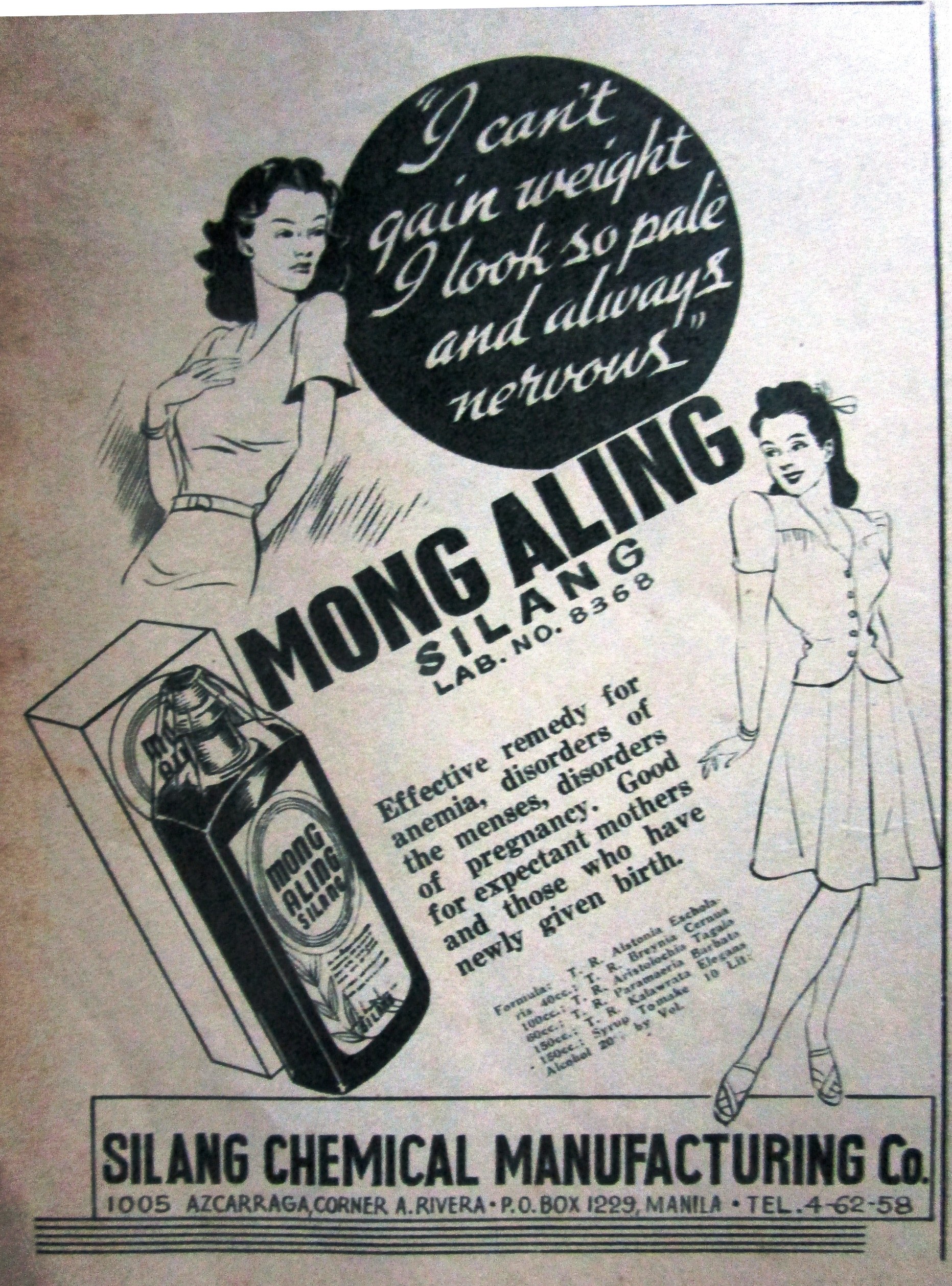
 

MONG ALING. Brand Name for: Remedy for anemia

This medicine intended for a serious disease has such a musical-sounding name, that it’s hard to believe it can bring relief to anemic women and mothers with disorders associated with pregnancy and their menses. Even the ingredients do not give a clue as why it was named MONG ALING. To make it more difficult to decipher, the word and numbers “Silang Lab.  No. 8368”, are appended to the brand name. One can just imagine if someone wrote a jingle for MONG ALING. It will probably go “Mong-aling-aling-ding-dong!”


ODORODO / ODORONO. Brand Name for: Deodorant

Brand names may sometimes sound alike, but these two midcentury anti-perspirant products have uncannily similarity and only a letter separates them: ODORODO and ODORONO.

The older one, ODORODO,  is a palindrome—it reads the same way when read backwards. Such literary devices were used to increase memorability of the brand name, but unfortunately Odorodo, even with its catchy name and unique Action-Proof formula, did not catch on. But at least, the euphemistic “B.O.” (for body odor) as headlined in this 1956 ad,  is still in our vocabulary today.  On the other hand, ODORONO is a cream deodorant which came out in 1961. In today’s stringent trademark rules, imitating the distinctive, perceptual features of a leader brand, such as its brand name is a violation.


OJOKOL. Brand Name for: Eye Remedy Solution

Say that again? Say this brand name wrong, and it will sound like a slang for self-erotic gratification. Time was when medicine brands had Spanish  names, a way of branding still in practice in the 1920s—when OJOKOL  was formulated by Botica Boie. The eye solution was meant to give cool relief to sore, irritated eyes (OJO means “eye” in Spanish, pronounced as “oho”), and as for the suffix, it’s one of those add-ons used by chemicals like alcohol,  glycol, ethanol. So next time you say OJOKOL, make sure  you pronounced it the way Spaniards do—not with the hard “j” we are accustomed to.


PALIKERO. Brand Name for: Pomade

Playboys and dandies would surely go for this pomade brand called  “PALIKERO”, that was produced in the mid 1930s. And it even had the audacity to use  on its paper label (unauthorized, for sure)  the picture of a  Hollywood icon who was known for his “palikero” roles on screen—Rudolph Valentino. Whether this pomade lived up to its name is a big question mark, as nobody seems to know this brand, or what happened to it.


REUTER’S  SOAP. Brand Name For: Skin Soap

The early toilet soap designed to beautify a woman’s complexion is a trademark of Lanman & Kemp-Barclay & Co., Inc. The company, itself was founded in 1808 by Robert I. Murray and its business was conducted under the firm name Murray & Lanman in New York.  The brand name--REUTER’S SOAP-- has nothing to do with the world-famous news bureau. It was named after its creator, Dr. John Reuter. The classic bar soap was sold in the 1950s under its Spanish brand name, Jabon de Reuter, in the Philippines. The company still is in cooperation today with headquarters in Westwood, New Jersey, and continues to sell the soap.


SAKITALIS. Brand name for: Medical Plaster

Now here’s another direct-to-the-point name for a pain-soothing medicated plaster—SAKITALIS (Aches away!).  The wordsmith had an easy time with this brand name, and even though it sounded like the aforementioned “Katialis”, it is still distinct in its category. SAKITALIS, which contains belladonna, was “the most effective plaster pan reliever”—in distinctive pink color! It was available in the late 1950s at all drugstores,  distributed by Colossal Drug Store. But the coming of made in Japan Salonpas, obliterated it, and by the 1970s, Salonpas became the dominant plaster brand, for its superior efficacy—not to mention its catchy, classy name that has become an everyday term for  a pain relieving plaster for all body parts.


SILENT NIGHT. Brand Name for: Perfume and Lotion

Yes, Virginia, there is such a perfume brand called SILENT NIGHT, ‘ a perfume masterpiece made by Countess Maritza of New York, U.S.A.”. It was locally distributed in local stores in 1962. But wait,  there’s also a SILENT NIGHT Lotion to complement it. Like a line from the carol, was it also tender and mild,? With a name like that, how can you miss? As the ad suggests—“it’s best to give on Christmas!”. One wonders if it is inappropriate to give SILENT NIGHT on other occasions, say, like birthdays and Valentines,


TANSAN. Brand Name for: Mineral Water

It’s okay to drink the TANSAN!!!

The crown cap revolutionized the glass bottling industry when it was invented in 1897 by William Painter. The first drink that featured the crimped tin cap was called TANSAN, a bottled mineral water marketed by Clifford Wilkinson in the early 1900s. The brand name TANSAN–believed to be of Japanese origin–has now come to mean crown caps in Filipino. The product first came out in straight-sided bottles, and then in small, bulb-shaped green bottles with the name in relief.  In its 1920s ads, TANSAN was proclaimed as a 100% pure, sourced from “natural waters free from all earthly deposits.” Being “radium-active,” TANSAN possesses many medicinal qualities, proven against stomach disorders.


VIN DÉSILES. Brand Name for: Tonic wine

The brand name of this revitalizing drink popular in the 1950s seem anachronistic as it sound like the name of contemporary Hollywood action star, Vin Diesel. But it was produced long before the action star of “XXX” and “The Fast and the Furious” was born.  VIN DÉSILES, a wine-based drink that claims to restore energy and appetite, and was distributed by Oceanic Commercial, Inc. in the Philippines. It may not have inspired the name of action star Vin Dieeel, but it sure is power-packed like him!

 NOTE: ORIGINALLY WRITTEN FOR ESQUIRE MAGAZINE AND PUBLISHED UNDER THE TITLE: The Most Hilarious Brand Names That Used to Exist in the Philippines, 11 February 2019.

.

Sunday, October 21, 2018

66. FILIPINIANA ART ON OLX.PH AT POPULAR PRICES


BAHAY KUBO BY THE BROOK, signed T.I. Sanchez, dated 1962.

You'll never know what you'll find in olx.ph--once known as sulit.com. I have been pretty successful sniffing out bargain art on this selling site. For example, I got this 1962 Filipiniana painting signed by T.I. Sanchez, at an amazingly affordable price. Mabini-style paintings are just my cup of tea, and this mid-century piece, though a bit scruffy,  is certainly a welcome addition to my collection.


THE PAINTING, as advertised on theonline selling site Olx.ph

I have scoured art books to find out who the painter is, but I have not been successful. The closest was an artist named Turino M. Sanchez, listed as a member of the Philippine Arts Guild in the the book, “The Struggle for Philippine Art”. I have also checked online sites auctions selling art, and  found one or two vintage T.I. Sanchez paintings with prices ranging from $16 to $350, but no info on the artist.


I sent a shout-out to art aficionados and had a response from an art collector who saw a similar painting for sale in a Long Beach flea market.  

SANCHEZ PAINTING FOR SALE AT LONG BEACH FLEA MARKET
Courtesy of Mr. Wuth Franza

Surprise, surprise! The artwork was not only painted by the same artist, but he painted the same subject too. The two looked almost identical, except that they were painted a year apart.
 
IDENTICAL T. SANCHEZ PAINTING, painted 1963, courtesy of Wuth Franz

At this point, finding the real name and background of this painting has become irrelevant. It’s the folksy appeal of the piece that is more important to me. When  at last, I cleaned the painting, its vibrant colors were revealed.


After a bit of retouching, I had the painting re-stretched and then re-framed. The results are on this spread.


Saturday, October 13, 2018

65. Filipiniana: A PORTRAIT BUST OF “JOSEFA”


I have been collecting bits and pieces of Filipiniana of all sorts—and one field of collecting interest are old Philippine busts. I have about a dozen portrait busts—Rizal, Bonifacio, Maria Clara, Macarthur, and some unknown personalities—made of wood, composition and cast cement. 


So, when this bust of a lady came into the market, I decided to acquire it to add to my collection. A bust is generally a portrait intended to record the appearance of an individual, but may sometimes represent a type, in this case, a Filipina type.


 It is very unusual for its tiny size, standing no more than 4.5 inches, including its plinth, which has an incised date of 1931. It may have been carved as a practice piece to test the skill of a student carver in shaping and carving the details.

But what drew me to this piece is its uncanny likeness to a Filipina war heroine—the socio-civic leader Josefa Llanes Escoda.  Of course, her martyrdom was still over a decade away, so this could not have been a memorial piece, but by 1931, Josefa was a prominent figure as a social worker, a civic leader and a champion of nationalism and women’s suffrage.

 In 1940, she founded the Girl Scouts of the Philippines. Tragically, she was captured by the Japanese for her underground activities during the war, and was presumed executed on 6 Jan. 1945.

That’s how I came to call my tiny wooden bust, “Josefa”. With her head slightly turned to the left, she has the exact middle-parted, marcel-curled hair that Josefa Llanes-Escoda sported in her extant pictures, a style popular in the late 1920s-30s. She is carved wearing a collared Western dress (Escoda favored the baro’t saya) and a bead necklace hangs from her neck.


“Josefa” is a fine example of Filipino skill and artistry, in a period where Western influences began intruding on our artistic traditions and making lasting impressions until today. 


SOURCE:

Monday, September 3, 2018

62. MABINI ART: From Tourist Souvenirs to Mainstream Masterpieces

WALL-TO-WALL ART. Filipinana paintings done in the so-called Mabini School style fill the walls of Serafin Serna's studio
.
 For over 80 years now, the 2-kilometer street located in once-genteel Ermita has been the nexus of touristy and artistic activities—Mabini Street---which, in its heyday,  teemed with art galleries and shops, making it Manila’s most colorful alley.

MABINI STREET AT NIGHT. 1957

Mabini was known in the late 1800s as Calle Nueva, and, like Calle Real (now known as  M.H. del Pilar St.) ran straight and parallel to the bay, starting from Wallace Field in the north and ending at the Pasay boundary. Back then, the Ermita-Malate district was peopled with Manila families from the principalia class, along with many Spanish and Spanish mestizo residents. After the 1860s, Ermita expanded as a suburb, along the main calles of Real and Nueva, which provided Manila with an important link to the Cavite harbors where the galleons landed.

MUSLIM COUPLE, by Crispin V. Lopez (1903-1985). From the Collection of  
Øcsalev Thor, Used with permission.

When the Americans came, they too were drawn to the quiet dignity and exclusivity of the suburb which characterized the uppity residential streets—Calle Nuevo included. Renamed during the American occupation as A. Mabini St. to memorialize the “brains of the Revolution”, the street slowly began its transition as a shopping destination, along with the Escolta and the walled city of Intramuros.

DAVID MEDALLA AT WORK AT HIS MABINI STUDIO.

By the 1930s, as the country opened its doors to the world, Manila’s population swelled to include international residents and visitors. Hotels, serviced apartments, posh homes and clubs sprouted along the area.  Joining the Germans, Dutch, Swiss and English traders were the Americans and their families—soldiers, teachers, diplomats, government officials, businessmen, adventure seekers, and tourists—whose fascination with our  exotic islands stimulated a demand for manufactured cultural souvenirs to send back home as gifts and travel mementos.

BARRIO STREET. Gabriel Custodio. 

 Mabini St. and its peripheries became the go-to place for such tourist souvenirs. The Little Home Shop ran by the Metcalfs on 676 A. Mabini was one of the first shops to offer “a treasure trove for the seeker of the unusual”. It carried everything from Moro brassware, embroidered piña and Igorot dresses. Nearby was Philippine Shell-Craft that created stunning remembrances of shell and mother-of-pearl. Also just a walk away, on 620 Mabini, was Manila Art Craft that specialized in reptile leather goods, trays, cards, candy boxes and other novelties.

The war decimated much of Ermita, but when peace settled in the country and rebuilding went underway, the proud district rose from the ashes with a renewed sense of optimism.  With the promise of independence fulfilled in 1946, the new country continued its spree of reconstruction and rehabilitation.

HARVEST TIME, By Serafin Serna.  He trained under Prof. Teodoro Buenaventura before enrolling at
the U.P. Fine Arts. His biggest commission was decorating the Philippine Pavilion at the New York’s
World’s Fair with murals and brass sculptures in 1964. 
Øcsalev Thor Collection, used with permission.

 Mabini St. attracted artists like Paombong-born Miguel Geronimo Galvez Sr., to open his own visual arts shop in 1949. Galvez had honed his painting skills as a sit-in student of Prof. Teodoro Buenaventura at the U.P. college of Fine Arts along Taft Avenue. Simon Saulog, from Imus, also located his studio cum shop along Mabini.

STARTING THEM YOUNG. Art along Mabini St.. 1952.

The early artists that gravitated towards this street painted in the realist tradition—led by such names as Galvez and Saulog, plus Ben Alano, Fermin Sanchez, Cesar Amorsolo,  Jose Bumanlag David, Elias Laxa, Romeo Enriquez and Gabriel Custodio.  Like master Fernando Amorsolo, the conservatives painted idyllic pastoral scenes, landscapes and ruralscapes, nipa huts set against mountain backdrops or rice fields, and other folkloric themes. Abiding by tradition, they painted what they saw-- the more real, the better.

Left: YOUNG RAJAH, by Jose Bumanlag David, 1955. The works of this Pampanga artist was often featured on
the pages of Graphic Magazine in the 1920s. Left: T’BOLI ELDER. By Fortunato Jervoso. Pasay-born Jervoso
learned painting via the International Correspondence School , Philadelphia from 1934-37. Alex Castro Collection.


BATHING BEAUTY, by Victor T. Cabrera. 1956. This U.P. educated artist
trained with Vicente Manansala
and Antonio Dumlao. His works--landscapes,
portraits, historical paintings--were characterized by 
" a silky, finished quality",
 
evident in this painting.Alex R.Castro Collection.

The  distant Far East from a Western perspective was always imagined as exotic, wild and tropical, an isolated part of the world—with swaying palm trees, bare-breasted island women, mysterious Mohammedans and mountain folks. These conceptions were consistent with the imageries that Mabini artists managed to deftly capture on their canvasses. Tourists, with tastes far different from art connoisseurs, snapped up these artworks, simply as remembrances of their Philippine experience. Not only where these paintings affordable, but the paintings were also portable to hand-carry home.

SIDEWALK ART EXHIBIT. Mabini St. 1952.

 “Commercial fine arts”, was a term first used by Fabian de la Rosa to describe  art associated with advertising—billboards, illustrations, magazine covers. It would later come to refer as well to the products of the “Mabini School”, meant to be sold and generate money. Anybody with a fairly good hand could churn out paintings of the same style and hackneyed Filipinana themes. As expected, academically-trained artists and aficionados of high art thumbed their noses at these creations—hastily done, painted in multiples, and cheaply priced.

MARANAO FISHERMEN. By Romeo Enriquez, 1953. A  much sought after portraitist,
 Enriquez 
established his studio-gallery along Mabini St.
 
Øcsalev Thor Collection. Used with permission.

No matter, the demand of tourists for commercial fine arts  intensified during this period.  Mabini St. assumed a bohemian air of some sort, as classicists and the rising modernists congregated in the area. The convergence would eventually lead to a clash in 1955, when, in a contest mounted by the Art Association of the Philippines (AAP), the modernists won over the conservatives, prompting a walk-out of some 20 realist painters. They also won the support of non-AAP members who join them in their outdoor shows in front of Manila Hotel, that elicited much attention from the public.
 
BANCA RIDE,Oscar T. Navarro. 1964. Alex Castro Collection.

Indeed, times were changing in the city’s landscape too. By the end of the 50s, the offbeat color of Mabini—often likened to New Yorks’ Greenwich Village—was starting to pale in its appeal. Alongside residences, quaint souvenir shops and art galleries arose in quick profusion, an amalgam of dress shops, 3rd rate motels, cocktail lounges, sleazy bars and unsightly tenement buildings and barong-barongs. But the artists stayed on, both the good, the bad and the downright phony.

  
LAPU-LAPU AND BULAKNA, by Rod Pasno. 1960s.

The output was more commercialized—velvet nude paintings that American servicemen favored, copies of famous European paintings (Da Vincis’s Mona Lisa, Last Supper), his ‘n hers ethnic kitsch (Rajah & Rani, Lakan & Lakambini, Moro & Mora, Igorot & Igorota) and Tiki crafts to decorate American dens and bars. Aesthetic rules could also be broken, based on the dictates of the buying customer. Thanks to the promotion of tourism, Mabini art—despite its reputation as cheap souvenir art for the tourist trade—enjoyed a ready, and steady market.

ISLAND GIRL, by Ben Alano, 1952. Alano maintained a studio in Ermita 
for over 20 years. Øcsalev Thor  Collection, used with permission.

True talents—in the persons of Paco Gorospe, Salvador Cabrera (Bencab’s brother), Roger San Miguel, and Leonardo Zablan, would emerge from this 60s decade, representing the second generation of Mabini painters with exceptional skills that were yet to be recognized. Galleries continued to proliferate in the area—Gorospe, Zablan and Lopez had theirs along Mabini—which gained major patronage from hotels, embassies and corporate buildings in need of interior decoration.
 
SUMMER FIELDS, Isidro Ancheta, 1904.

Pistang Pilipino (later, Sining Pilipino) a one-stop commercial arts and crafts center with 200 stalls, was put up along Mabini in the 80s, and carried many souvenir paintings of Filipino artists, in varying grades of finish and quality.  These artists, many of whom remained nameless,  constituted the third wave of Mabini painters that began painting in the 70s through the 90s.

MABINI STREET IN 1957.

The political turmoil and the economic instability of the mid 80s dealt a severe blow to Philippine tourism, and Malate-Ermita business felt the impact more than any other district.   Alternative commercial centers like Greenhills and Makati drew more “quality” crowds as opposed to Mabini, which suffered from its ‘red light district’ image.  Regular crackdowns on illicit trades didn’t help in hastening Mabini’s decline. Many art galleries closed, and while Pistang Pilipino remained open until 1995 and then relocated, its business was never the same again.
 
MANOBO ELDER. By Crispin Agno. 1955. Alex R. Castro Collection.

But just when everyone thought that Mabini art was on its way out,  a new breed of art aficionados began rediscovering them in other parts of the world with the advent of the the internet in the mid-1990s. Filipiniana paintings from the mid-century and older began appearing in online museums as well as international selling sites, gaining a core group of patrons, mostly overseas Filipinos.

 
GALLERY ON THE STREET, 1957.

 It must be recalled that in the course of 50 or  so years, thousands of these Mabini paintings made their way to other countries, especially the United States, where they either hung in homes or stashed away for keeping, passed on to descendants, to be recovered in estate, garage sales, auctions, and flea markets.  
 
GRAND OLD LADY. By Miguel Galvez, 1937. Miguel left Paombong to work in the household of
his uncle-artist PrOf. Teodoro Buenaventura, who enrolled him at the U.P. Fine Arts. He was the
first artist to open a studio on Mabini St. in 1949.

International online selling sites like  ebay.com and liveauctioneers.com  regularly offered vintage Philippine paintings as early as the late 80s, posted by sellers who picked such pieces from rummage and yard sales, and sold outright or thru bidding.

From a few dollars, the prices for these Philippine works  have quickly escalated to hundreds, even up to thousands of dollars. A quick check on ebay’s current inventory (as of July 2018), features a 24” x 20” Simon Saulog 1959 painting of a Filipina gathering palay that is priced for sale at $1, 650. Two Crispin V. Lopez portraits are more realistically priced at $299 each.
 
Add captionLeft: SAN MIGUEL ARCANGEL, A painting copied from Sanzio Raphael. Signed "Rafael Sanzio
por Dumlao". By Antonio Dumlao.1955. Right: ORACION EN EL HUERTO. By Domingo Celis. 1951.
He is one of the first graduates of the UP school of Fine Arts in 1914.

American museums, like the Field Museum of History in Chicago, keep many good examples of this kind of genre paintings. Since 1989,  Geringer Art based in Honolulu, Hawaii has also been studying and marketing fine Southeast Asian paintings, including Filipino works wrought by artist who began their careers in Mabini,

In 1992, a book based on the art collection of Jorge B. Vargas, the former Executive Secretary of Pres. Manuel L. Quezon, was written by Prof. Santiago Pilar Albano on the occasion of the Vargas Centennial Celebrations. The book, PAMANA, featured write-ups and photos of paintings of many Mabini luminaries, raising further awareness for Vargas’ vintage paintings which he bequeathed to the University of the Philippines, where they are now housed at the school’s Filipiniana section.

WINNOWING RICE. By San Fernando-born Patricio Salvador of U/P. 1967.

Suddenly, collectors and critics from here and abroad began taking a more serious look at these artworks and the painters that created them, finally acknowledging their significance and their place in the development of Philippine art history.
 
BALIK-TANAW EXHIBIT in Chicago. Courtesy of Victor Velasco

In June  2013,  Filipino expatriate Victor B. Velasco assembled Filipiniana paintings found in the U.S. in a representational exhibit in Chicago entitled “Balik-Tanaw: Philippine Images Beyond Nostalgia” . The exhibit featured the paintings of Mabini artists and others who worked in the same style like Serafin Serna, C.V. Lopez, Hernando Ocampo, Crispin Agno and Isidro Ancheta.

OLD SPANISH CHURCH. Elias Laxa of Macabebe,Pampanga. 1964.

Art collector Mr. Jack Nasser, founder of Philexcel Business Park and a pioneering investor  in Clark Field, Pampanga,  began amassing Mabini art paintings beginning in the 1960s. When he passed away, his widow, Ariella Nasssr-Moskovitz, organized the Jack Nasser Collection and put the artworks on permanent display at the Philexcel Art Center, inaugurated  in 2016. The paintings on exhibit, many done by Oscar Navarro and Paco Gorospe, is open to the viewing public.

WEDDING GIFTS, by Simon Saulog, 1954. Commissioned by Heacock’s Department Store in Escolta. 
Alex R. Castro Collection.

Perhaps, the most convincing proof that Mabini Art had indeed gained mainstream status as well as respectability  in the art world is the inclusion of paintings in the two premiere auction houses in the Philippines—Salcedo Auctions and the Leon Gallery Auctions. Along with the like of Amorsolo, Bencab and Manansala, examples of Mabini Art are now being offered on regular basis on the prestigious auction houses—and doing very well.

MABINI STREET, 1976.

For example Cesar Buevantura’s “Planting Rice” had an ending price of Php 303,680 from a staring bid of Php 120,000. The “Barrio Scene” painting of Romeo Enriquez sold at Php 163.520, more that quadruple its initial Php 40,000 bid. Oscar Navarro’s “Sailboat”, which had a starting price of Ph 16,000, was snapped up for Ph 46, 700. Simon Saulog’s “Nude”, was had a tag price of Php 30,000, and which sold at Php 327,040. Finally, Antonio Dumlao’s painting, “Bountiful” ,  with a starting bid of Php400,000, ended with a realized price of Php 759,200.The prices are still far away from the millions people pay shell out for a Manansala or a Bencab, but selling is brisk and the demand remains strong.

BAHAY KUBO BY THE BANKS, by Felix Gonzales,1955. Gonzales
owned a gallery at the Manila Hotel 
then moved to Mabini. Many of
his children became artists like him.

The popular art form persists and endures today, although slowed down by the vagaries of tourism industry and fads of taste. In some nooks and crannies of Mabini and neighboring M.H. del Pilar, there are still a handful of studios which continue to churn out canvas after canvas of nipa huts, tinikling dancers, grazing carabaos and toiling farmers—objects of beauty that have also become idealized expressions of our culture. In those holes-in-wall may yet arise another Amorsolo, de la Rosa or Manansala, but what is clear is that Mabini Art, once disparaged by local patrons, is finally receiving the appreciation it deserves today.

SOURCES & REFERENCES:
Mabini’s Arty Street, Sunday Times Magazine,  6 January 1957, pp. 14-15, photos by Ben Santos
Castañeda, Dominador C., Trends and Influences in Fine Arts, PROGRESS 1955. Pp. 26-34
Quingco II, Oliver, Hartung III, Klaus W. Revisiting Mabini Art, Transwing ® Jane Hartung, e.k., 2013
Albano, Santiago Pilar, Pamana: The Jorge B. Vargas Art Collection, Committee on Arts and Culture, Vargas Centennial Celebrations, U.P. Vargas Museum, 1992
Balik-Tanaw: Philippine Image Beyond Nostalgia, exhibit catalog 2013
Castaneda, Dominador, Trends and Influences in Fine Arts, Progress 1955. Pp. 27-33
ERMITA Magazine, 1976 issue
The Dynamics of Change in Tourist Arts