Showing posts with label collecting hobby. Show all posts

Tuesday, April 16, 2024

78. AMUSING BRAND NAMES YOU WON’T BELIEVE WERE USED IN THE PHILIPPINES!

What’s in a brand name? A brand name defines and differentiates a product from its competitors in the eyes of the customer. So important are brand names that they can make or break a product—an urban legend has it that a car maker once named its new vehicle “Nova”, not knowing that “no va” meant “not going” in Spanish.

Would you go to a coffee house called “Cargo House” or “Pequod”? Those names by the way, were considered for your now favorite Starbucks. Then, there’s Lithiated Lemon, a lemon-lime drink introduced in 1929. But when renamed 7-Up, sales increased six-fold. On the other hand, there are perfect brand names like “Jollibee”, “Hapee” and “Mr.Clean” that evoke positive images of joy, clean living and fun.

 Before marketing experts offered their brand-naming services, many makers of products just coined their own brand names, resulting in amusing, unusual and sometimes, weird-sounding names.

***********

ANALGINA. Brand Name for : Medicine syrup for rheumatism and headaches

ANALGINA is the name of this cure-all also indicated for diarrhea, neuralgia, cramp, breastache, backache, indigestion and cough. At first impression, it has a name seemingly coined from two delicate parts of the human female anatomy—well, at least that’s how it reads.  But the first part of the brand name is derived from ‘analgesia” , which means “relief from pain”.  With the  suffix added however, ANALGINA, as a brand name, doesn’t evoke anything medicine-y; rather it sounds like a disease!  In 1929, you can buy ANALGINA over-the- counter at Botica Insular along Quesada St. in Manila. Just don’t say the name out loud.


ASEMBLEA FILIPINA. Brand Name for : Local cigarettes

Why would someone name a cigarette brand after the Philippine Assembly (Asemblea Filipina) ? Well, Simeon Roque y Compania,  maker of these “cigarillos” in Betis, Pampanga, just did. In fairness, the inauguration of the Philippine Assembly in 1907 was a major event, as that gave a glimmer of hope to Filipinos for self-rule. To the local cigarette maker maybe, that historic milestone is worth celebrating with a puff of a “cigarillo” stick. The cigarette label of “Asemblea Filipina” cigarettes even contain a short poem in the vernacular, exhorting customers Philippine-made products, not imported ones—and exhortation to nationalism, at a time we needed it most.


ATOMIC / ATOMI-CHLOR. Brand Name for :  Pomade / Pesticide

The atomic age began when the first nuclear bomb was detonated in 1945 that led to the bombing of Hiroshima and Nagasaki  which ended World War II. It also started our fascination with atomic designs and organic forms,  inspired by atoms, missiles and rockets, that found their way in product designs and even in brand names. Such is the case with two different products sold and manufactured locally in the 50s .The first is ATOMIC Solid Brilliantine, a men’s pomade brand available in glass jars. What can this pomade do? Will it split the atoms in your hair?  Will you be positively charged? We may never know as this product had a short shelf life.

Another is ATOMI-CHLOR, a liquid product formulated to rid pet dogs and your lawn of  fleas, ticks and insects. This Chlordane-based product came out in 1951. One is wont to wonder if ATOMI-CHLOR had radioactive properties that killed these pests. But we now know that Chlordane is a chemical compound classified as an organic pollutants hazardous to animals, and even human health. Oops.


BAGONG LITAO. Brand Name for : Local cigarettes

Another strange name for a cigarette brand is “BAGONG LITAO” (Newly-Appeared), locally made and rolled in Pampanga by a certain Martin Torres. Even the front panel illustration is rather odd: it shows 3 Filipina women in baro’t saya—and they are not even smoking.  For cure, BAGONG LITAO is a reference to the new arrival of the product. But wouldn’t the name become obsolete in a year or so? Because by then, it will no longer be new. It will no longer be BAGONG LITAO, right? Hmmm, I need a smoke.


BALATKINIS. Brand Name for: Skin Ointment

Katialis is the most successful and most popular local skin ointment in history, with a formula developed by Dr. Lorenzo C. Reyes. Its name was derived from Kati+ Alis (Itch Away) . But the actual concoction was done by his chemist brother, Manuel, who mixed the ointment at the Locre Laboratorio in San Lazaro, Manila. After a decade, Manuel struck it on his own and developed his own product in  that, like Katialis, promised to eradicate: “galis, buni, pigsa, tagihawa, butlig, anan,pekas alipunga at sugat na maliliit”.  Manuel also named it like Katialis—combining Balat + Kinis to come up with the brand name BALATKINIS  (Smooth Skin).  Launched in 1947, BALATKINIS, the copycat product with a copycat name proved to be short-lived.  


BARRY’S TRICOPHEROUS. Brand name for:  Hair Tonic against baldness, thinning hair and dandruff

BARRY’S TRICOPHEROUS was introduced in the late 1840s by "professor" and former New York wig-maker, Alexander C. Barry. The term “tricopherous” alone  conjures many images—either a serious, incurable disease or the name of an extinct dinosaur. But despite its name, the product did surprisingly well.  Barry exhorted his customers: “Stimulate the skin to healthful action with the Tricopherous, and the torpid vessels, recovering their activity, will annihilate the disease.” Apparently, that worked for many satisfied men. The product contains 97% alcohol, 1.5% castor oil, and 1% tincture of cantharides (Spanish fly), which supposedly help stimulate the scalp’s blood supply.  BARRY’S TRICOPHEROUS is still being produced and sold today by Lanman & Kemp-Barclay & Co.


BLACK PANTHER. Brand Name for: Hair Pomade and Perfume Lotion

Nope, this cosmetic brand was not inspired by Stan Lee’s character, Black Panther, who ruled over the kingdom of Wakanda and who first appeared in comic books in 1966. The cosmetic products BLACK PANTHER Hair predate Stan’s superhero by a good decade, appearing first in the early 1950s. BLACK PANTHER was manufactured by Lander New York, andsold in the Philippines by eter & Co., in Manila. “The slumbering fire of BLACK PANTHER…attacks a man’s heart…attack a woman’s heart…until they merge in a flame of ecstacy”—so goes a line from its print ad, worthy of an Oscar. T’Challa would have approved.


GALISATUMBrand Name for: Skin Ointment

GALISATUM Lunas Galis was a skin ointment developed by Dr. Carlos Jahrling of Botica Sta. Cruz in the 1930s. Dr. Jahrling was a German pharmacist from Offenbach who opened his own business in Manila.“Galis” was an all-encompassing local  term for any skin conditions. “-Atum” was a suffix that was  commonly used in pharmaceutical products  like “mentholatum”and “petrolatum”.  GALISATUM with Lunas Galis sounds more like an incantation or a Latin spell to improve skin condition, especially when you say it thrice.  But it does relieves prickly heat, chafing, pimples, mange, eczema, dandruff and  maladies with mysterious names like Dhobie’s Itch (another term for Jock’s Itch) and Hongkong Foot (a slang for athlete’s foot), as this ad from 1936 claims.


GAYTOP. Brand Name for: Concentrated Hairdressing and Conditioner

Before gay language became more elaborate, it was okay to for Helene Curtis to dub its latest hair conditioner product.  GAYTOP. Nothing wrong with that--in the late 1950s. Today, GAYTOP sounds so suggestive with its homo-erotic undertones;  it seems to reveal  one’s orientation and preferred sexual role—especially when talked about in a beauty parlor! Indeed, if this product were around today, it will be a “brand that dares not speak its name”.


JAGGING JAGGING. Brand Name for:  Face Powder and Pomade

There really is no reason why a  cosmetic product guaranteed to make you “lovely to look at” be named JAGGING JAGGING. It is nonsensical, unfeminine and the sound is far from mellifluous. But  Chun Huat Pomade Factory, the manufacturer, did just that, making it hard to believe that Jagging Jagging  is indeed,  a “girls’ favorite”. Ad from 1934.


KULSO-ALIS. Brand Name For:  Anti-diarrhea, anti-dysentery

Another product coming from Dr. Jahrling’s Botica St. Cruz is  KULSO-ALIS, a concoction with a brand name that comes from “Kulso” (diarrhea, loose bowel movement) and “Alis” (to be free from, begone). It was a common way to coin brand names for products this way, bewildering the Pilipino name may be to a foreigner. Perhaps this anti-LBM medicine was really meant to target local market only.It is interesting that Kulso-Alis lists  opium as one of its ingredients. Ad from 1937


LUTO. Brand Name for: Laundry soap

Philippine Manufacturing Company (PMC), founded in 1908, forayed into vegetable shortening production in 1917, and launched Purico to great success in 1919. It was made from palm oil, and sold in solid blocks, packed in cartons. When Procter & Gamble U.S.A. purchased PMC in 1935, the product portfolio expanded  to include detergents. In 1951,  the laundry soap LUTO came into the market. It had a rather strange name—LUTO—or “cook”. It also came in white blocks, which reminded people of Purico. Actually LUTO was derived from the process of making soaps, in which coconut or palm oil with lye is cooked to form a detergent soap, that is then molded into bars.  Thus, “Mag LUTO na tayo!” doesn’t just mean,”let’s cook”, but also let’s do the laundry!”, at least in the early 50s!
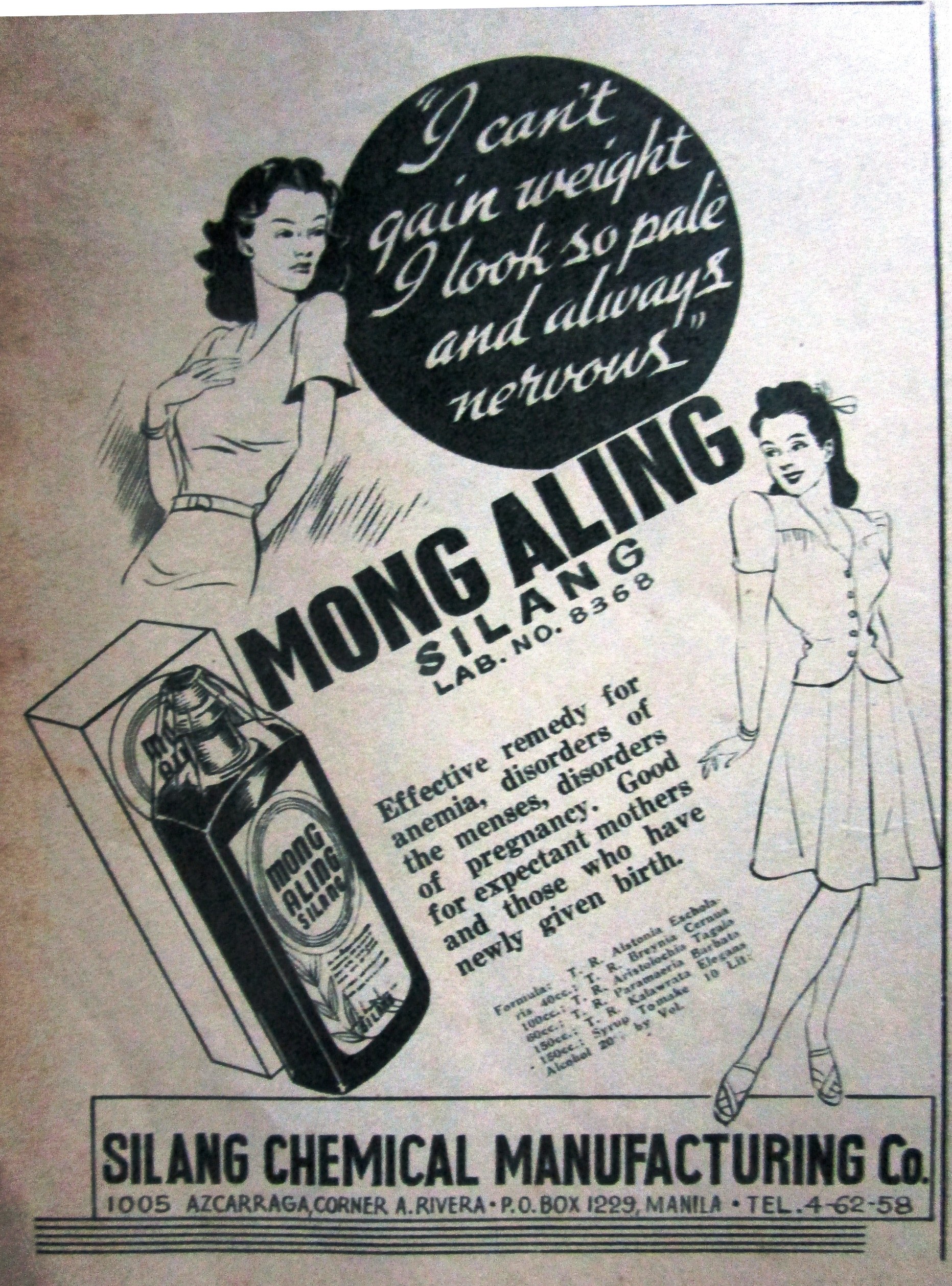
 

MONG ALINGBrand Name for: Remedy for anemia

This medicine intended for a serious disease has such a musical-sounding name, that it’s hard to believe it can bring relief to anemic women and mothers with disorders associated with pregnancy and their menses. Even the ingredients do not give a clue as why it was named MONG ALING. To make it more difficult to decipher, the word and numbers “Silang Lab.  No. 8368”, are appended to the brand name. One can just imagine if someone wrote a jingle for MONG ALING. It will probably go “Mong-aling-aling-ding-dong!”


ODORODO / ODORONO. Brand Name for: Deodorant

Brand names may sometimes sound alike, but these two midcentury anti-perspirant products have uncannily similarity and only a letter separates them: ODORODO and ODORONO.

The older one, ODORODO,  is a palindrome—it reads the same way when read backwards. Such literary devices were used to increase memorability of the brand name, but unfortunately Odorodo, even with its catchy name and unique Action-Proof formula, did not catch on. But at least, the euphemistic “B.O.” (for body odor) as headlined in this 1956 ad,  is still in our vocabulary today.  On the other hand, ODORONO is a cream deodorant which came out in 1961. In today’s stringent trademark rules, imitating the distinctive, perceptual features of a leader brand, such as its brand name is a violation.


OJOKOL. Brand Name for: Eye Remedy Solution

Say that again? Say this brand name wrong, and it will sound like a slang for self-erotic gratification. Time was when medicine brands had Spanish  names, a way of branding still in practice in the 1920s—when OJOKOL  was formulated by Botica Boie. The eye solution was meant to give cool relief to sore, irritated eyes (OJO means “eye” in Spanish, pronounced as “oho”), and as for the suffix, it’s one of those add-ons used by chemicals like alcohol,  glycol, ethanol. So next time you say OJOKOL, make sure  you pronounced it the way Spaniards do—not with the hard “j” we are accustomed to.


PALIKERO. Brand Name for: Pomade

Playboys and dandies would surely go for this pomade brand called  “PALIKERO”, that was produced in the mid 1930s. And it even had the audacity to use  on its paper label (unauthorized, for sure)  the picture of a  Hollywood icon who was known for his “palikero” roles on screen—Rudolph Valentino. Whether this pomade lived up to its name is a big question mark, as nobody seems to know this brand, or what happened to it.


REUTER’S  SOAP. Brand Name For: Skin Soap

The early toilet soap designed to beautify a woman’s complexion is a trademark of Lanman & Kemp-Barclay & Co., Inc. The company, itself was founded in 1808 by Robert I. Murray and its business was conducted under the firm name Murray & Lanman in New York.  The brand name--REUTER’S SOAP-- has nothing to do with the world-famous news bureau. It was named after its creator, Dr. John Reuter. The classic bar soap was sold in the 1950s under its Spanish brand name, Jabon de Reuter, in the Philippines. The company still is in cooperation today with headquarters in Westwood, New Jersey, and continues to sell the soap.


SAKITALIS. Brand name for: Medical Plaster

Now here’s another direct-to-the-point name for a pain-soothing medicated plaster—SAKITALIS (Aches away!).  The wordsmith had an easy time with this brand name, and even though it sounded like the aforementioned “Katialis”, it is still distinct in its category. SAKITALIS, which contains belladonna, was “the most effective plaster pan reliever”—in distinctive pink color! It was available in the late 1950s at all drugstores,  distributed by Colossal Drug Store. But the coming of made in Japan Salonpas, obliterated it, and by the 1970s, Salonpas became the dominant plaster brand, for its superior efficacy—not to mention its catchy, classy name that has become an everyday term for  a pain relieving plaster for all body parts.


SILENT NIGHT. Brand Name for: Perfume and Lotion

Yes, Virginia, there is such a perfume brand called SILENT NIGHT, ‘ a perfume masterpiece made by Countess Maritza of New York, U.S.A.”. It was locally distributed in local stores in 1962. But wait,  there’s also a SILENT NIGHT Lotion to complement it. Like a line from the carol, was it also tender and mild,? With a name like that, how can you miss? As the ad suggests—“it’s best to give on Christmas!”. One wonders if it is inappropriate to give SILENT NIGHT on other occasions, say, like birthdays and Valentines,


TANSAN. Brand Name for: Mineral Water

It’s okay to drink the TANSAN!!!

The crown cap revolutionized the glass bottling industry when it was invented in 1897 by William Painter. The first drink that featured the crimped tin cap was called TANSAN, a bottled mineral water marketed by Clifford Wilkinson in the early 1900s. The brand name TANSAN–believed to be of Japanese origin–has now come to mean crown caps in Filipino. The product first came out in straight-sided bottles, and then in small, bulb-shaped green bottles with the name in relief.  In its 1920s ads, TANSAN was proclaimed as a 100% pure, sourced from “natural waters free from all earthly deposits.” Being “radium-active,” TANSAN possesses many medicinal qualities, proven against stomach disorders.


VIN DÉSILES. Brand Name for: Tonic wine

The brand name of this revitalizing drink popular in the 1950s seem anachronistic as it sound like the name of contemporary Hollywood action star, Vin Diesel. But it was produced long before the action star of “XXX” and “The Fast and the Furious” was born.  VIN DÉSILES, a wine-based drink that claims to restore energy and appetite, and was distributed by Oceanic Commercial, Inc. in the Philippines. It may not have inspired the name of action star Vin Dieeel, but it sure is power-packed like him!

 NOTE: ORIGINALLY WRITTEN FOR ESQUIRE MAGAZINE AND PUBLISHED UNDER THE TITLE: The Most Hilarious Brand Names That Used to Exist in the Philippines, 11 February 2019.

.

Wednesday, July 10, 2019

68. A Mountain He Could Not Climb: JOSE W. HERNANDEZ and his Facebook Painting

ZAMBALES LANDSCAPE, 24" x 30", oil on canvas, signed Jose Hernandez, 1983.

When Facebook was founded in 2004, it was only a matter of time that sellers and dealers discovered it as an effective selling platform. Which was why, in 2016, Facebook launched its Facebook Marketplace that continues to be a convenient destination on  social media to discover, buy and sell items with people in one’s community.

It was in this way that I stumbled on a painting offered by dealer Kenito Romero, who had posted it, along with other picks on the said selling site.  I had previously bought a Ben Alano portrait from Kenito, who, when not on assignment in Qatar doing aircraft maintenance, also dabbles in freelance selling of collectible like antiques and paintings.

THE PAINTING, AS IT APPEARED FOR SALE ON A FACEBOOK GROUP.

This was, however, my first time to see a Jose Hernandez painting offered for sale from a picker—usually I see these in galleries and personal collections. I have always wanted a Hernandez artwork, as I am partial to the works of Kapampangan artists, of the “Mabini-style” kind, and Hernandez’s works reflect this style. He was more partial to large-scale themes, and I have seen these in paintings capturing town fiestas teeming with people, sprawling landscapes,  and Amorsolo-esque rural scenes.

Jose Hernandez was actually born in Tondo, Manila on 22 September 1944. The family, however, moved to Pampanga after the war, when his father, a lawyer, accepted a teaching job at the Harvardian College, a local law school in San Fernando. By 1948, the Hernandezes were well-settled; they had also established the Luzon Women’s Fashion Academy beginning that year.

SIGNATURE OF JOSE W. HERNANDEZ

Jose Hernandez, nicknamed “Boy” showed an early interest in the arts. As early as Grade IV at the Assumption Academy, he would use his notebooks to doodle and draw at the expense of his school work. As a teen,  he earned extra money as a painter- apprentice in a movie theater sign shop owned by Nards Mendoza. He was painting even as he started his high school at Pampanga High School. In his senior year, he was given a scholarship by Pres. Diosdado Macapagal, allowing him to graduate in 1963.

But his heart was in the arts, so, in the mid 60s, he pursued this passion under the mentorship of future National Artist, Fernando Amorsolo, Carlos “Botong” Francisco and Vicente Manansala. At the same time, he was also visiting the studios of  such popular artists as Simon Saulog, Cesar Buenaventura,  and  Miguel Galvez. He totally abandoned his education to learn art from these masters.

HERNANDEZ PAINTINGS ONLINE  Sources: alamy stock photos/worthpoint.com

In 1965, he was honored to join his idols in a group exhibit held at the National Library.  Later in the decade, his paintings were carried in the Angeles gallery of Conrado Zablan. Finally, he struck it on his own by opening his own gallery along Friendship Highway in 1974.

In 1980, he made it in the international scene with an exhibition of his works at the Fine Arts Gallery in Spokane, Washington. It was from this period that this mountainscape from Facebook Marketplace was painted.

NOTE THE CONDITION OF THE PAINTING, that has been glued on plywood, and framed.

When it arrived at my doorstep, this large 24” x 30” was in dire condition. It had been glued to a thin plywood, as it was the custom to keep the canvass flat, and it was coming off from the frame, which seemed too small to hold it. At the back, a dedication was inscribed with a pentel pen: “To Sammy, A Remembrance & Thanks for Everything. Robert Domingo P.D.” ( A quick google check revealed a certain Robert Domingo, a Production Designer for movies)

DEDICATION, written in pentel pen on masking tape at the back of the painting.

The seller, Kenito, told me that it had hanged in a restaurant in Tagaytay for years, which explains its sorry state.Exposed to the elements, the painting had sustained many scruffs and accumulated layers of dirt, I had to clean it at once, first with sponge and soap, followed with a generous rub of Wipe-Out cream. The original colors came alive, and the brush stroke details revealed that this could have been painted briskly, and quickly—on-the-spot.

THE CANVAS, as found was glued to a plywood board that revealed a paper sticker about its provenance.

I was so bothered that it had been glued on a plywood, so I set about trying to pry the canvas out. After a few, firm tugs, the canvas started to come off—thank God, the rubber glue had completely dried off.  It took awhile for me to pry the canvass loose, as even with careful peeling, all that pulling I added more scruffs and scratches to the painting.

To my  surprise, I found a sticker on the plywood to which the canvas had been affixed.  I could not avoid tearing the sticker to pieces, but I pieced it together like a jigsaw puzzle, revealing important information about the painting and its provenance,

RECONSTRUCTED STICKER , shows the piece came from Genesis Gallery.

The sticker yielded the name of the gallery it had come from: Gallery Genesis, a well-known gallery still extant today,  based in Pasig. It also confirmed that Jose Hernandez was the artist behind the painting, entitled “Zambales Landscape”, painted in 1983. The rest of the information, unfortunately, is unreadable due to the damage I caused, but all I needed to know was there.

ZAMBALES LANDSCAPE,restored detail.

The scene is actually a portion of the grand Zambales mountain range, and it shows a peak that looks like Mt. Dorst, painted from the Pampanga side. The trees, foliage and vegetation were painted with quick, energetic short strokes, which suggest that this artwork was painted in situ--the artist had tom paint quickly as he was at the mercy of the fickle outdoor weather, The deft handling of the perspective using different shades of blues and greys, and elements like the tiny nipa huts, and the mountains beyond-- give us a sense of the great distance and vast grandeur of this great mountain divide.


Next came the business of having the painting retouched and re-framed. For this part of the job, I sought the service of local painter, Roy L. Datu, a longtime artist since 1967, with a studio along Don Juico Ave., It also helped that Datu knew the painter personally. Datu’s specialties are portraiture and painting restoration, one of the few to have mastered the tedious art. But it took just two weeks for him to finish the restoration job, and double-frame the painting--which he did commendably, as these pictures show.

RESTORED AND REFRAMED "ZAMBALES LANDSCAPE" 

Though the rest of the 80s and the 1990s were a period of  relative stability and success --he opened a frame shop in Bacoor in 1988, was a finalist in the 1995 International Art Competition in Bardonia, New York, and had his “Fiesta” painting reproduced as a UNICEF Christmas Card----Hernandez began having bouts with depression, that grew worse in the 1990s.


While he had weathered the challenges of a struggling artist, his mental illness, compounded by his personal problems,  proved to be a more difficult mountain to climb.  Sometime in the late 1990s, he decided to end it all by taking his own life by hanging. His works today are avidly sought after by discriminating collectors who value the realist tradition with themes made popular by Amorsolo,  of which Hernandez was one true master.

Friday, August 24, 2018

57. Facebook Paintings: LAPU-LAPU AND BULAKNA, by Rodolfo Pasno


LAPU-LAPU AND BULAKNA, painted by Mabini artist Rodolfo Pasno ca.1957, in as-found condition on a facebook group. 

Will wonders never cease? I just found these paintings on a Facebook group--and they were for sale. The original description noted that these were portraits of Lapu-Lapu and his wife Bulakna. One look and I knew they were painted in the familiar Mabini tradition---paintings of ethnic types done in pairs, made for the burgeoning tourist market in the 50s-60s.


The paintings were done by the late artist Rodolfo Pasno, who used to work in the Mabini area and who had an atelier at the Pistang Pilipino, the mecca of things Filipiniana. The pair measured 16" x 20", with missing frames. There were a few issues with these paintings, common with vintage ones--there were some chips and paint losses, but the canvasses were still tightly drawn on their stretchers.


I also suspected that the backgrounds of the portraits were painted over, but this flaw does not detract from the powerful artistry of the paintings, as gleaned from the vibrant colorations and confident brush strokes of the artist.


Restretched, cleaned-up and reframed, the two Pasno portraits now hang on the stairwell of my condo, an addition to my growing collection of midcentury Mabini works, that is slowly, but surely being appreciated by a growing legion of art collectors.


Thursday, November 27, 2014

54. CESAR AMORSOLO’S WARRIOR PRINCESS

THE BOLD AND THE BEAUTIFUL. Oil painting of a native warrior princess, by Cesar Amorsolo, signed, painted and dated 1956. 22 x 30". 

 Early paintings of the Filipina almost always depict her as a shy, sweet demure lady, dressed in embroidery-embellished baro’t saya, adorned with her jewelry pieces. In her fair hands, she holds a fan—for fluttering, fanning and for hiding her smile. For years, this was the stereotype image of her—until artists looked for other painting inspirations that showed her differently.

 The rise in popularity of ethnic type paintings afforded the adventurous artist more leeway in presenting the Filipina. It was a movement that flowered in the 50s, partly fuelled by the tourism industry, which drove interest for portrait paintings of ethnic minorities, in their colourful, native attire.


 Suddenly, it was alright to paint her as an ethnic princess, dressed in her native—and skimpy-- outfit, showing more skin, her delicate parts covered only in beads. Unlike her urbanized sister, this ethnic Filipina displays a more tempered mien, ranging from a controlled smile to a serious, stern, almost willful expression,  Soon, variations of the portrait paintings cropped up—and one enduring image that emerged was that of the Warrior princess.

Picture source: The Struggle for Philippine Art, by Purita Kalaw-Ledesma, Amadis Ma. Guerrero, (c) 1974 by Purita Kalaw-Ledesma. p. 22.

One famous painting came from the brush strokes of Antonio Dumlao---“Princess Urduja”—the fabled royalty from Pangasinan. In this 1955 prize-winning masterpiece, the princess is arrayed like a warrior—bare-breasted, her right hand clutching the handle of a kampit, the left, on her narrow waist. She stands proudly with her head and chin up, her eyes merely slits, her lips pursed—an intimidating sovereign, indeed. Yet, her delicate, feminine side can be gleaned from her adornments—strings of colored beads on her chest, circlet earrings, bangles and bracelets, feathers and gold beads on her hair, and a woven wrap-around for a skirt. The princess cuts a striking figure, but exuding sensual power.


 A rush of artists quickly replicated this new representation of the Filipina – a perfect combination of beauty and brawn, strength and softness. Cesar Amorsolo (Jan. 1912-1998) was one such painter who helped perpetuate the image of the ‘’Warrior Princess”. Amorsolo was born in Manila, and was educated at the University of the Philippines, earning in Fine Arts degree in 1934. He was the son of Alejandro Amorsolo, whose brother was the National Artist Fernando Cueto Amorsolo.

 The painting of ethnic types was not new to him; in fact, he was well known for painting them in pastel. He became a member of the Academy of Philippine Artists, and he achieved a measure of success when his works were included in the Travelling Art Exhibition sponsored by the Dela Rama Shipping Co. Inc.


 This large painting on canvass, dated 1956, shows a seated young bronzed beauty, naked , saved for her beads, bracelets and loincloth. Her styling is similar to the work of Dumlao, right down to her kris in one hand. Her left hand holds a native hat. But unlike Dumlao’s Urduja, this nubile princess stares directly at the viewer with steely, scheming eyes. Such power does her gaze hold!

 The lighting effect is outstanding in this artwork, echoing the sunlit canvass o his famous artist-uncle. The glint of the sun bathes the flawless kayumanggi skin of the subject in a wash of golden ochre. The monotone background of clay tapayans (jars), coconuts, nipa walls and bamboo flooring set off the browned, burnished complexion of our warrior princess.


 Amorsolo’s take on the Warrior Princess has become my favorite midcentury piece, for its sheer artistic qualities, a fine Filipiniana piece when an artists’s talent was measured in terms of his technical skills—in his ability to draw beautifully the human form, to replicate realism and to illuminate his work with his palette of colors.

Monday, November 18, 2013

44. 'TIQUES TRIPPING, part II

Oh where, o where have all the Casa Tesoro antique shops gone? Seeing my shocked expression, the kind lady whose boutique now occupies Nora’s former place, directed me to Joncor Bldg., just across the street, where most of the shops have relocated since December. As usual, I was the last to know.

It was easy to find Atsing Nora’s new shop, she has the biggest space on the 2nd floor. After my hurried greetings, I surveyed her antique stock and came up with these quality pieces, both big and small. This 5 inch painted wooden Nino on a new manger is an excellent example of naive carving. I thought it was being sold individually, but it turns out he comes with a San Jose and Sta. Maria pair, thus driving the price up to 5 digits.


There’s also a 1950s San Isidro Labrador, from some religious commercial store..


But the more impressive pieces include this century-old talyado San Roque with traces of gilt on its carved robes. As is the common case with this santo, the dog and angel are missing..


I was interested in this consigned San Agustin head that was matched with a wrong size body. It reminded me of the San Agustin I chased around in Apalit, the one that got away and which I later found again for sale in a Manhattan shop! I choked when Atsing Nora quoted the price; I was interested in buying the santo head, not the whole Joncor Building! ;-).


One floor up, I chanced upon Bonnie having lunch, so I told him not to mind my nosey presence. The biggest item in his shop was the first thing that I saw: a magnificent century old, almost lifesize Crucified Christ that would have been perfect for a Semana Santa procession. And, it was in pristine condition!


The haunting face reminded me so much of Byzantine Christs.


I knew this was definitely way beyond my means, so I said a hurried goodbye and darted off outside, for a quick omelet lunch at Frendy's along Mabini St. I need to be more realistic! So, the next leg of my trip took me to good old Philtrade. I grabbed a cab which whisked me to the waiting antique pavilions, in no time at all. I worked the Philtrade shops systematically, hopping from one shop to another, and ocassionally chatting with familiar people manning the stores. Though the afternoon was s-l-o-o-w, I was quick to spot interesting finds!

At BERNALES ANTIQUE SHOP, I was shown this beautiful set of Virgin and Nino ivory heads and hands, still in a box!


I loved the carving, even if the faces had natural ivory striations. I imagined a future 5 footer Nstra. Snra. del Rosario for myself! (Reasonably priced too. Tantamount to 2 round trip tickets to the U.S. East Coast with pocket money to spare! ;-). In any case, I got hold of the store's contact numbers.


At BAYLOSIS SHOP, I saw this folksy santo grouping, heavily repainted, but charming, nevertheless. There was a Sta. Filomena, Virgen Antipolo, Maria, among others. Oh, but really not my cup of tea..


The sweltering heat was taking its toll on me and just as I was about ready to collapse, I found some energy to visit BLAS CORDOVA's ANTIQUE SHOP. Sometimes, Blas surprises with great finds from his Visayan forays.

Sure enough, I saw an unusual San Roque mounted on a cylindrical base, with 2 similar dovetailed bases for the dog and angel. Underneath the dirt and grime, I could see brilliant prolychromes of green, yellow and red. Blas told me the tableau came from Iloilo. I scrutinized it for a full 5 minutes and was smitten. To sweeten the pot, Blas further reduced the price from Ph P8,500 to PhP6,500. But I coaxed and cajoled. Being his VIC* (Valuable and Important Client, i.e. no bouncing checks to date), he further lopped off PhP500 from the price. Ano pa nga ba, e di..SOLD!


I took my San Roque home, gave it a sponge bath and a coat of wax, polished it..and here's how it looks now, occupying a place of honor on an already crowded table. Looks good to me!


And that's how I spent my Labor Day holiday. Tomorrow, it's back to the rat race. For us ordinary mortals, it's another day to make kayod..so I can fill my table with food...my cabinets with clothes..and my altar table with antique santos. Such is the cycle of my life. Until the next trip!

(1 May 2007)