Showing posts with label Philippine fashion. Show all posts

Saturday, July 20, 2024

93. ROY T. GONZALEZ, 1st Filipino Design Genius to Conquer Europe's Fashion Houses

IMAGE 1:  DESIGN WIZ. 22-year old Roy T. Gonzales, works on designs for the House of Cardin at his Paris office. Pierre Cardin handpicked the young Filipino to join his fashion house after seeing his award-winning designs while a student at the famed Ecole de la Chambre Syndicale de la Couture Parisienne. Image: Sunday Times Magazine

In 1964, a young Filipino design student placed first in a class of 80 students from  France’s premiere fashion school Chambre Syndicale de la Couture Parisienne. It was a historic triumph in the fashion capital of the world for the unassuming Kapampangan boy who displayed his mastery in cutting and designing to beat competition.  Little did his professors and classmates know that Froilan “Roy” Gonzales, had long prepared for this, living and breathing fashion design in all  his 20 years.

His auspicious win would presaged a long career in Paris, where he would conquer the elite fashion houses of the city—the likes of Cardin, Patou and Lecoanet-Hemant, the Versace and Calvin Klein of that period.

Undoubtedly, his creative genius was in his genes, imbibed from both his grandmother and mother, prominent couturiers back in Manila. But the course of his career was also shaped an influenced by a unique background, the kind of story that movie dramas are made of, and which must be retold.

IMAGE 2: ALING BELTA, MODISTA PAR EXCELLENCE. Roy’s design genius was inherited from grandmother Roberta “Belta” Paras, whose own drama-filled life story tested her will and shaped her character. Image: A Century of Couture R.T. Paras, 1902-2002.

Roy’s grandmother was  Roberta “Belta” Tablante Paras, a woman of extraordinary talent and character, very much ahead of her times. She was the daughter of Modesto Paras, a juez de paz of Angeles, Pampanga and Juliana Tablante. Early on, Belta showed dexterity in handling needle and thread; she could cut and sew clothes with such skill that she started making a name for herself as dressmaker of note. Thus, in 1902, the young modista opened her Angeles shop.

IMAGE 3: JOSEFINA PARAS. Roberta Paras’ love-child with prominent Angeles doctor, Dr. Jose Tayag, and Roy’s mother, at her communion. Image: A Century of Couture R.T. Paras, 1902-2002.

By a twist of fate, she would fall in love with Dr. Jose Tayag, a prominent Angeles doctor who was very much married man.  Her father disowned her, so she fled to Manila, heavy with the child of Dr. Tayag. Yet, she managed to open a small dressmaking shop in Quiapo on Fraternal St. near the Pasig River in 1912. She would give birth to her daughter, Josefina,  on November 9, 1912, but once she recovered, the single mother went back toiling in her little shop.

IMAGE 4: CLIENT CALL. Lola Belta gained a reputation for her beautiful bridal gown creations. Her early commissions include this bridal gown of Socorro Brigida Naval for her wedding with Zosimo P. Ricafort. Image: A Century of Couture R.T. Paras, 1902-2002.

Her ambition and determination paid off; her creations—from bridal ensembles to ball gowns and formal wear found a steady stream of clients, many from among Manila’s elite. So in 1918, she moved her shop to Binondo in where her business gained more ground

IMAGE 5: R.T. PARAS BUILDING, along Rizal Avenue, housed a school of dressing as well as the fashion shop of Roberta Paras. Image: A Century of Couture R.T. Paras, 1902-2002.

But there was more to come. With her substantial earnings, Belta invested on a property along Manila’s premiere commercial center, Avenida. She put up her own R.T. Paras Building at 859 Rizal Avenue, which housed not only her couture shop but also a school of dressmaking. The last venture, too, flourished, and Belta’s fashion business was now a big-league enterprise.

IMAGE 6: ALING BELTA WITH GRANDCHILDREN, TITA & ROY GONZALES. Image: A Century of Couture R.T. Paras, 1902-2002.

Roberta Paras lived long enough to reap the rewards of her dreams and enjoy them. She remained selfless in the midst of her success, welcoming even Dr. Tayag’s children to her house in Manila during their schooling in the University of the Philippines, and treating them as her own. Most important too, she managed to pass on to daughter Josefina her passion for her art and craft, her exacting eye for good design, and her fine taste in fashion couture. These too, were not lost on grandson Roy, who, at a young age, was a witness to her grandmother’s talent, work ethics, and strong family values that  that would serve him well as a design student in Paris.

IMAGE 7: INANG, THE SUCCESSOR. Josefina “Inang” Paras (with  Roy), continued the R.T. Paras fashion house and her business savvy helped grew the family enterpriseImage: A Century of Couture R.T. Paras, 1902-2002.

When Roberta Tayag Paras passed away in 1952, her daughter, Josefina, took on her mantle and embraced her new role as the head of the fashion house. She brought to the table, her sharp business acumen honed by years of being an assistant to her mother as a teen. She finished her high school at St. Theresa’s College and earned a Commercial Science degree from Jose Rizal College. She also enrolled at her mother’s dressmaking school, and successfully completed that course too.

 “Inang” (b. Nov. 9, 2012) as she was fondly called, married Francisco Gonzales of Camiling, Tarlac who gave him two children, Robertita (Tita) and Froilan (Roy). The two would tag along with their mother when she reported to the shop of their Apung Belta, staying close as the elders managed the affairs of the day.  Tragically, at age 9, Tita would  drown in a summer swimming accident that would test Inang’s faith and spirit. A woman of weaker constitution would have spiraled into profound despair at this great loss, but Inang pulled herself together, buried her daughter, and carried on with what she had left—her son Roy, and her mother’s legacy, now a flourishing fashion business she had promised to run.

IMAGE 8 : ON THE MOVE. The House of R.T. Paras at the new Quezon Boulevard location in 1957. Image: A Century of Couture R.T. Paras, 1902-2002.

Inang proved to be as strong-willed as her mother, but on her own, she was also a visionary of sorts. In 1957, Inang moved R.T.Paras to a new location in Quezon City, an area that was then just being developed. A spanking, modern building was built to become the all-new House of R.T. Paras Haute Couture.

IMAGE 9: A WEDDING GOWN CREATED FOR BRIDE NONNIE AGUINALDO. Image: A Century of Couture R.T. Paras, 1902-2002.

This proved to be a smart move as the fashion house even became even more popular, its elite roster of clients growing by leaps and bounds. In its heyday, the House of R.T. Paras got to dress all the First Ladies of the country (except Dra. Loi Ejercito), beginning with Mrs. Aurora Aragon Quezon . Presidents Corazon Aquino and Gloria Macapagal-Arroyo were also valued clients. Manila’s 400 came knocking at the doors—the Cojuangcos, Aranetas, Tansecos,  Lagdameos , among others.

IMAGE 10: THE SON ALSO RISES. Young Roy Gonzales showed his design skills early, using his school notebooks to sketch and do fashion illsutrations.Image: A Century of Couture R.T. Paras, 1902-2002.

Froilan “Roy” Gonzales (b. Mar. 23, 1944) remembers distinctly how, as an 8-year old, he started sketching his own designs in his school notebooks. He was just 13 when the House of R.T. Paras opened in Quezon City. Although not a stranger to the comings and goings in the house—client consultations, design discussions, cutting, sewing, endless fittings--the pace of activities have quickened at an accelerated rate. And, he was absorbing, as he was observing everything with much interest.

Roy’s horizons expanded when his mother took him to her trips abroad, traveling to such places as Hong Kong, Egypt and Europe, with the last making the most impression on him. He was an Economics sophomore at the Ateneo when he made up his mind to help continue the legacy left behind by his grandmother, now in the able hands of his hardworking mother. And so, still in his teens, he decided to study Fashion Design in Paris no less, home to the world’s leading fashion houses.

IMAGE 11: PARIS, HERE I COME. Roy Gonzales was admitted to the hallowed fashion school, Ecole de la Chambre Syndicale de la Couture ParisienneImage: A Century of Couture R.T. Paras, 1902-2002.

Roy enrolled at the famed Ecole de la Chambre Syndicale de la Couture Parisienne, a fashion school founded in 1927. For almost four decades, the school have been turning young talents into polished,  highly-skilled professionals who are seen to chart the course of fashion and the fashion industry. Beginning in 1960, the school started creating international affiliations, paving the way for Roy, a Filipino, to be a student of the school.

His first place award for school year 1963-1964 drew the attention of Pierre Cardin, the French-Italian designer who would take the fashion world by storm for his avant-garde unisex creations—including the bubble dress launched in 1954. Taking an interest in Roy’s talents, he handpicked him for an interview one day in June 1964.  Roy strode in to meet Monsieur Cardin armed with his sketches, that so impressed the design icon that he hired him on the spot.

The Filipino designer, who had just turned 20, was quickly put to work on the Spring Summer Collection of the House of Cardin. The Op Art collection reflected the rage of Paris at that time, marked by stark, geometrical patterns, with a bold splash of orange and yellow, the colors of the season.  Unlike in Manila, it was not just the dresses that Roy designed, but also the accessories to go along with the look, including hats, jewelry and shoes.

 IMAGE 12: DESIGNS BY ROY. Some of Roy’s designs for the House of Cardin reflected the style of the season: op art. Creations include dress inspired by a kimono, day dresses, and accessories like hats and pieces of jewelry.Image: Sunday Times Magazine, 8 May 1966 issue.

As Cardin’s lone fashion designer, Roy reported daily at the Cardin workshop that occupied a whole building along Rue du Fauborge Sainte-Honore, on Paris’ 5th Avenue. He worked directly under Cardin, and a small staff that includes a business director (who took care of contracts involving the sale of patterns to American department stores), two Frenchwomen  and a Swiss who staged Cardin’s fashion shows.

His rigid schedule begins from 10 a.m. to 1 p.m., and then from 2:00 pm. to 7 p.m., a full 8 hours that involved sketching and designing. Cardin would then choose the ones he liked for production. In his first attempts, only a few would be selected by Cardin from his scores of design. Being a quick learner, he was soon averaging about 5 approved designs for every 10 sketches submitted. “I think I know Cardin’s taste by now”, he says, “which is for me an accomplishment”.  The cutters and seamstresses are then put to work to execute the design, and when finished, are shown off by models to prospective clients.

IMAGE 13: TWO TERNOS, by Roy T. Gonzales. Even in a foreign land, Roy also designed Filipiniana pieces. These ternos, designed 40 years apart, shows a tri-colored terno and a terno specially designed for her mother, Inang. Images: Sunday Times Magazine/  A Century of Couture R.T. Paras, 1902-2002.

In the six years (1964-1970) with Cardin, Roy got to know many high-profile customers of Cardin, like actresses Jeanne Moreau (who was romantically linked with his boss), Greek superstar Melina Mercouri, Natalie Wood, Bridget Bardot, Mme. Dewi Sukarno and Mme. Claude Jacqueline Pompidou, First Lady of Prance.

From the House of Cardin, Roy worked for a year (1972-1973) at the House of Cerruti, founded by Italian stylist Nino Cerruti. As an assistant modéliste (model maker), he created the patterns of a garment based on a sketched design, which showed his cutting skills at his best.

IMAGE 14: JUDOKA JACKET of white cotton pique damask, edged in braid over pleated black satin trousers. Jean Patou designed by Roy Gonzales. 1978. Image: https://www.shrimptoncouture.com

It was at the House of Patou that Roy’s star would shine even brighter. The venerable couture house was founded  by designer Jean Patou, who died unexpectedly in March 1936. His sister Madeleine, together with husband Raymond Barbas,  continued the House of Patou which have come to include world- renowned designers like Marc Bohan (1954–1956), Karl Lagerfeld (1960–1963) and Jean Paul Gaultier (1971–1973).

Enter Roy Gonzales, now with more fire, more experience tucked under his belt. Starting as a modéliste, he proved his worth for five years, where his technical wizardry in design served him well, indeed.  

IMAGE 15: PATOU IN THE PHILIPPINES! Roy T. Gonzales, design head of the House of Patou, brought the Jean Patou Collection to Philippines in 1976. Image: A Century of Couture R.T. Paras, 1902-2002.

In 1976, Roy returned to the Philippines, to stage a homecoming fashion show at Hotel Intercon featuring his designs worn by statuesque Patou models. The show was a smash hit; Manila revelled in his international success, which further elevated the quality high-fashion reputation of the House of R. T. Paras. The next year, Roy was finally named design head of Patou, thus establishing him firmly as a world-class fashion genius.

In the summer of 1977, Roy  presented his summer collection for Patou that was hailed as “one of its prettiest collections in recent years”. Here, he deftly replaced traditional blouses with little waistcoats. He also featured a lot of strapless dresses which doubled as evening skirts when dropped from bust to hip. Singled out as Patou's best was a fluttery shirt of red-striped beige over a red dotted beige skirt and topped by a beige canvas waistcoat. The collection  was noted for its eminently European, ultra-feminine look.

He made quite a splash at the fall couture show held in July 1977 in Paris with such eye-turning numbers such as a vest made of feathered patchwork and a batwing cardigan sweater. In the 1978 editorial of Vogue Paris, his sumptuous designs for Patou were featured on the pages magazine considered as a fashion bible.

IMAGE 16: GET WELL SOON! An illness forced Roy to slow down and check-in at a French rest house where he would convalesce. While recovering, he was visited by his mother Inang. Photo: A Century of Couture R.T. Paras, 1902-2002.

But a debilitating illness befell Roy, which would hound him for months, so in 1981, he took off from work to recover in a country home in France where his mother, Inang,  visited him. His convalescence however, took more time than usual,  and he sadly decided to quit the House of Patou in 1982, and return to the Philippines for a much needed rest. Roy would be succeeded by the equally brilliant Christian Lacroix as design head in 1982, and who, in a matter of years, become a fashion superstar.

Back on his feet in 1982, Roy returned to Paris and  was signed up as by Dorothée Bis as its modeliste-stylist . The ready-to-wear house was founded by Jacqueline and Elie Jacobson in 1962. It would earn repute for its stylish sportswear line, that included knits.

In 1984, he would start a long and illustrious career at Lecoanet Hemant, which was founded by Didier Lecoanet and Hemant Sagar in the ’80s, right on the street where Roy first worked for Cardin, close to the Elysée Palace. The fashion house became known for a unique style that mixed eastern and western elements, most evident in the drapings reminiscent of the Asian sari, that characterized most of their creations.

IMAGE 17: ROY IN THE PARIS METRO, after a 1984 Didier Lecoanet Hemant Sagar fashion show 1984. Photo:  Jean-luce Huré, http://snap361.com/ig-tag/roygonzales/

Draping was one of Roy’s area of expertise being a superbly-skilled technician, and he would leave his mark in this haute couture house that was patronized by European aristocrats, Middle eastern blue-bloods, as well as the international jet set crowd. He would stay with Lecoanet Hemant until 1998.

By then, Roy’s mother Inang was already 86 years old. Away for more than three decades, he finally decided to come home for good in 1998 to spend time with her. It was also the perfect time to take over the reins of the R.T. Paras Couture House which her mother had so productively ran by herself with her loyal staff, and which had set a record by becoming the longest continuing haute couture shop in the country. Indeed, the name “R.T. Paras” was top-of-mind when it came to creating opulent wedding gowns, smart corporate attire, suits and formal wear.\

IMAGE 18: HER MOTHER’S SON. Roy Gonzales and her mother Josefina Gonzales at the pinnacle of their success, Photo: Ruppert Jacinto, A Century of Couture R.T. Paras, 1902-2002.

 Comfortably settled in Manila, Roy indulged her mother’s passion for dinners, dances and costume parties with her ‘amigas’. They were even planning the 2002 centennial of the House of R. T. Paras, plus her 90th birthday. Roy had already designed a fabulous terno for her mother to wear for the said occasions. But Inang would not be there to see the celebration of their milestone of the design empire that she helped built; she passed away on January 28, 2001. It was a most heartbreaking moment for Roy, and he would reflect later on that “her absence scooped out a portion of our lives…and for me, it was a bucketful.”

On November 9, 2002, on what would have been the 90th birthday of Inang Gonzales, the House of R.T. Paras celebrated its 100th year, marked with a spectacular fashion show and an exhibit of vintage Paras gowns at the NBC Tent, Fort Bonifacio.   The beaming Roy chose to call it a “family reunion”, as it was attended by many patrons of the house, veritable members of Manila’s who’s who.

Roy Gonzales now holds high the torch of the esteemed fashion business that was begun a century ago by his Apung Belta and his beloved mother, Inang. But he also keeps the fire close to his heart, as he strives to continue the legacy of the house—now solely  his own.

These days, Roy has totally immersed himself in the local fashion scene, and his couture creations been seen everywhere—from the President’s State-of-the-Nation Address to gala balls and fashion runways. Part of his continuing journey is his mission to share and impart his couture knowledge to budding designers and students. In 2010, Roy was one of the mentors in the Designer Fashion Workshops  organized by fashion professionals in collaboration with iacademy.

The trailblazing Filipino who conquered the leading fashion houses of Europe and who paved the way for other local designers to leave their mark in the international fashion scene, can afford to rest on his laurels, no doubt.  But he chooses not to, for while he holds high the torch of the fashion business started a century ago by his Lola Belta and Inang, he also keeps the fire close to his heart. Now infused with the lifeblood of three generations, the House of R.T. Paras lives on.

 SOURCES:

Gutierrez, Lydia C., The Wizard of Op. Sunday Times Magazine, May 8, 1966, pp. 50-51.

A  Century of Couture, R.T. Paras 1902-2002, Le Recueil des Anniversaires

Tayag, Claude. My Tita Inang, TURO-TURO column,  6 October 2002 https://www.philstar.com/lifestyle/sunday-life/2002/10/06/178780/my-tita-inang

https://prabook.com/web/froilan_tayag.gonzales/775456

Shrimpton Couture: Photos of Patou Designs,

https://www.shrimptoncouture.com/blogs/curated/shadows-and-lights-on-the-new-evening

 Photo, Vogue Paris, 1977. Photo by Helmut Newton. http://snap361.com/ig-tag/roygonzales/

 The Pantagraph from Bloomington, Illinois · Page 28, Publication: Thursday,  October 27, 1977, https://www.newspapers.com/newspage/73127955/

 Image: “Surprise Encounter ! Didier Lecoanet Hemant Sagar in the Paris Metro after their show 1984 and Roy Gonzales”,  Photo Jean-luce Huré, http://snap361.com/ig-tag/roygonzales/


Friday, August 24, 2018

59. FILIPINA BATHING BEAUTIES: Evolving Swimwear and Sensibilities


AMERICAN BATHING BEAUTIES through the years. (1900s-1950s)
Image: www.ebay.com

America introduced to the world a new pictorial genre of the female shape that would come to be known as the Bathing Beauty. The rapid evolution of the swimsuit contributed to this phenomenon, which transformed from heavy, shapeless outfits in the early 1900s to the two-piece bikini which showed more shape, skin and sass.


1940s PIN-UP ICON, BETTY GRABLE, posing in her bathing suit, painted on the nose of 
the B-17 Flying Fortress, nicknamed ‘Sentimental Journey’. 1944.
            Image: The Star, WWII Bomber visits Canada, Along with 1940s Pin-up Icon:             https://www.thestar.com/news/gta/2013/06/28/wwii_bomber_visits_canada_along_with_1940s_pinup_icon.html

The American Bathing Beauty, however, was seen not in Olympic pools as a competitor, but as a sexy inspiration (or distraction) for thousands of American boys marching off to world wars. Who can forget the indelible image of  a swimsuit-clad actress Betty Grable and her million dollar legs, painted on the nose of a bomber plane? Or the millions of pin-up posters of Rita Hayworth, Dorothy Lamour,  Carole Landis and Noel Neill that adorned the walls of soldiers’ bunkhouses?


PRETTY BEACH BABES ALL IN A ROW, c. 1920s.
            Photo: www.ebay.com

On the beach, instead of warding off the male gaze with maximum body coverage, it now became acceptable (even a little patriotic) for women to begin to respond to masculine attention, as well as to gratify the camera’s eye.

However, the image of a Filipina as a Bathing Beauty was inconceivable even at the height of the American presence in the Philippines (1920s-1930s), where influence in fashion styles and mores was at its strongest. While it was true that sajonistas took to wearing flapper dresses and  shorter skirts, the donning of a swimsuit took much daring and courage.


EAST MEETS WEST. 1929 Miss Philippines Pacita de los Reyes shakes the hand of 
1926 Miss America, Mary Campbell. Their attires are still a world apart.
Photo: Alex Castro Collection.

For all her exposure to American modernism that includes images of provocatively aggressive Western vixens, the Filipina still held fast to her age-old values shaped by her culture and religion, as exemplified by Rizal’s Maria Clara character from his novel, “Noli Me Tangere” .

The religious Maria Clara was depicted as a woman of virtue, a pure soul—“shy, demure and self-effacing, loyal to the end”. Rizal exalted her as the ideal image of a Filipina deserving of a place on the “pedestal of male honor”. Maria Clara also perpetuated a native attire that required a woman to be swathed in layers upon layers of clothing pieces, beginning with a camisa, a voluminous saya, a pañuelo, and  tapis that were laboriously tucked, pin, and wrapped around her body.


MARIA CLARA UNWRAPPED. Left, Maiden in baro’t saya, sitting on a river rock, early 1900s. 
Right: Actress Rosa Rosal in a bathing suit, sitting on a river rock, 1951.
            Photo: Alex Castro Collection.

Over time, beginning in the 1930s, the Filipina began to shed off these layers—one piece at a time--as new ideas of leisure and recreation began to emerge. So did a new flirtatiousness in swimwear design that called for comfort, ease of movement and freedom. Bulky fabrics, corsets and unsightly undergarments were abandoned, necessitating the exposure of and collarbones, ankles and elbows, cleavage, and more flesh, slowly but surely. Then, in the 1950s, the rise of contemporary beauty pageants began making the wearing of swimsuits de riguer for candidates.  And so, ikevenus arising from the sea,  the Filipina Bathing Beauty was born.

PRE-SPANISH: Wrapped and Ready for Her Bath

Jesuit Pedro Chirino’s book “Relacion de las Islas Filipinas”, published in Rome in 1604, not only gave us  an excellent description of  17th century Philippines, but also its inhabitants—our forebears--by chronicling their daily habits. In fact, a whole chapter was devoted to the Filipinos’ bathing practices.


 BAYWATCH BABES. Filipina bathers in wrap-around sarongs take a 
plunge at the Manila Bay in Ermita area, ca. late 1800s.
            Image: Fernando, Gilda Cordero., Turn of the Century, GCF Books, Quezon City, Philippines. © 1978. P. 60.

“From the day they are born these islanders are raised in the water, and so from childhood both men and women swim like fish and have no need of a bridge to cross rivers.” Of the female bathers, Chirino noted: “They bathe at all hours indiscriminately, for pleasure and cleanliness…They bathe crouching and almost sitting down, out of modesty, with water up to their neck and with extreme care not to expose themselves, even if there is no one around to see them…”


A PUBLIC BATH HOUSE FROM 1792. Filipinos, mostly women,  
swimming and frolicking in the privacy of a bath house.
            Image: Juan Ravenet. "Casa de baños en Manila" (Bath houses in Manila). 
1792. Museo    Naval (Madrid) Collection.

People then preferred to take their baths at sunset, after work, in a river. By the late 18th century, public baths were seen in Manila, both patronized by men and women. An old print shows such an example, where a portion of a body of water was enclosed with nipa and bamboo and equipped with steps and handrails.


VISAYAN BELLE IN A PATADYONG, a pre-Spanish wrap-around loose skirt worn 
by women, especially in the Visayan lowlands, similar to the Indonesian sarong.
            Image: Best, Jonathan. A Philippine Album. American Era Photographs 1900-1930. 
Bookmark, Makati City, 1998.p. 30.

The bathing outfits of these early Filipinas included wrap-around skirts or tube skirts (patadyong or malong) with ends gathered and tucked in, under the armpits. Others seem to be taking a dip in their basic house clothes—blouses and skirt. In any case, they seemed to be oblivious to their various states of deshabille, lost in the enjoyment of their aquatic moment.

THE SPANISH PERIOD (1800s-early 1900s) : Swimming With Your Saya On.

Fashion in 19th century Philippines brought a new sense of modesty, aligned with the dictates of social and  Catholic religious  attitudes.  One wore a collarless camisa  with a folded pañuelo  pinned over it to hide the cleavage. Matched with a full, wide skirt (saya) with a long trains, the skirt was then wrapped once more  with knee-length overskirt called tapis.


WADE IN THE WATER. Believe it or not, women dressed in simplified baro’t saya plus a head covering, even for water excursions. Taken at San Juan Baño, Arayat, already a favorite resort destination back in the 1900s.
            Image: Alex R. Castro Collection

Outdoorsy Filipinas often went to picnic dressed in simplified versions of such native outfits—but with a shorter saya, minus the pañuelo,  and a bandana to cover the head. The bakya was an indispensable foot gear, as the wooden shoes can taken off anytime for quick river wade.

The same was true in the Western world—American ladies in the 1870s trooped to the beach completely covered, wearing unflattering woolen bathing suits that hid both arms and legs. Many women even wore stockings and lace-up shoes to the beach.  Sailor-inspired suits worn with bloomers or drawers came into vogue in Europe, but this did not catch on in the Philippines, although these became popular with Filipino children.

THE AMERICAN YEARS

1910s: The Shape of Things To Come.
The  Australian“underwater ballerina”, Annette Kellerman, created a sensation—and a outrage—when she came to the U.S. in 1907 to perform her famous swimming and diving act, dressed in a formfitting swimsuit that bared her arms, legs and neck. So controversial was her swimsuit that in Boston, she was arrested for indecent exposure.


SOMETHING NEW, SOMETHING OLD. A group of female excursionists.  Note the younger girls in Western-style swim-suits. The girl with a head wrap in the foreground has covered herself with a floor-length robe. The rest—who probably just waded in the river—are in low-waisted American fashions. The matrons are still in their baro’t saya.
            Image: Alex R. Castro Collection

Kellerman was vindicated when the 1912 Summer Olympics accepted female swimmers from 17 countries  to compete in the aquatics events. Seven swimmers wore one-piece swimsuits similar to Kellerman’s.  Carl Jantzen, whose Portland Knitting Company in Oregon created rowing suits for athletes, was inspired to design and market the first functional two-piece swimwear of wool, a close-fitting one-piece with short sleeves on top and shorts on the bottom. This would later be improved in 1915,  with the launch of the first rib-stitched Jantzen brand in 1915, also the first to be called as “swim suit”.


SWIMMING UNDER THE INFLUENCE. An early picture of Filipinas bathing in 
Western clothes, discreetly taken with men around. Ca 1918.
Image: Alex R. Castro Collection

Women switched to this new “swimsuit”, as shoulders and legs became more interesting enough to be exposed. Finally, they had a swim wear designed for the public display of these liberties, and not just for the free play of active bodies.

Demure Filipinas found this American view too hard to accept. With Catholic conservatism deeply-entrenched in our culture, the thought of displaying one’s body in these skin-revealing suits was just appalling. Torn between her values and the call of American modernism, it would take more time and effort for a Filipina to start removing the veneers of her old-fashioned modesty.


ROLLING IN THE DEEP.  In these dresses, these girls look more suitably garbed for shopping than for swimming. One is even in a long-sleeved dress. In contrast, the boys have no trouble getting into their swimwear. Image: Alex R. Castro Collection

But, she was willing to compromise. She ditched her baro’t saya for the more conveniently-designed and lighter Western dress, which she wore in her beach and river excursions. It was a strange compromise—especially when one sees photos of girls in ruffle-collared dresses with their male friends in swimsuits---but the Filipina Bathing Beauty is getting there, one little dainty step at a time.

1920s: The Filipina In The Swim of Things, Finally.
 The first swimming pool in the Philippines was constructed at Fort McKinley, when the YMCA opened in 1907. Soon, swimming pools were all over the city, including those of the American Columbian Club, YMCA Manila,, Manila Polo Club, which spurred interest in water sports.


POLO CLUB PADDLERS. American women and their children taking a dip  in
 the exclusive-for-Americans only swimming pool of Manila Polo Club, ca. 1926.
            Image: Van Den Muijzenberg, Otto. The Philippines Through American Lenses.
 Ateneo    de Manila University Press, 2008. P. 159.

At first, only American men were invited to participate in aquatic events as in the case with American Columbian Club’s first swimming meet in 1911. The next year, the meet was opened to Filipino swimmers. Up until the 1913 Far East Games held in Manila, only male swimming events were on the program.

It was only in the 1920s that water sports were opened to Filipinas when the University of the Philippines and Philippine Women’s College began training students in competitive swimming as part of their Physical Education subjects. American women by then, wear donning new swimsuits that were more figure-hugging than any previous swimwear. Upper thighs came into view, and the natural lines of the body were visible at last.


SWIMSUIT COMPETITION. The pioneer batch of Filipina swimmers 
posing in period swimsuits before their competition at the Philippine Natatorium, 1925.
            Image: Philippine Progress Report, “Fashion on the Go”, 1957.

As expected, Filipinas were slow to follow this fashion trend. When the pioneering U.P. Filipina swimmers made their first appearance at a swimming meet in 1925 at the Philippine Natatorium in Manila, they were dressed in swimsuits alright, but in styles that were at least 10 years behind. While the sleeveless tops freed the arms, the bottoms were still loose, bulky drawers and baggy bloomers.

1930s: Streamlined Ladies and Sarong Girls
In the more Americanized 1930s, Filipinas began embracing western-style couture. There was nary a problem with wearing skimpy swimsuits in the competition pool. Swimming was becoming a popular women’s sport, and during the 1934 Far East Games trials, U.P. mermaids came dressed in close-fitted knits that permitted real swimming. The athletic swimsuits had a daringly-low cut back, that were also perfect for the new sunbathing fad.


ATHLETIC CUT.  Swimmers in official competitive swimwear at the 
1934 Far East Games National Trials. Among those who made the cut for 
the national team were the two daughters of jurist-hero Jose Abad Santos: Amanda and Luz.
            Image: Graphic Magazine, May 10, 1934, p. 28

Outside of the sports arena, wearing the new swimsuits was done with more caution. Many still recall how Violeta Lopez, a  leading candidate for the 1930  Manila Carnival Queen crown dashed all hopes of victory, when she refused to wear a bathing suit during a pre-judging event. Her defiance won her praise, and she was hailed for her courage in a time when the nation was experiencing a breakdown of this “womanly virtue of modesty”.


U.P. MERMAID. Rosario Ruiz Zorrilla was in the same batch with Violeta Lopez, the candidate who lost in the 1930 Manila Carnival Queen search supposedly for refusing to wear a swimsuit. Zorrilla took up swimming at U.P, so wearing a bathing suit was no big deal. She placed 4th at the finals.
            Image: Woman’s Home Companion, 1975.

The 1930s also saw the rise of a new Bathing Beauty mold that was a perfect fit for the Filipina. Western eyes have always been fascinated with visions of a long-tressed,  island girl in a wrap-around skirt. She would become one of the indelible images associated with the exotic Far East, along with swaying palm trees, nipa huts and tropical jungle heat.

Hollywood would take this picture of a woman in a “sarong” (a Malay term for a skirt wrap) and perpetuate it on screen while holding her up as shapely icon of the South Seas. 


CAN’T GO WRONG WITH A SARONG. Actress Leila Moreno, channeling the aura 
of a strong and sultry South Sea maiden, in her tropical print sarong.
            Image Alex R. Castro Collection

While Hollywood had their “Sarong Queen” in Dorothy Lamour, the Philippines had the likes of Rosa del Rosario, who appeared sarong-clad in the 1937 film, “Zamboanga”, a saga set in the Sulu Sea. In later years, actresses like the curvaceous Lilia Dizon (dubbed as “Bathaluman of the Philippines” ) and Leila Moreno would join the sarong set.


ISLAND GIRL. Covergirl Virginia Warne as an sarong-wrapped jungle beauty. 
She became the wife of Bob Razon, dean of glamour photography. 
            Image: Quintos, Floy, ed., Bob Razon: A Life Devoted to the Salon Style.

The birth of salon photography  that flowered in the 1930s—led by Sun, Venus, Trianggulo and Juan dela Cruz Studio—further imprinted this type of Filipina Bathing Beauty in the minds of Filipinos.  It would be elevated to fine art with Bob Razon , when he established his renowned studio “Bob’s” along Avenida in 1946. For the next decades, Bob’s would immortalize Filipinas at their most glamorous, in or out of their swimsuits.

1940s: Bosom Bodies 
In 1940, the stirrings of a world war were still far from the consciousness of Filipinos who continued to bask in the relative prosperity of the peacetime era.  Excursions, picnics and swimming parties preoccupied the leisure time of the young generation.
In the years before the war, female swimwear made great strides in styling. Focus shifted from the long sexy legs to the woman’s bosom, which was accentuated through swimsuits that molded the breasts with shirrings, darts and tucks.


IN THE BOSOM OF FRIENDS. A girl gang at a poolside resort. The first three girls are wearing the newer swimsuit styles that accentuate the breasts, and the rest are wearing cotton dresses. 1940.

A few brave Filipinas tried this kind of swimsuit  but a majority still  wore bahing dresses with short skirts that were a throwback from past generations—although improved with the use of lighter fabrics and prettified with colorful prints.


IMELDIFIC BODY. Teenager Imelda Marcos in a contemporary 
bust-defining bathing suit, but with a skirt bottom. 
          Image: Pedrosa, C. The Untold Story of Imelda Marcos. 
1st ed. Parañaque City: Navarro .Pedrosa Publishing, 1969.

Filipinas were not quite ready to have their bosom become their centers of attention, so they deferred wearing this new fashion statement for the next decade, with the launch of sponsored beauty contests that would become our national obsession.

Just when everyone thought that world peace had been attained in 1946, French designer Louis Réard dropped the bomb with a scanty outfit made from 4 tiny triangle fabric pieces. He had a stripper model his creation in a poolside fashion show, and a new swimwear—and scandal—was born: the Bikini.

1950s: Beauties, Bombshells and Bikinis

 
PAGEANT PATTY: An early beauty pageant in Manila. 1953
            Image: Alex R. Castro Collection

The fifties decade proved to be a major turning point for swimwear design as well as  Filipino attitude towards Western modernism in sartorial style. On record, the first post-war national beauty contest was the 1947 corporate pageant of Philippine Airlines that saw the crowning of Evangelina de Castro as Miss Philippines. In 1951, the first Boys Town-sponsored search for Miss Philippines was held, a title won by Teresita Villareal.


FIGURE FLATTERY.  Jean Sanderson, a 1952 Miss Philippines candidate, stuns in
 this figure-hugging swimsuit that molded the breasts—perfect for more provocative posing.
            Image: The Sunday Times Magazine

In 1952, when Miss Universe-- “the First International Tournament of Beauties”--was launched by United Pictures International, Catalina Swim Suits, and Pan-Am Airways, the Philippines was invited to send its delegate for the planned 1953 event in Long Beach. Local organizers sounded a call for applicants, with a clear  stipulation  that the girls must be ready to wear bathing suits, as the international contest rules made it mandatory for the contestants to wear Catalina-made swimsuits in Long Beach.


WHO’S GOT THE OOMPH?  Miss Philippines Teresita Sanchez gingerly takes 
her place among bathing beauties competing at the first-ever 1953 Miss Universe Pageant.
            Image: George Silk © LIFE Archives

And so, when U.S.T. secretarial student Teresita Sanchez was crowned as the first-ever Miss Philippines, she became the first ever Filipina to compete in a bathing suit at an international beauty pageant.


SMIZE IT, GIRL!. Miss Philippines 1952, Teresita Sanchez, tries to look fierce for the camera.
Image: George Silk © LIFE Archives

 Sanchez wore a modern strapless Catalina swim suit cinched at the waist, which provided support for the bust from below, thus highlighting the female torso. Judging from her photos from the contest, our lovely bet seemed ill at ease exposing her body to the universe.


NAVEL ATTRACTION! Actress Lydia Montañez wears a bare midriff number consisting of a bra and short trunks for this 1951 film Note the blurb: “the picture with legs and one big heart”.Image: Alex R.Castro Collection

Two swimwear fads from previous decades would go mainstream in the 1950s and create quite a splash. The “Bare Midriff” was seen as early as the 1930s, where the two-piece midriff-baring creation consisting of a bra and shorts-like trunks were favored by women in posh, private resorts. Though considered vulgar to be worn in public, similar designs of midriff-baring suits and tops were often seen in American teen magazines in the 1950s. 


GIRL IN A BIKINI. The bikini is forever associated with French femme fatale
 Brigitte Bardot ever since she graced the Cannes Film Fest in the sexy floral two-piece in 1951.
            Image: www.ebay.com

The aforementioned salacious Bikini that shocked the world in 1946 started to achieve a measure of acceptance when blonde bombshell Brigitte Bardot wore a floral bikini at the Cannes Filmfest in 1953. She popularized a trend continued by Raquel Welch and Ursula Andress, who flaunted the risqué swimwear in films and in public beaches.

Their Filipina counterparts, however, no matter how daring and open they claim to be, would not touch the Bikini until the 1960s—with sex sirens Divina Valencia and Stella Suarez showing the way.

1960s: Two-Piece Eye Treats
While California Girls were cavorting on beaches in their itsy-bitsy string bikinis, Filipina ladies continued to be wary of the Bikini. Beauty contests have been attracting colegialas from Catholic schools in limited number, due to the strict rules of these institutions against improper behavior. Wearing of swimsuits was deemed indecent,  parading before a leering audience was a bigger sin.


ROYALTY IN PLAYSUITS. Miss Philippines 1963, Lalaine Bennett 
was crowned in a playsuit, along with her court.
            Image: Sunday Times Magazine, 1963.

As such, two-piece bare midriff outfits became the safer alternatives to the bikini—“playsuits” they call them, which looked more like abbreviated resort wear than swimsuits. Miss Philippines 1963 Lalaine Bennett was crowned in a white playsuit, consisting of a sleeveless top and body-hugging shorts that hid the navel. The experience  was unnerving for many of the contestants.


SUITED FOR THE CROWN. Gemma Cruz wowed the crowds watching the 1965 Miss International with her swimsuit presentation, even if it was her first time to parade in one before an audience. Gloria Diaz, on the other hand, made it as one of the Top 10 Best in Swimsuit at the Miss Universe 1969 contest.
Image: Sunday Times Magazine, 1964, 1969.

Gemma Cruz had to go through the same experience the next year, but at the Miss International Contest in Long Beach, she refused to wear a swimsuit for a pictorial. At the session, she put on a Maria Clara costume while her fellow candidates were in swimsuits. During the actual contest which had a swimsuit competition segment, Gemma had no choice but to wear one. She acquitted herself well, gliding on stage in her official blue one-piece swimsuit—this, despite the fact that she had never worn one in public before. She went on to win the plum title of Miss International 1965. Four years later, Gloria Diaz would be adjudged one of the 10 Best in Swimsuit, en route to winning our first Miss Universe crown.


 A BEVY OF BIKINI BODS. In the 1966 film, “Sungit Conference”, 
actor Rodolfo Garcia plays the role of a secret agent, shown here flanked by
            Image: Video 48

For up and coming showbiz sexpots, there was very little hesitation in wearing the teeny-weeny Bikini.  One of the earliest actresses to wear them was Divina Valencia and her arch rival, Stella Suarez. Valencia wore one in 1964, for the film  “Agent 69” starring Max Alvarado. In 1966, Lucita Soriano wore a hot pink bikini number for the 1966 movie, “Sungit Conference” along with a bevy of alluring starlets.

Local ”bikini” movies, patterned after the Elvis beach movies,  were also produced in 1967:  “Bikini Beach Party” and “The Gold Bikini”, which starred American import Elizabeth Thompson and Stella Suarez.

1970s-80s: The Way of the Flesh
Inhibitions were finally let loose in the revolutionary 1970s as Filipinas in all their swimsuited glory became the object of affection of camera lenses. While the standard of this era was the simple, low-cut, one-piece swimsuit popularized by Farrah Fawcett, the saucy bikini was finding its way on the pages of PIC, the first local girlie magazine published in 1971.

SCARLETT FEVER. One of the more famous star from the age of 
“bomba” movies of the 70s, Scarlett Revilla, sizzles in a bikini. 1971.

            Image: PIC Magazine

The barrier-breaking publication devoted photos of Filipinas who bared more for the eager eyes of the world, never mind the lousy quality of print production. Some of those who posed in and out their bikinis  were stars of the “bomba” craze: Yvonne, Rizza, Monica Locca, Scarlett Revilla. But many more were young, ambitious ingenues willing to take a shortcut to stardom through skin shows on print.


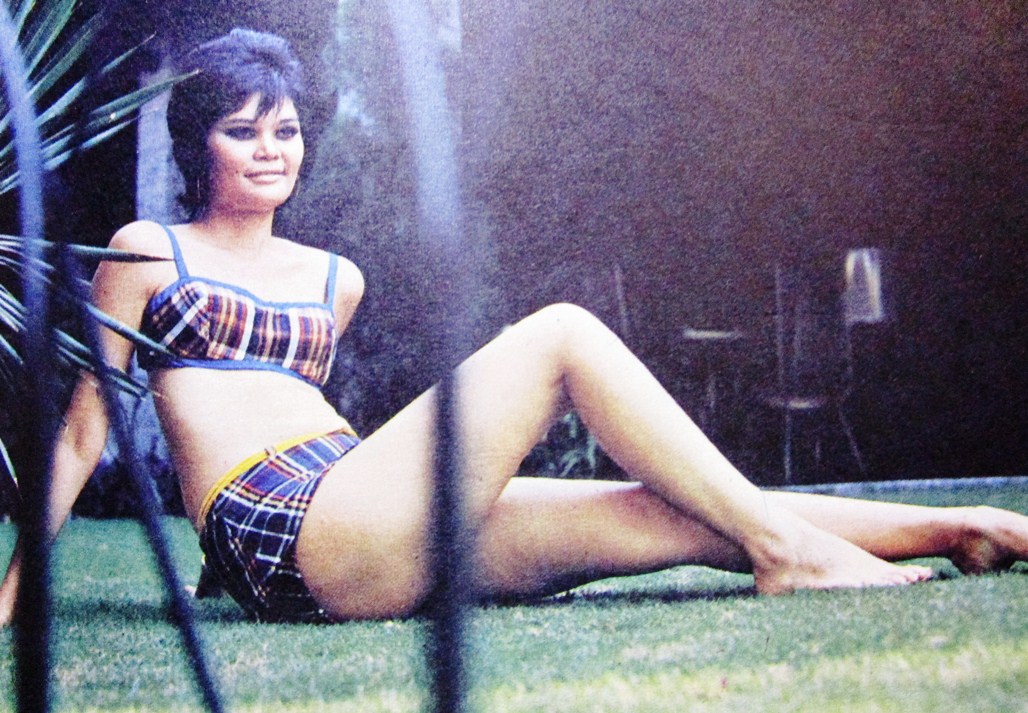
BIKINI WATCH: A shapely model in a Madras print bikini, modest by today’s standards. 1971.
            Image: PIC Magazine

The 70s decade saw much experimentation with swimsuit fabrics, with designers working with leather, velvet, crocheted squares, fur and metallic Lurex. A breaktrhough synthetic fiber fabric was developed in the 80s, that would give competitive swimming a big boost. Spandex (an acronym of “expands’) and Lycra swimwear felt like second skin yet it also had superior elasticity and strength.


STAR FOR ALL SWIMWEAR. Vilma Santos vamps it up in a high-cut dance swimsuit in a TV show.
            Image: Fashion Pulis

Style-wise, swimwear with high cut bottoms were all the rage, as they give maximum exposure to a woman's legs and thighs to the max, elongating the silhouette while showing off her natural contours. High cut leg swimsuits would not only drive the popularity of tangas and thongs, but would also spawn a new beauty service business: waxing. Media censors were mortified to see cheek-baring tangas worn on TV by sexy  dancing stars like “Tanga Queen” Alma Moreno and Vilma Santos.


BARE AND BROWN IS BEAUTIFUL. Tetchie Agbayani, simply bodacious on the pages of Playboy.
            Image: Video 48

But a 21 year-old Filipina beauty queen would take the display of feminine sensuality to the extreme in 1982—not in a swimsuit, but in her birthday suit.  Tetchie Agbayani made history by becoming the first Filipina to pose nude for the German edition of  Hefner’s famous Playboy Magazine.  By so doing, she showed us how to be comfortable in our own skin, though hounded no end by moral crusader Polly Cayetano. Agbayani also proved that swimsuits don’t make a woman, but the confidence to do what she believes in.  Which is why the world has never lost sight of the beautiful Filipina,  not even for for a second, ever since. 


SOURCES:
Timeline of Art History The Bikini:
Hollander, Anne. “Swimsuit Illustrated”, American Heritage, July/August 1990.pp. 58-65.
“A Smalltown Parades its Beauties”, Sunday Times Magazine, January 13, 1957
“The Bathing Suit in Asia”, Sunday Times Magazine, April 19, 1959

PHOTO SOURCES
Photo, Bomber with Betty Grable: The Star, WWII bomber visits Canada, along with 1940s pin-up icon: https://www.thestar.com/news/gta/2013/06/28/wwii_bomber_visits_canada_along_with_1940s_pinup_icon.html
Photo, U.P. Swimmers at the Far East Games trials: May 10, 1934 issue, p. 28
Photo, Rosa Rosal, Movie Song Literary Magazine, 1951
Photo, Teresita Sachez at Miss Universe 1952: George Silk © LIFE Archives
Photo, Lucita Soriano: Agent 69: Video 48