Category: Books
Genre: Arts & Photography
Author: Leigh Keno and Leslie Keno
Since childhood, these identical twins have been antiquing like crazy--going to flea markets as teens and re-selling their finds for a profit. It was but natural that as adults, they went into the antique business, and have now become even more familiar with their appearances on the "Antiques Roadshow", a popular U.S. TV show.
In this book, they recount their early fascinations for old things, and from there, as they acquired sophisticated knowledge about American antiques, they narrate their fabulous finds--from a pair of 18th c. chairs found in a chicken coop...to a stunning silver-mounted secretary-bookcase uncovered in Paris, to the small mahogany card table bought at a yard sale for 25$ that turned out to be a masterpiece of American furniture worth hundred of thousands of dollars!
Lots of great color pictures, "before and after" restorations and personal archival documents from the authors. Though the examples shown are American (not exactly my taste), the stories resonate with the same feeling of excitement brought about by the thrill of a serendipitous find that any antique collector can relate to. Why, I even see a lot of myself in the Keno brothers (except that they both are blond, blue-eyed and have more greenbucks). Get a copy of "Hidden Treasures" today! Where? At your nearest Book Sale, of course!
(15 July 2009)
Showing posts with label antiques. Show all posts
Sunday, December 8, 2013
Monday, November 18, 2013
44. 'TIQUES TRIPPING, part II
Oh where, o where have all the Casa Tesoro antique shops gone?
Seeing my shocked expression, the kind lady whose boutique now occupies Nora’s former place, directed me to Joncor Bldg., just across the street, where most of the shops have relocated since December. As usual, I was the last to know.
It was easy to find Atsing Nora’s new shop, she has the biggest space on the 2nd floor. After my hurried greetings, I surveyed her antique stock and came up with these quality pieces, both big and small. This 5 inch painted wooden Nino on a new manger is an excellent example of naive carving. I thought it was being sold individually, but it turns out he comes with a San Jose and Sta. Maria pair, thus driving the price up to 5 digits.
There’s also a 1950s San Isidro Labrador, from some religious commercial store..
But the more impressive pieces include this century-old talyado San Roque with traces of gilt on its carved robes. As is the common case with this santo, the dog and angel are missing..
I was interested in this consigned San Agustin head that was matched with a wrong size body. It reminded me of the San Agustin I chased around in Apalit, the one that got away and which I later found again for sale in a Manhattan shop! I choked when Atsing Nora quoted the price; I was interested in buying the santo head, not the whole Joncor Building! ;-).
One floor up, I chanced upon Bonnie having lunch, so I told him not to mind my nosey presence. The biggest item in his shop was the first thing that I saw: a magnificent century old, almost lifesize Crucified Christ that would have been perfect for a Semana Santa procession. And, it was in pristine condition!
The haunting face reminded me so much of Byzantine Christs.
I knew this was definitely way beyond my means, so I said a hurried goodbye and darted off outside, for a quick omelet lunch at Frendy's along Mabini St. I need to be more realistic! So, the next leg of my trip took me to good old Philtrade. I grabbed a cab which whisked me to the waiting antique pavilions, in no time at all. I worked the Philtrade shops systematically, hopping from one shop to another, and ocassionally chatting with familiar people manning the stores. Though the afternoon was s-l-o-o-w, I was quick to spot interesting finds!
At BERNALES ANTIQUE SHOP, I was shown this beautiful set of Virgin and Nino ivory heads and hands, still in a box!
I loved the carving, even if the faces had natural ivory striations. I imagined a future 5 footer Nstra. Snra. del Rosario for myself! (Reasonably priced too. Tantamount to 2 round trip tickets to the U.S. East Coast with pocket money to spare! ;-). In any case, I got hold of the store's contact numbers.
At BAYLOSIS SHOP, I saw this folksy santo grouping, heavily repainted, but charming, nevertheless. There was a Sta. Filomena, Virgen Antipolo, Maria, among others. Oh, but really not my cup of tea..
The sweltering heat was taking its toll on me and just as I was about ready to collapse, I found some energy to visit BLAS CORDOVA's ANTIQUE SHOP. Sometimes, Blas surprises with great finds from his Visayan forays.
Sure enough, I saw an unusual San Roque mounted on a cylindrical base, with 2 similar dovetailed bases for the dog and angel. Underneath the dirt and grime, I could see brilliant prolychromes of green, yellow and red. Blas told me the tableau came from Iloilo. I scrutinized it for a full 5 minutes and was smitten. To sweeten the pot, Blas further reduced the price from Ph P8,500 to PhP6,500. But I coaxed and cajoled. Being his VIC* (Valuable and Important Client, i.e. no bouncing checks to date), he further lopped off PhP500 from the price. Ano pa nga ba, e di..SOLD!
I took my San Roque home, gave it a sponge bath and a coat of wax, polished it..and here's how it looks now, occupying a place of honor on an already crowded table. Looks good to me!
And that's how I spent my Labor Day holiday. Tomorrow, it's back to the rat race. For us ordinary mortals, it's another day to make kayod..so I can fill my table with food...my cabinets with clothes..and my altar table with antique santos. Such is the cycle of my life. Until the next trip!
(1 May 2007)
It was easy to find Atsing Nora’s new shop, she has the biggest space on the 2nd floor. After my hurried greetings, I surveyed her antique stock and came up with these quality pieces, both big and small. This 5 inch painted wooden Nino on a new manger is an excellent example of naive carving. I thought it was being sold individually, but it turns out he comes with a San Jose and Sta. Maria pair, thus driving the price up to 5 digits.
There’s also a 1950s San Isidro Labrador, from some religious commercial store..
But the more impressive pieces include this century-old talyado San Roque with traces of gilt on its carved robes. As is the common case with this santo, the dog and angel are missing..
I was interested in this consigned San Agustin head that was matched with a wrong size body. It reminded me of the San Agustin I chased around in Apalit, the one that got away and which I later found again for sale in a Manhattan shop! I choked when Atsing Nora quoted the price; I was interested in buying the santo head, not the whole Joncor Building! ;-).
One floor up, I chanced upon Bonnie having lunch, so I told him not to mind my nosey presence. The biggest item in his shop was the first thing that I saw: a magnificent century old, almost lifesize Crucified Christ that would have been perfect for a Semana Santa procession. And, it was in pristine condition!
The haunting face reminded me so much of Byzantine Christs.
I knew this was definitely way beyond my means, so I said a hurried goodbye and darted off outside, for a quick omelet lunch at Frendy's along Mabini St. I need to be more realistic! So, the next leg of my trip took me to good old Philtrade. I grabbed a cab which whisked me to the waiting antique pavilions, in no time at all. I worked the Philtrade shops systematically, hopping from one shop to another, and ocassionally chatting with familiar people manning the stores. Though the afternoon was s-l-o-o-w, I was quick to spot interesting finds!
At BERNALES ANTIQUE SHOP, I was shown this beautiful set of Virgin and Nino ivory heads and hands, still in a box!
I loved the carving, even if the faces had natural ivory striations. I imagined a future 5 footer Nstra. Snra. del Rosario for myself! (Reasonably priced too. Tantamount to 2 round trip tickets to the U.S. East Coast with pocket money to spare! ;-). In any case, I got hold of the store's contact numbers.
At BAYLOSIS SHOP, I saw this folksy santo grouping, heavily repainted, but charming, nevertheless. There was a Sta. Filomena, Virgen Antipolo, Maria, among others. Oh, but really not my cup of tea..
The sweltering heat was taking its toll on me and just as I was about ready to collapse, I found some energy to visit BLAS CORDOVA's ANTIQUE SHOP. Sometimes, Blas surprises with great finds from his Visayan forays.
Sure enough, I saw an unusual San Roque mounted on a cylindrical base, with 2 similar dovetailed bases for the dog and angel. Underneath the dirt and grime, I could see brilliant prolychromes of green, yellow and red. Blas told me the tableau came from Iloilo. I scrutinized it for a full 5 minutes and was smitten. To sweeten the pot, Blas further reduced the price from Ph P8,500 to PhP6,500. But I coaxed and cajoled. Being his VIC* (Valuable and Important Client, i.e. no bouncing checks to date), he further lopped off PhP500 from the price. Ano pa nga ba, e di..SOLD!
I took my San Roque home, gave it a sponge bath and a coat of wax, polished it..and here's how it looks now, occupying a place of honor on an already crowded table. Looks good to me!
And that's how I spent my Labor Day holiday. Tomorrow, it's back to the rat race. For us ordinary mortals, it's another day to make kayod..so I can fill my table with food...my cabinets with clothes..and my altar table with antique santos. Such is the cycle of my life. Until the next trip!
(1 May 2007)
Monday, November 11, 2013
43. 'TIQUES TRIPPING, part I
I knew this one day holiday was coming, so, as early as last week, I reserved May 1 as my LWL day (read: LiWaLiw, a code my friends in the office use when we want to do a bit of gallivanting, yes—even during office hours.) Heck, I need this break; I’ve been under tremendous stress lately, coping with work while dealing with sickness and death in the family.
What better way to recharge than to go antiquing, a hobby that I’ve put on hold for the last few months? I have not made the rounds of Manila shops lately, and so, on this day dedicated to workers, I decided to work the antique circuit and see what’s in stock (or what’s new, but then that would have been inappropriate).
Mind you, the intent of this trip was to de-stress, which, in my case, could be accomplished by feasting my eyes on objects of history, beauty and value (read: santos), nothing more. But of course, I am always noted for uttering those famous lost words. More often than not, after filling up my senses, I end up filling a bag with an antique purchase.
On this hot sweltering day, I took a cab and found myself in Manila’s antique enclave: the streets of Mabini, M.H. del Pilar, Padre Faura. It was just past 10 a.m. when I entered DEUS—it was open! Immediately, santos attack my senses and my heart palpitates..
I was in luck. Noted director and owner Floy Quintos, an acquaintance, was around! He was rushing to Iloilo that day but still found time to show me interesting santos of all shapes and sizes. But the one that caught my eye was a seldom-seen antique Sta. Ines—our barrio patroness! Hmm, there was a sense of familiarity when I beheld this image. It’s chapel size, the body definitely old, the carving folksy—in fact, a tad too folksy for my taste.
Next to it was a not-too-old, not-too-new ivory Del Rosario. Yours to bring home for PhP 200K! Any takers?
On top a nearby altar table is this Raffy Lopez restored ivory Crucifixion scene in its original virina. Nice! Nice price too.
So, okay, to the wooden santos then. This polychromed San Roque is a good piece. Heavy wood. Now if only it had a dog and angel…
Floy also showed me an unusual miniscule all-ivory Nino sitting on a media luna (half moon) and dated 7-17-1959. A vintage piece, but still a rare representation of the Child Jesus. In my excitement, I forgot to take a photo. Sayang. I think, though, it will go to his private vault.
Next door to Floy is the shop of Nellie Enriquez, who sells more bagong luma (reproductions) now than genuine antique pieces. Nellie’s shop had always been here; I would go to her to buy new santo bases and for santo vestments repair. I found several items here that piqued my fancy: First, a complete 2 footer San Roque (albeit undressed), with a silver pukpok base, that unfortunately does not show in the picture.
There's a repro San Sebastian, which also caught my eye:
The glass escaparates yielded these small ivory Ninos, just around 3 inches long. One looked like a Nino Inocente for a Virgen Desamparados. The tag? PhP 4,500 each.
My heart skipped a beat when Nellie brought out a cardboard box where this well-carved head of a processional Veronica emerged! It was in great condition, encarna and glass tears intact, and well-carved. The only problem was that it was fairly new (dated 1982 incised at the nape, too recent for me!). The other bigger problem was the price (25K!—arrggh!, 5K more and I can have Nick Lugue carve a whole complete santo)..
I found out that this head was consigned by Nora Ignacio of SINAG TALA ANTIQUES, which explained why the price is so—impossible. I must go to Atsing Nora! But wait, BERNALES ANTIQUES nearby may have something worth seeing too. No santos, but I was shown these embroidered altar cloth pieces with Agnus Dei and floral motifs that offer a lot of possibilities.
The asking price of PhP70K was just too much for these frayed pieces that are threatening to disintegrate at a touch. Oh, well. Perhaps, it's really time to go to Atsing Nora, it's almost lunchtime anyway.
I’ve known Atsing Nora for over 20 years, back when I was a fresh graduate in my first job. She was the first to offer installment payments on santos I wanted to buy, and some of my initial pieces came from her shop.
But upon reaching Casa Tesoro, her shop was nowhere to be found! In fact, all the other antique shops housed in Casa Tesoro are gone!
(1 May 2007)
What better way to recharge than to go antiquing, a hobby that I’ve put on hold for the last few months? I have not made the rounds of Manila shops lately, and so, on this day dedicated to workers, I decided to work the antique circuit and see what’s in stock (or what’s new, but then that would have been inappropriate).
Mind you, the intent of this trip was to de-stress, which, in my case, could be accomplished by feasting my eyes on objects of history, beauty and value (read: santos), nothing more. But of course, I am always noted for uttering those famous lost words. More often than not, after filling up my senses, I end up filling a bag with an antique purchase.
On this hot sweltering day, I took a cab and found myself in Manila’s antique enclave: the streets of Mabini, M.H. del Pilar, Padre Faura. It was just past 10 a.m. when I entered DEUS—it was open! Immediately, santos attack my senses and my heart palpitates..
I was in luck. Noted director and owner Floy Quintos, an acquaintance, was around! He was rushing to Iloilo that day but still found time to show me interesting santos of all shapes and sizes. But the one that caught my eye was a seldom-seen antique Sta. Ines—our barrio patroness! Hmm, there was a sense of familiarity when I beheld this image. It’s chapel size, the body definitely old, the carving folksy—in fact, a tad too folksy for my taste.
Next to it was a not-too-old, not-too-new ivory Del Rosario. Yours to bring home for PhP 200K! Any takers?
On top a nearby altar table is this Raffy Lopez restored ivory Crucifixion scene in its original virina. Nice! Nice price too.
So, okay, to the wooden santos then. This polychromed San Roque is a good piece. Heavy wood. Now if only it had a dog and angel…
Floy also showed me an unusual miniscule all-ivory Nino sitting on a media luna (half moon) and dated 7-17-1959. A vintage piece, but still a rare representation of the Child Jesus. In my excitement, I forgot to take a photo. Sayang. I think, though, it will go to his private vault.
Next door to Floy is the shop of Nellie Enriquez, who sells more bagong luma (reproductions) now than genuine antique pieces. Nellie’s shop had always been here; I would go to her to buy new santo bases and for santo vestments repair. I found several items here that piqued my fancy: First, a complete 2 footer San Roque (albeit undressed), with a silver pukpok base, that unfortunately does not show in the picture.
There's a repro San Sebastian, which also caught my eye:
The glass escaparates yielded these small ivory Ninos, just around 3 inches long. One looked like a Nino Inocente for a Virgen Desamparados. The tag? PhP 4,500 each.
My heart skipped a beat when Nellie brought out a cardboard box where this well-carved head of a processional Veronica emerged! It was in great condition, encarna and glass tears intact, and well-carved. The only problem was that it was fairly new (dated 1982 incised at the nape, too recent for me!). The other bigger problem was the price (25K!—arrggh!, 5K more and I can have Nick Lugue carve a whole complete santo)..
I found out that this head was consigned by Nora Ignacio of SINAG TALA ANTIQUES, which explained why the price is so—impossible. I must go to Atsing Nora! But wait, BERNALES ANTIQUES nearby may have something worth seeing too. No santos, but I was shown these embroidered altar cloth pieces with Agnus Dei and floral motifs that offer a lot of possibilities.
The asking price of PhP70K was just too much for these frayed pieces that are threatening to disintegrate at a touch. Oh, well. Perhaps, it's really time to go to Atsing Nora, it's almost lunchtime anyway.
I’ve known Atsing Nora for over 20 years, back when I was a fresh graduate in my first job. She was the first to offer installment payments on santos I wanted to buy, and some of my initial pieces came from her shop.
But upon reaching Casa Tesoro, her shop was nowhere to be found! In fact, all the other antique shops housed in Casa Tesoro are gone!
Sunday, June 16, 2013
26. HIDDEN TREASURES AT THE ANNUAL GREENHILLS ANTIQUE FAIR
I didn’t even know that the famous Greenhills Antique Fair was already under way since last week; I had earlier texted a dealer for an appointment, and he texted back—asking me to meet him instead at his stall at Greenhills. Apparently, it’s that time of the year again for this longest-running antiques and collectibles show which I have been attending since the mid 90s. I think its history goes even further than that.
For 4 weeks, Manila’s antique dealers, segunda mano shops, numismatists, deltiologists, philatelists, collectors, “junkies” and kibitzers congregate near the fountain area of the Greenhills Shopping Center for a full day of wheeling, dealing, trading and swapping. Anything of value is sold here---the term ‘antique fair’ is not quite accurate as there are more repros being sold than the real thing.
Thus, Greenhills is not for buying quality century old santos; instead, it is for rummaging and scrounging around for collectibles of all sorts—not too old, mostly vintage, but still capable of invoking nostalgia, that hard-to-explain longing for a connection to the past, which many collectors like me experience in the presence of anything old, passé and defunct.
Toys, softdrink bottles, old product packaging, medals, stamps, 1950s magazines, schoolbooks, clocks, pens, pinback buttons, vinyl records, prints—name it, the Greenhills Fair has it—well, almost.
Supply seems to decline over the year judging from the number of participating dealers this year. This did not deter me from rushing over at Greenhills on one Sunday afternoon, ready to jostle with the thick weekend crowd in the hope of unearthing a ‘find’.
But the old reliables are still there—my tocayo, Alex Villaflor, is still at it, peddling ephemera, artworks and kitsch with his partner Sonny Benitez. Alex founded the first pop culture collectible shop in the country—Circa—back in the 80s at Creekside. He used to have a fne array of Bakelite radio and Coca Cola memorabilia, but those are long gone. Instead, he had these nice Flora de Filipinas botanical prints (called ‘Blanco prints” by collectors), ready for framing.
The famous George Bonsai also has one or two stalls here, but unfortunately, he was still setting up.
Jun Macaro had a fine display of medals and coins, but I was after his old photos, which he failed to bring, to my disappointment. I’ve have had lots of luck with Jun—I found my small ivory Sto. Entierro complete with his wooden calandra in his Aurora Blvd. junkyard and I also bought most of his old photos from the estate of Jorge Pineda.
I just hopped from stall to stall—the antique shops from Tiendesitas are in full force—but they carried mostly reproduction santos dressed in gaudy clothes—they looked more like overdecorated dolls.
Talking about dolls--it was at Mike’s stand that I saw, lying on the bottom-most shelf of his glass display—an old cardboard box that had a large doll inside.
The box was wrapped in plastic, but it took only one look for me to recognize the moppet with curly golden locks tucked inside, which even had a cardboard leg separator and head support.
This is a large composition Shirley Temple Doll from Ideal Novelty Inc, perhaps the most popular doll in the world based on the likeness of the top child star of the 30s, at the time of its release in 1937. A good sized doll (22 in.) in this condition (mint in box), would command at least $900 in the market today.
So with no one looking, I snatched the "world's darling" away after just a few minutes of friendly negotiation. Expect the unexpected when you go this fair of fairs--because buried underneath mounds of second-hand trifles, you might just unearth a treasure just like me!
Sunday, April 28, 2013
19. PRE-WAR PORTRAITS BY GALVEZ & TECSON
In his preface to the exhibit of portrait paintings entitled “LARAWAN, Immortality & Identity in Filipino Portraiture” at the Ayala Museum in 1989, Jaime Laya wrote: “Portraits are challenges to mortality. The originals may have long become dust, but their likenesses remain—on marble, on canvas, paper, plaster—seeking to remind at least the next few decades after they pass on, that once they were here.
“ Before the advent of photography, the art of portrait painting was practiced by a few artists in the 19th c. like Justiniano Asuncion, Damian Domingo, Antonio Malantic and Simon Flores. Academically-trained artists followed suit, and notable among this group are Lorenzo Guerrero, Felix Resurreccion Hidalgo and of course, Juan Luna. Only the affluent and powerful could afford such artworks, considered as trappings of wealth. The subjects sat in his finest clothes for the painter, and he was often painted surrounded by symbols of his accomplishment and status—from silver-tipped canes, silk hankies to ostrich feathered fans and ivory santos on a marble-topped table.
In-demand portraitists during the American period (1900-45) included Fabian de la Rosa, Miguel Zaragoza, Teodoro Buenaventura, Jorge Pineda and above all, FernandoAmorsolo, whose style would dominate the period.
Pre-war portraits are hard to come by in the local market; families tend to keep them because of their personal connection with the subject. They are not exactly favorites of collectors either, preferring religious subjects and landscapes over these strange, nameless faces with stiff postures and icy stares. The Ayala exhibit opened many collectors’ eyes to the value of portrait paintings which are part of Philippine art history that began over 250 years ago.
These two portrait paintings were discovered by chance in the warehouse of an occasional antique dealer whose main preoccupation is buying house parts, architectural details, and sometimes, its entire content, which would invariably include house décors such as paintings. They are significant finds in that they survived the war, saved for some slight scruffs and manageable tears, and they represent the early works of two award-winning Filipino artists who started painting during the American occupation and into the 80s. Whereas one went on to be written about in art books, and with works rising in value, the other remains virtually unknown outside of his province.
The first painting which I randomly pulled out of a stack of paintings leaning against a wall showed the thin, almost gaunt face of an old grand dame, who, in her 70s, could be anybody’s lola. There, on the lower right had corner was the signature of the artist-- M. Galvez-- only 25 when he completed the painting on 13 September 1937. This portrait can be classified as coming from his Classical period (works from the 1920s-30s) when he painted genres and landscapes with carefully=studied compositions done in impasto.
The portrait is a sharp departure from his usual landscapes, but nevertheless, the young artist painted in detail, the subject’s most notable features—her wide forehead, her bony cheeks and chinky eyes. Grandma here is forcing a smile, her eyebrows slightly furrowed, as if with worry. Indeed, one could almost detect a pained expression on her face.
As realistic as the subject’s expression is the exquisite detail of her dress and accessories, starting with her gold criolla earrings and her gold necklace from which is suspended a small cross with the crucified Christ. Below her slender neck, she wears a seed pearl-encrusted pin to hold her baro in place. But the baro itself is even more amazing—the gossamer translucence of her embroidered baro of piña is captured beautifully with his brush, with four-petalled flowers and viney blue blossoms accenting her butterfly sleeves and panuelo.
The 73 year-old portrait was cleaned and restored, then –re-framed in an appropriate period frame. Galvez would later experiment with abstraction, cubism and expressionism in the 60s, but would later revert to straight realism for which he was always noted for.
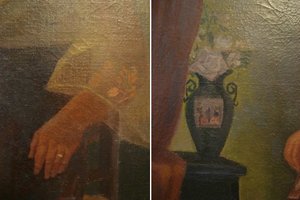
The second painting was found hanging at the rear of the warehouse, possibly because the thin, fragile canvas had suffered a V shaped tear on the neck area of the subject, which, fortunately had not affected the face. There were also lots of paint losses, the most major of which was a vertical line that cuts through her shoulder area. The portrait had a painted 3-inch gray border and it came with its original heavy wood narra frame that also had a screwed-on wooden backing.
Dated 1941, the portrait showed an elegant, robust lady seated on a chair inside her residence that showed the trappings of her wealth—there is a small landscape painting on the wall and an imported vase with gardenias on a plant stand. A heavy red velvet curtain falls on the painting’s left side, framing the lady’s importance.
Her hair in a neat bun, she is posed more casually but with a stare fixed on the painter. She is Filipina in every respect, from her morena complexion, rounder eyes and very full lips. Obviously a family matriarch, she cuts a commanding figure despite the simplicity of her baro’t saya, which consists of a diaphanous, spread-out baro matched with a plain brown saya that falls in drapes on the carpeted floor. Her only piece of jewelry is a plain wedding band on her finger.
This portrait was signed L. D. Tecson Jr., Cabiao, N.E. , and when I asked the dealer about the provenance, he could only say he rescued the painting from an old house in Cabiao town in Nueva Ecija. It took me awhile to acquire this painting not only because of its damage but also because I did not know the artist. His name did not appear in local art books nor did it show on google search.
Finally, one contemporary art book yielded his name and a short biographical sketch—Lauro Dizon Tecson Jr. was born in Cabiao, Nueva Ecija in 1912—so he must have set up shop in his own neighborhood after his graduating from the University of the Philippines with a Fine Arts degree. Cabiao was a rich and vast farming town that had its share of hacenderos, so this must have been commission from a landed family in the town.
Little else is known about Tecson, aside from the fact that he won First Prize in one art competition sponsored by the Art Association of the Philippines. His accomplishments have all but been overshadowed by J.D. Castro, his contemporary and fellow Nueva Ecijano who settled and did good business in Baliwag.
In a special way, these women continue to live on through these recovered portrait paintings, providing us with a permanent memory of how they looked while opening a window to their past world for us to witness and see: from their manner of grooming and dressing , their personal taste for adornments, to the social class they belonged in, as well as hints of their wealth and identity. It is simply amazing how one can summon hidden memories and conjure stories just by looking at a face on a canvas. Such is the power of the art of portraiture.
“ Before the advent of photography, the art of portrait painting was practiced by a few artists in the 19th c. like Justiniano Asuncion, Damian Domingo, Antonio Malantic and Simon Flores. Academically-trained artists followed suit, and notable among this group are Lorenzo Guerrero, Felix Resurreccion Hidalgo and of course, Juan Luna. Only the affluent and powerful could afford such artworks, considered as trappings of wealth. The subjects sat in his finest clothes for the painter, and he was often painted surrounded by symbols of his accomplishment and status—from silver-tipped canes, silk hankies to ostrich feathered fans and ivory santos on a marble-topped table.
In-demand portraitists during the American period (1900-45) included Fabian de la Rosa, Miguel Zaragoza, Teodoro Buenaventura, Jorge Pineda and above all, FernandoAmorsolo, whose style would dominate the period.
Pre-war portraits are hard to come by in the local market; families tend to keep them because of their personal connection with the subject. They are not exactly favorites of collectors either, preferring religious subjects and landscapes over these strange, nameless faces with stiff postures and icy stares. The Ayala exhibit opened many collectors’ eyes to the value of portrait paintings which are part of Philippine art history that began over 250 years ago.
These two portrait paintings were discovered by chance in the warehouse of an occasional antique dealer whose main preoccupation is buying house parts, architectural details, and sometimes, its entire content, which would invariably include house décors such as paintings. They are significant finds in that they survived the war, saved for some slight scruffs and manageable tears, and they represent the early works of two award-winning Filipino artists who started painting during the American occupation and into the 80s. Whereas one went on to be written about in art books, and with works rising in value, the other remains virtually unknown outside of his province.
The first painting which I randomly pulled out of a stack of paintings leaning against a wall showed the thin, almost gaunt face of an old grand dame, who, in her 70s, could be anybody’s lola. There, on the lower right had corner was the signature of the artist-- M. Galvez-- only 25 when he completed the painting on 13 September 1937. This portrait can be classified as coming from his Classical period (works from the 1920s-30s) when he painted genres and landscapes with carefully=studied compositions done in impasto.
The portrait is a sharp departure from his usual landscapes, but nevertheless, the young artist painted in detail, the subject’s most notable features—her wide forehead, her bony cheeks and chinky eyes. Grandma here is forcing a smile, her eyebrows slightly furrowed, as if with worry. Indeed, one could almost detect a pained expression on her face.
As realistic as the subject’s expression is the exquisite detail of her dress and accessories, starting with her gold criolla earrings and her gold necklace from which is suspended a small cross with the crucified Christ. Below her slender neck, she wears a seed pearl-encrusted pin to hold her baro in place. But the baro itself is even more amazing—the gossamer translucence of her embroidered baro of piña is captured beautifully with his brush, with four-petalled flowers and viney blue blossoms accenting her butterfly sleeves and panuelo.
The 73 year-old portrait was cleaned and restored, then –re-framed in an appropriate period frame. Galvez would later experiment with abstraction, cubism and expressionism in the 60s, but would later revert to straight realism for which he was always noted for.
******
The second painting was found hanging at the rear of the warehouse, possibly because the thin, fragile canvas had suffered a V shaped tear on the neck area of the subject, which, fortunately had not affected the face. There were also lots of paint losses, the most major of which was a vertical line that cuts through her shoulder area. The portrait had a painted 3-inch gray border and it came with its original heavy wood narra frame that also had a screwed-on wooden backing.
Dated 1941, the portrait showed an elegant, robust lady seated on a chair inside her residence that showed the trappings of her wealth—there is a small landscape painting on the wall and an imported vase with gardenias on a plant stand. A heavy red velvet curtain falls on the painting’s left side, framing the lady’s importance.
Her hair in a neat bun, she is posed more casually but with a stare fixed on the painter. She is Filipina in every respect, from her morena complexion, rounder eyes and very full lips. Obviously a family matriarch, she cuts a commanding figure despite the simplicity of her baro’t saya, which consists of a diaphanous, spread-out baro matched with a plain brown saya that falls in drapes on the carpeted floor. Her only piece of jewelry is a plain wedding band on her finger.
This portrait was signed L. D. Tecson Jr., Cabiao, N.E. , and when I asked the dealer about the provenance, he could only say he rescued the painting from an old house in Cabiao town in Nueva Ecija. It took me awhile to acquire this painting not only because of its damage but also because I did not know the artist. His name did not appear in local art books nor did it show on google search.
Finally, one contemporary art book yielded his name and a short biographical sketch—Lauro Dizon Tecson Jr. was born in Cabiao, Nueva Ecija in 1912—so he must have set up shop in his own neighborhood after his graduating from the University of the Philippines with a Fine Arts degree. Cabiao was a rich and vast farming town that had its share of hacenderos, so this must have been commission from a landed family in the town.
Little else is known about Tecson, aside from the fact that he won First Prize in one art competition sponsored by the Art Association of the Philippines. His accomplishments have all but been overshadowed by J.D. Castro, his contemporary and fellow Nueva Ecijano who settled and did good business in Baliwag.
In a special way, these women continue to live on through these recovered portrait paintings, providing us with a permanent memory of how they looked while opening a window to their past world for us to witness and see: from their manner of grooming and dressing , their personal taste for adornments, to the social class they belonged in, as well as hints of their wealth and identity. It is simply amazing how one can summon hidden memories and conjure stories just by looking at a face on a canvas. Such is the power of the art of portraiture.
Subscribe to:
Posts (Atom)