Thursday, April 11, 2024

76. AMERICANA VS. CAMISA: The History of Filipino Men's Fashion

FROM CAMISA TO AMERICANA. America exerted much influence in men’s fashioning, modernizing Filipino taste with such styles as the classic suit, locally called ‘americana’. The ‘americana’ replaced the everyday ‘camisa’ that was favored in the provinces, as seen in these late 1920s photos. The men on the right wore straw boat hats to complement their American look.

 Our love affair with America was marked with long periods of loving and loathing. The turning point in our history, historians say, began with the inauguration of the Philippine Assembly in 1907, and which saw Filipino participation in self-governance for the first time. Fear and initial distrust for these “damned Yanquis” slowly gave way to awe, admiration and fond affection, especially when the policy of “benevolent assimilation” which sounded so sincere to Filipinos, was introduced.

Filipinos took to adapting the great American lifestyle and the term “Sajonista” (Saxonist) was used to describe with a sneer, these Americanized natives, the new “modernistas”,  who took to their new Western ways like the proverbial duck to water.

 AMERICAN JAPORMS . “Sajonistas” (Saxonists) was a term ascribed to students who learned American ways in Manila schools. They aped not only the stateside accent, but also donned their fashions, like these two collegians, bothly smartly attired in “Americana” . 1920s.

 Youngsters didn’t just infect their speech with American twang but also adapted the fashions of “Modern Youth” and the “Young Generation”. They were “young ladies and gentlemen”, products of the public schools, who have taken to addressing each other with “Mister” or “Miss”, and who sought out to differentiate themselves from the common provincianos.

Names were the first to updated to give them a cosmopolitan sound—so Francisco became “Frank”, Jose “Joe” and Lucia, “Lucy”. Filipino parents had a heyday naming their babies with American appellations—Henry, Mary Rose, Helen, Charles. The young lads and lasses who went to Manila for their schooling returned home to their towns in their smart drill suits, stylish frocks, hats worn askew,  copied from American fashion magazines and thigh-high stockings. 

 Suiting Up and Fitting In.

Image 3 : FILIPINOS IN CAMISA CHINOS. Two Filipino gentlemen wearing “camisas”--collarless, long-sleeved shirts, buttoned in front, with optional pockets. The Chinese-inspired camisa, made from lightweight fabrics, was perfect for our tropical clime. Ca. early 1920s.

Indeed, it was from the 1920s to the early 1940s, that the peak of American impact—particularly in fashion—was most felt and seen. Even the Japanese, who displaced the Americans in the country during the War , were appalled not only at the pro-Americanism of the Filipino but at the magnitude of American influence absorbed by Filipino culture.

 Image 4:  MIX ‘N MATCH MENSWEAR. An all-male group steps out in  transition fashions, wearing native barongs and camisas, paired with narrow pants, two-tone shoes and boater’s hats—all very American. The man in the middle holds a walking cane, more of a fashion statement than a functional accessory. 1930s.

It is surprising to think that barely two decades earlier, young Filipino men’s everyday wear consisted of collarless camisas with buttoned front, paired with drawstring pants that can easily be rolled up, for work purposes.

For more formal occasions, the sheer barong, woven from delicate jusi or piña fiber was worn untucked, matched with a pair of pantalon de fina lana. The versatile native wear which was perfect for Philippine weather,  was embellished with embroidery of the most wondrous variety. Mestizos and ilustrado dandies—favored European fashions, often incompatible with the tropical heat.

But such fashions were to change dramatically with the coming of our new masters, the Americans, who brought a whole cabinet of stylistic influences that would hasten and alter Philippine dressing tradition.

Image 5: OLD SCHOOL, NEW SCHOOL. The 1915 picture on the left shows the standard outfit worn by Filipino boys in school—a drill suit with standing collar, buttoned up to the neck. The Americans not only revamped our educational system, but also the school uniform, replacing it with the black or white ‘americana’, worn with a bowtie and  paired  with white pants, —as seen on the right photo of two school lads, from 1924.

The American suit—or Americana—became ubiquitous in urban city streets and in schools, where it became a standard piece of wardrobe for men in the 1920s.

Schoolboys began shedding their plain, long-sleeved, buttoned-up drill shirts with standing collars and began donning the classic white or black Americana.

Image 6: SCHOOL IS COOL.Group of San Ildefonso, Bulacan  students pose for their high school class picture in their pristine white ‘americana’ suit. 1924.

The suit had open, thin lapels and was worn over a close-necked collared shirt (hence the term, Americana cerrada), with a tie. The coat was matched with high-waisted, slim-fit white trousers locally called “baston” , so-called because the pants tapered off at the knees and down to the ball of the ankles, showing off the socks. Trousers also began to be worn cuffed at the bottom.

Hat tricks, shoe business.

Image 7: HAT STUFF. LEFT:  A Filipino dandy in a straw boater hat, made of stiff straw and has a stiff flat crown and brim, with a solid or striped grosgrain ribbon around the crown. They were so named because they were the favorite headgear of boaters during summer. RIGHT: A man in a fedora hat, with a soft brim and indented crown.

To add to the ‘imported American’ look, our dashing Filipino ‘palikero’ went out with a straw boater hat—that had a flat top, a flat brim and a black band around the crown. Filipinos from the middle to upper class, wore panama hats, fedoras or  bowler  hats, while working people who spent much time outdoors wore  native Western-style woven hats, replacing the sambalilos and salakots which were deemed too antiquated.

All sorts of hats and accessories could be sourced from the posh Sombreria Secher, an exclusive ‘Gent’s Furnishing Store” located at 131 Escolta that sold varias clases sombrero del pais y extranjero (various kinds of local and imported hats). Cheaper Philippine-made hats like “balibuntal” from Lucban, were also available at the pre-war Manila Hat Store along M.H. del Pilar.

Image 8: IF THE SHOE FITS. Manila was major shoe-making center, and Toribio Teodoro’s “Ang Tibay”, which he founded in 1922, was the go-to place for locally-made, Western-style shoes. Esco Shoes, was another pioneer pre-war shoe store founded by the American Frank Hale.

Before he stepped out, the Filipino sajonista put on his sharp-pointed leather shoes, available in different styles—two-toned, cutaway, with ‘air conditioned’ feature—which could be bought from the world-class Ang Tibay Stores at Plaza Goiti, or at their Ilaya branch. Or one could opt to go to Escolta to check out the Esco Shoe Store where proper men’s shoes could be had from 9 to 11 pesos a pair.

Suit yourself.

Image 9: MADE TO MEASURE. Avenida Rizal in Manila, teemed with master tailors, many from the provinces, who set up tailoring and haberdashery shops, to take advantage of the demand for suits of distinction, as well as uniforms of all sorts. Ads from the 1930s.

For young, style-conscious gents, only primera clase (first class) suiting materials imported from Paris by leading Manila emporiums like La Puerta del Sol, Oriental Bazaar, and Osaka Bazaar in Echague.  Of course, the city’s  best master cutters and tailors were entrusted by discriminating Filipinos to create their suits, in their shops clustered along Rizal Avenue and Escolta.

Image 10: TAILOR-MADE. A selection of ads from tailoring shops touting their credentials and specialties. Of these, Luis Liwanag reigned supreme as the master maker of suits of all kinds, vests, tuxedos, and even church vestments! He also offered altering services.

German Adolfo Roensch Co. & Outfitters was an early haberdashery shop in Escolta that also sold men’s fashion accessories, including military uniforms. But local enterprising tailors--Kapampangans, Bulaqueños and Chinese—also proved to be sartorial masters. Tailor Luis Liwanag from Bulacan,  was one such specialist in suit-making, who not only had an Avenida shop, but also ran a fashion academy (tailoring school) at the posh Crystal Arcade.

Image 11: COLLAR YOUR WORLD. Portraits of  fashionable mestizos wearing different collar types. RIGHT:  A detachable stiff collar, worn with a necktie, 1919. LEFT: Two winged collar, with folded collar tips,  worn with a bowtie and a necktie, mid 1920s.

American shirts came also in different styles—some had winged collars that were starched, around which a tie was worn. The winged collar evolved from the Gladstone collar named in honor of British statesman William Gladstone, who popularized it. Filipino gents took to wearing winged collars to gala events as it gave them an air of class and distinction. There were also detachable stiff collars that one could purchase, fashionable since the 1850s, but which only caught on during the American rule.

Image 12: TUX REDUX. LEFT: Man in black tuxedo with coat tails, 1913. RIGHT: A trio of gents in identical tuxedos, dress shirts and bowties. 1920s.

For the most formal affair, however, a white tie ensemble is de riguer.  The black tuxedo with coattails (swallow-tails)  is also worn in glamorous events, matched with trousers trimmed with side satin ribbon strips, often worn with a vest, and black ties. Filipinos took liberties with this dressing protocol by wearing short black coats, and bow-ties.

Turncoating on new trends.

 Beginning in 1925, a  new fashion craze swept the country with the “balloon pants” fad. Filipinos had already discarded the barong, and now the slim white pants were being replaced by the “balloon”—a pair of white, super-wide pants that flared at the bottom. Immediately, this fashion trend caused a major furor among nationalists, and self-proclaimed stylists.

Image 13: BALLOON-EY!. This mestizo looker is wearing the super wide and super loose balloon pants, matched with an oversized coat, foreshadowing the ‘zoot suit’ of the 1930s-40s. Filipinos in balloon pants were criticized for wearing this inappropriate trouser style that made them look even shorter.

In the July 23, 1927 issue of Graphic Magazine, an article derided the “balloon pants” as unfit for young Filipinos, who were generally short in stature. The loose, baggy “balloon”, the article contended, made Filipino men look even shorter.

By the 1930s, the Philippines was completely under the American spell. It is said that the boogie-woogie, jitterbugging kids of the Swing Era were probably the most Americanized generation of young Filipinos. An observant few were quick to lament the eradication of our values as Filipinos became enamoured with the American dream with Hollywood movies, the carnivals and cabarets, the cigarettes and the scotch—providing the cheap thrills of youthful leisure.

Image 14 : KEEPING ABREAST. The 1930s saw the introduction of the double-breasted suit, shown here, worn with a vest, by a trendy Filipino. The suit features  crossover panels in front, with 2 rows of buttons. His dashing mates are wearing conventional  gray American suits. 1930s.

The period was also notable for having given us some new fashion trends. One of these is the double-breasted suit that had a distinctive  features: front crossover panels, peaked lapels, broad shoulders and buttons galore—6 of them!  The distinguished suit was soon being worn by Hollywood icons and royalties—including the Duke of Windsor who had his own 4-button version. Matinee idol Rogelio de la Rosa and president Manuel Roxas cut such fine, aristocratic figures whenever they went to functions wearing double-breasted suits made of expensive sharkskin.

 
Image 15: PADDED DEUX. Coats also from the Gatsby period tended to be broader on the shoulder arewith the use of padding to create a bulkier torso and a more masculine look. This style persisted till the early 1950s, as seen from these 2 photos of actor Efren Reyes (note his high-waisted pants), and photographer, Ricardo Twaño.  Ca, 1948.

Another ‘30s trend was the use of shoulder pads to create an impression of a larger, broader torso. The body acquired a square shape, and the peaked lapels framed the chest area. Sleeves were narrowed at the wrist. Padded suits worn with matching double-pleated, high-waisted pants would reappear in the late 40s thru the early 50s.

A style associated with the Jazz Age was the so-called Zoot suit—an extra-long and loose coat with wide lapels and exaggerated padded shoulders,  paired with high-waisted, wide-legged pants that narrowed at the ankles. The look was popularized by jazz musicians—like our very own Borromeo Lou-- through the 40s decade. Vertically-challenged Filipinos stayed away from this style though, but Latinos fell for the zoot’s appeal.

Gentlemen of leisure.

Image 16: SUITS ALL OCCASIONS. The “Americana” was worn even during moments of leisure, as in these cases: LEFT: Male revelers sweltering in their “americanas”, stop by for refreshments at a Manila Carnival booth in Luneta, ca. 1924. TOP RIGHT: Excursionists in Arayat. The men, by the stream, look overdressed than the women, ca. 1917. BOTTOM RIGHT: Three pals in Baguio, in suits, to protect them from the nippy weather.1930s.

Through two decades, the americana had an all-purpose, all-weather quality and so was worn practically everywhere—during shopping trips, while attending the carnivals in Luneta, and in out-of-town excursions to Baguio. In the 20s and 30s, excluding sports uniforms, there were very few men’s clothes made expressedly for leisure.

Image 17: GOOD SPORT. Young Filipino lads, in sporty outfits, fresh from America. LEFT: This boy is ready for a stroll with his suit worn over a knitted vest. Note his snazzy newsboy cap with a folding visor. RIGHT A budding tennis star in a cardigan sweater and a cap. 1928.

Men ventured into the great outdoors in loose light-colored shirts, hardy khaki pants and straw hats. Long and short-sleeved, multi-pocket loose shirts of khaki with wide collars were considered casual wear in the 1940s. Khaki gave these shirts a “military” feel, and eventually, the khaki would give way to light fabrics like cotton. By the 1950s, casual wear of this cut would have many versions—including the Hawaiian shirt, made attractive with printed resort island motifs.

Image 18: OUTDOORSY OUTFITS. Casual clothes for the great outdoors in the 1940s include” LEFT: Loose, short-sleeved shirts with large pointy collars, buttoned low for comfort.  MIDDLE: Short-sleeved khaki shirts with covered pockets and wide collars inspired from military uniforms were standard get-ups for the young man on the go. RIGHT: Hawaain shirts made a splash as resort wear in the 1950s.

Meanwhile, bathing suits were an offshoot of the sporting events introduced in the first decade of the 20th century by Americans, who were avid sports enthusiasts. The first Far East Games held in Manila in 1913 had male swimmers wearing the all-in-one woolen swimsuit in public, an abbreviated version of the first suit  that had first appeared in 1870 with long sleeves and legs.

Image 19: IN THE SWIM OF THINGS. A teenager in a one-piece men’s woolen swimsuit, next to a swimming hole. 1924.

By 1925, men’s swimwear began to look similar to a wrestling singlet. This competition swimsuit found its way in men’s aparador, until it lost its top and became a pair of bathing trunks in the 1940s.

Cut and trim.

While clothes make the man, it is his well-trimmed, well-groomed hair that is his crowning glory. The first decade of the 20th century had men wearing facial hair and slicked back hair. This trend continued into the next decade, with more Filipinos doing away with moustaches and beards, and going for a slick, straight back hair finished with brilliantine pomade, for maximum gloss. The cut was neat and clean around the ear and tapered down to nothing at the nape.

Image 20: THE VALENTINO LOOK. Straight, slicked-back hair is a versatile, easy-to-manage hairstyle, popularized by Hollywood icons led by Rudolph Valentino. RIGHT:  Movie star Leopoldo Salcedo, was the Filipino John Barrymore, famous for his great profile shown at its best with his well-groomed slicked-back hair. LEFT: A Caviteño named Tomas, shows off his own version of the tight and neat Valentino look in his 1930 portrait.

This look was immortalized by Hollywood romantic star Rudolph Valentino, Ramon Navarro and  “Great Gatsby” icon Fred Astaire , who were soon imitated by starstruck young men. They not only went for a full pin-straight slicked back, but added a part to one side, or in the middle. The latter was resurrected by comedian Cachupoy in the 60s who briefly gave the style his name.

Image 21: LOOKING THE PART. LEFT: Slicked-back hair can be parted in the middle, as preferred by this Pinoy gent, named Julian. RIGHT: How it looks with a side-part.

Men’s hairstyles in the 1930s strayed away from convention of the previous years, as Americans sported longish hair in front and on top, with shorter side hair, and fading in the back, plastered with creams and hair tonic. Hollywood was the main purveyor of this look in the islands led by Clark Gable, Errol Flynn, Douglas Fairbanks Jr. and Gary Cooper.

Image 22:  NOT A HAIR OUT OF PLACE. Before gels, hair was controlled, managed and maintained with brilliantine pomades and creams (both imported and locally-produced) , which gave hair a lustrous sheen while keeping every strand in place.

The War years paved the way for short-cropped, low maintenance, military cut hair,. It was said that American soldiers sported high and tight crew cuts to control the spread of lice in their crowded quarters. Suddenly, the local Aguinaldo haircut that our first president was famous for, came into vogue again.

The  Japanese attempted to promote the revival and appreciation of Filipino cultural traditions (they encouraged speaking in Pilipino) as part of its policy of ‘Asia for the Asians’, but as soon as the war ended, Filipinos once more, went “stateside” in their sartorial and grooming taste.

Image 23: HAIR-RAISING. Longer hair resulted in new hairstyle trends. LEFT: Matinee idol Rogelio dela Rosa imitates the greased, tousled hair of Douglas Fairbanks here, long in front, short at the sides. RIGHT: Actor-singer Manding Claro sporting his pompadour.

Boys grew their hair longer, leading to the emergence of the pompadour, where hair is swept upwards and worn high over the forehead, with sides and back upswepts. The result is high volume hair on the head, reminiscent of Madame de Pompadour’s hairstyle. James Dean and his gang of greasers of would make the pompadour famous among youngsters in midcentury Philippines.

Nearly American.

What effects did sajonismo bring to the Filipino male?

Is the white ‘saxon” culture truly fit to be assimilated by brown-skinned Pinoys?

A 1929 article published on Free Press paints a picture of a returning student educated and Americanized in Manila.

“Behold him as he struts along Main Street of his little town barrio, the cynosure of all eyes…a king in his own right, a sort of collegiate Caesar. The arbiter elegantiarium also, he is. …his clothes are studied, his shoes are studied, his hat and how he wears it—everything about him becomes the object of emulation and envy. Is it any wonder that, under the incense of such flattery, he feels himself a superior being, a conquering hero?”

Image 24: THE AMERICANIZATION OF JUAN DELA CRUZ. Different styles, different folks, all-American look.

The article ends with a call for understanding for the sajonista and his affectation of  superiority complex. We paid him excessive hero worship, which he basked in—a very human thing to do. But it also left a reminder to this instant modernista—carpe diem—seize and enjoy the moment, for it will soon last. As it turned out, our love affair with America would last longer than most, and colonial mentality would continue to persist, even with the rise of nationalism in the 1950s, through the 70s and 80s.

We thought that would end when Pinatubo kicked out America from Clark with finality in 1991.  The American absence cleared the air, giving us  time and space to reflect on what colonial mentality has done to us, and what we have been missing all these years. But new media technology has also flung the door wide open for new influences to come in: we fell for Taiwanese F4’s  metrosexual, long-hair look promoted by F4, Japanese Harajuku street fashion, and the current K-Pop rage.

Our taste for fashion defines not just our individuality but also our collective cultural identity as one nation. But whether attired in traditional barong tagalog or dressed in Banlon polyesters, Armani suit, colorful animé fashions, knitted bonnets and skull caps, drop crotch pants, mismatched prints, neck scarves and quirky Crocs—our menfolk can carry it all with confidence and aplomb, proof that  when it comes to all-time porma, the Filipino is second to none.

THIS ARTICLE WAS ORIGINALLY PUBLISHED FOR ESQUIRE MAGAZINE, 1 APRIL 2019

SOURCES:

All Photos: Alex D. Castro Collection

Fernando, Gilda Cordero, Recio, Nik, “The Dressing Tradition”, Turn of the Century, GCF Books, Quezon City: 1978, pp. 113-133.

Joaquin, Nick. “Pop Culture: the American Years—The Filipino as Sajonista 1900s-1940s). vol. 10. Pp. 2732-2744. Published by PCPM, reprinted by Felta Press.

Sta. Maria, Felice. “The 1920s: When the Balloon Pants Came to Town”, Filipino Heritage, vol. 9. Pp. 2378-2380. Published by PCPM, reprinted by Felta Press.

McCoy, Alfred, Roces, Alfredo. Philippine Cartoons: Political Caricature of the American Era, 1900-41, Vera-Reyes (Manila), 1985

“A Suit of Clothes”, The Origin of Everyday Things, Reader’s Digest Association Ltd. © 1998. Pp. 128-129.

Wiesman,  Luc. “THE MOST ICONIC MEN’S HAIRSTYLES IN HISTORY: 1920 – 1969”, 28 Mar, 2016. https://www.dmarge.com/2016/03/iconic-mens-hairstyles-history-1920-1969.html

Watkins, Ted. THE CREW CUT MEN’S HAIRCUT HISTORY, https://myhairdressers.com/blog/crew-cut-history/

THE HISTORY OF MEN'S SWIMWEAR, https://therake.com/stories/style/history-mens-swimwear/

 A History of Men's Suits From 1900 – 2013, https://imgur.com/gallery/u9N66

 Wikipedia.org. “1920s in Western fashion”, https://en.wikipedia.org/wiki/1920s_in_Western_fashion

Wikipedia.org, “Zoot suits”,https://en.wikipedia.org/wiki/1920s_in_Western_fashion

 Sharma, Tanya. “Fashion of the 1930s”,https://mens-fashion.lovetoknow.com/Fashion_of_the_1930s


Sunday, January 2, 2022

75. ODE TO THE CALENDAR

Calendars are useful for keeping track of events, holidays, meetings, deadlines, and milestones. They help us visualize our daily schedules to make us productive. In the old days, new parents referred to calendars for possible babies' names, as the pages contained feast days of saints--which explains my 2nd name, Maynardo--I was born on Jan. 21, 1957, the feast of an obscure saint, St. Meinrad (Maynard).

 My late father prefers the large Chinese calendars,  the ones that Chinese-owned stores in our town gave away. The numbers are laid out in a graph-like format allowing him to write reminders like the day a new LPG tank was installed, bill payments, addresses and phone numbers of people. 

 In the 60s and 70s, we had all sorts of complimentary calendars for the taking--from our local banks, groceries, hardware shops, PASUDECO (the province's largest sugar mill where my grandfather was a client), and even insurance companies. 

It's sad that we take calendars for granted, ripping a page every month, until a calendar's gone. Now, they are so hard to find, and if you are ever given a free calendar--it's usually the one-page freebie printed on thin cardboard, with small, numbered days that you can barely see. I have already a 2022 calendar containing the picture of a politician whose face occupies 3/4 of the calendar space.

I am keeping this anyway--along with the extinct 1980s Ginebra pin-up calendars that the liquor company distributed to store owners, of which my Mother was a recipient, having operated a friendly neighborhood store back then. She gave these away to drooling, drunken customers, but  still had many left.  I stowed them anyway--they make nice cabinet shelf liners and are useful for my paper craft projects.

More importantly, and kidding aside, old calendars give forgotten details to events past. Take this 1957 calendar, issued the year that I was born. I found out that  I was born on a Monday--isn't a Monday's child supposed to be "fair of face"?. Did you know that Pres. Magsaysay died on a Sunday, March 17, 1957?  All Saints' Day, Nov. 1, fell on a Friday--which probably meant that people went home on Oct. 31 for an unprecedented  4-day holiday! Dec. 25 Christmas was in the middle of the week--Wednesday--but back then, the holiday school break was all of 2 weeks!

Elsewhere around the world, 1957 was also the year of the Asian Flu pandemic that claimed over 150,000 lives world wide, foreshadowing the current, more deadly covid pandemic. Russia also launched its Sputnik satellite in October 4 (thank God it's a Friday!)--thus ushering in the Space Race war.  On the lighter side, the Frisbee came out for sale in January, but this flying plastic saucer became popular here only in the 70s!

These seemingly trivial facts and details don't appear on your FB Memories, they are revealed and recalled only in old calendars. So the next time an unsavory "politico" gives you a calendar, don't throw it away. By all means, use it...keep it...or repurpose it! Fitted with a foam board at the back, that calendar with the candidate's face makes a nice dartboard! Para mawala na sa kalendaryo!

Thursday, December 30, 2021

74. 2021: THE YEAR THAT WAS.


And so we come to the tail-end of 2021, the second year of the global covid pandemic, annus horibilis, part II. I am not sure if things are really getting better, or we’re just getting used to how things are going, thus far. ). Cooped up at home, I whiled away the time trying to be a “plantito”, a restorer, a repairman, and a movie marathoner. Yes, we have seen a bit of the light—hooray for vaccines (also for Hidylin Diaz, Maria Resa, Carlos Yulo and EJ Obiena.) But the normal that we knew before 2019 is still blurry—after delta and omicron, there are still 22 letters of the Greek alphabet that we haven’t heard, and which I hope to never hear on the news.

A lot of people I know are still jobless, their careers in Manila put on hold. Our economy has never been in this bad shape. Meanwhile, the cultural projects we were working on were deprioritized (thank God, I have Museo Mabalacat to keep me busy—now on its 2nd year, don't forget to "Like" and "Follow" !) . And yes,  even my planned travel in 2020 did not push through,  leaving me stuck here in Pampanga, mostly in my pajamas.

2021 began on a not-so-good note.  I was plagued with a series of ailments—laryngitis, trigger fingers, eye problems (I had pesky floaters!). But in June, I tore my rotator cuff, causing shoulder , back and arm pains that caused me sleepless nights.  I had to take several trips to the hospital for X-rays, MRI’s and evaluations by two orthopedists. That required months of medication, physical therapy, and in-home exercises that I continue to do to this day. By the way, my favorite 12 year-old car decided to get “sick” as well, right in the middle of my medical appointments. It went kaput and had to be overhauled in the“casa”, for over two months.

Thank God, I got my 2 doses of covid vaccines—the first in May, and the second in July. This December, I got my Booster shot, finally, in Clark. I have all but forgotten the torturous inconveniences that I went through to avail of those shots!

Then of course, I and my family had to deal with personal losses and crisis. In April 27, we marked the 1st death anniversary of my former boss, and tourism secretary Mon Jimenez Jr., through a beautiful online memorial where close friends shared their “MonJ stories”. I still miss him, and his wife and colleague, Abby Jimenez, as I’ve known them all my professional life.

October was the bleakest, saddest month ever. Our university president, Dr. Luis Ma. Calingo—and a friend of MonJ—succumbed to covid complications in the U.S.A. On October 3, my lolo’s 127th birthday, we lost a first cousin, Elizabeth. A day after we buried her, her older brother, Alvin, followed. The next month, the husband of their sister Cynthia, Atty. Eddie Rivera, died unexpectedly. We grew up with these dear cousins of ours, so it was hard not to be profoundly affected by their passing.

We also lost Atching Atang, this year, she was 83. She had worked for the family since my parents got married, and was in fact, a yaya of my eldest sister. At several points in our lives, her hardworking children too, helped my mother with laundry and house chores , and for that we are grateful. Now, 4 of her daughters are all abroad, living comfortable lives, yet they have never forgotten their humble beginnings, and most of all, have never forgotten us.

A major crisis hit our family in September, when my sister’s granddaughter, Olivia, was stricken with an inexplicable disease, which no New Jersey  doctor could diagnose. With multi-organ failure looming, she was airlifted to a Children’s Hospital in Philadelphia, where a doctor diagnosed her as having multicentric Castleman’s disease—the same disease that struck him as a medical student. Upon surviving, this kind doctor, decided to find ways to manage the disease. Olivia required chemotherapy, transfusions, bone marrow tests, and dialysis plus some 2 months’ stay in the ICU. Thankfully, our Olivia bounced back strong, although her health needs to be monitored for the next few years.

God is good, you see. Last year, we had 2 babies born in the family, making 2 of my brothers, Noel and Momel, first-time grandfathers, with the births of Jonah (in Florida) and Levi (in New Zealand), born just days from each other. This year, we welcomed 2 more grandkids—Felicity Nouvel (b. Oct. 16, NY, a first for my brother Mike and wife, Lulu), and Jalin Alexander, our Christmas Eve baby (another one, for Noel).  Our genetic pool is growing and going international! (Not to be outdone, our guard dog Peachy delivered 4 pups in February!).

Ohhh—lastly--on a personal note, 2021 will be the last year I will be proclaiming myself as a young senior retiree (I was 58 when I retired). In a few weeks, I will be 65, the official age of retirement, the official age of a true senior citizen, where you can no longer complain if they call you “lolo”.  65 is the point of no return—there’s no “new 40”, “new 50”—you are 65, and you are old, and you feel it.  I guess it’s time to start putting my affairs in order, because when you hit this number, time just doesn’t fly, it whizzes by like a Ferrari!. Should I download a “Last Will” form? Start auctioning off my ‘cherished possessions? Or maybe leave signed blank checks?.

Something to ponder on, while I water my cactus.

72. THE CASTRO FAMILY'S TALK-OF-THE-TOWN CHRISTMAS LANTERNS 1980-1983

1980, STEVE OWLSEN LANTERN

O OWLY NIGHT: THE LANTERN THAT STARTED IT ALL-- OUR "STEVE OWLSTEN" PAROL, Christmas 1980. I remember the day when our holiday home decorating took a turn for the strange, the outrageous, and for many of our neighbors—the bizarre. Three years before the infamous E.T. lantern, we siblings, conceived of a way to transform our roof into a veritable Christmas display a la Manila C.O.D. We resisted all traditional lantern forms— star, Oriental-inspired, box lanterns---and decided to come up with an animal-inspired lantern to rival our previous Santa’s reindeer display.  We did not have to look far for an inspiration. That year, we caught an OWL that strayed in our backyard---and that was how the queerest of birds became our pet (we had a pet monkey before that).  We named our pet owl “Steve Owlsten”,  after 6 Million Dollar Man’s Steve Austin (played by actor Lee Majors), which was still a big hit on TV that time. But alas, our big-eyed  bird Steve died in captivity---and as a supreme tribute to the wide-eyed fowl, we crafted a lantern in his likeness, fashioned from used cardboard packaging. It had super big cellophane eyes which could be lit from the inside, if I remember right. And it was kinda tall, with pointed ears that made him looked like a cross between a horned carabao and a bird. As soon as we hanged our STEVE OWLSTEN Parol creation outside our 2nd floor window, it became our neighbors' conversation piece. Maybe it reminded oldtimers that once, Pampanga had fish-shaped lanterns---the fish being a symbol for Christ. But an OWL lantern? Well---we just tell people that “ the wise bird is the symbol of the 3 Wise Men, haller, don’t you know that??!”

1981, MEDUSA LANTERN

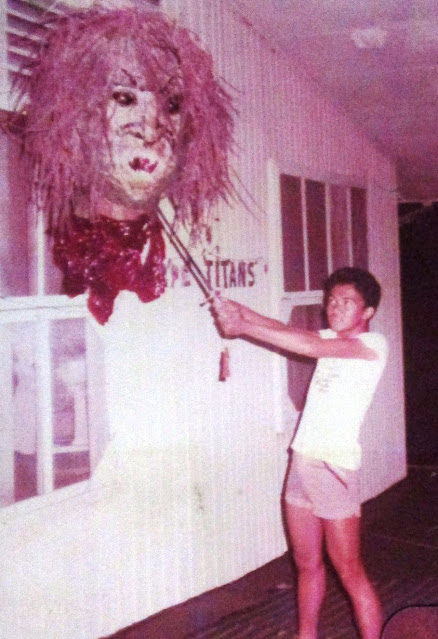
BE GOOD, FOR GOODNESS SNAKES:  OUR MEDUSA PAROL, Christmas1981. If looks could kill, our Medusa head lantern from Christmas 1981 would have killed the  whole neighborhood, or turned the neighbors to stone. We were inspired by our favorite 1981 movie, “Clash of the Titans” to create this Gorgon head---the serpentine hairstyle was fashion from coconut inflorescences—those clump of flower twigs  that look like slithering “snakes” from a distance. In the Greek myth, Medusa was beheaded by Perseus—here, acted out by my brother Michael Castro—who only needed a P.M.T. sword to do the job. For our many horrified neighbors, this Medusa head was their worst nightmare before Christmas!!!!

1982, HANGMAN LANTERN

NO CHANCE OF PAROL(E): OUR HANGMAN LANTERN, Christmas 1982. This is the lantern that sent our poor Mother screaming bloody hell and left her so upset!  I recall her ordering us to bring it down immediately-but to no avail. I think our holiday decorating reached its dismal, abyssmal depths in 1982, with this tasteless, totally improper human parol, complete with blood and tongue sticking out. My siblings probably figured that if mistletoes, stockings and ornaments were meant to be hanged, why not a person with a death sentence? At the way our neighbors reacted to our Hangman Lantern (morbid!!!) , we could say that the "execution" of our parol was outstanding!  The next year, we reprised the "hanging" parol idea using E.T.!

1983, E.T. LANTERN

OUR PAROL GOES EXTRA-TERRESTRIAL.Christmas 1983. Had the Pope seen our parol hanging in the front of our house in 1983, he would have excommunicated us. Even my poor Mother was mortified, and begged us to take our “parol” down. Our neighbors along the street would whisper about those “Castro kiddie weirdos”. We didn’t mind; on the contrary, we thought our lantern was uniquely cute! It was 1983, and the worldwide hit movie "E.T. The Extraterrestrial" had just been shown in Philippine cinemas. And we were hooked on the adorable alien. We thought E.T. would make a better, moe engaging lantern than the very common star parol. Both aliens and stars are from outer space anyway. Why, even Manila C.O.D. had space-themed Christmas displays! So, my brothers fashioned a papier mache E.T. mask, which was put on a body, complete with feet in rubber shoes and boxing gloves (the hand with individual fingers was too laborious to make in papier mache). Since we couldn’t make our E.T. lanterns stand on our roof landing-we hanged it by the neck. When we lit up our E.T. lantern in December, our neighbors stood transfixed, but mostly in shock, with eyebrows raised. Our house was the cynosure of attention that Christmas of 1983. Looking back now, our E.T. parol was, indeed, in such bad taste, fit more for Halloween than Christmas. But we succeeded in what we set out to do: to make our Christmas decoration the most talked about in the neighborhood. If KMJS had only been  around in 1983, Jessica Soho would have phoned us home, and featured our E.T.parol on her show!!

71. I SURVIVED ONE YEAR OF RETIREMENT! 30 March 2015

HAPPILY RETIRED, 30 MATCH 2014

Same time, last year, on March 30, I "disengaged" from my ad agency of 19 years and the ad industry for good--a life-changing decision. 

Today, my pockets may not be as full, but my heart always is--gaining the freedom to pursue the things I love best: I taught, got invited to speak in a national literary conference, gave talks on various aspects of culture in schools, became a consultant for a university, wrote major chapters for two books, provided creative recommendations for the relaunch of the Clark Museum, moonlit for an ad agency, set up a museum exhibit, attended art fairs, book launches and award ceremonies, sat as a member of the board of trustees for Kuliat foundation, won a Xmas essay contest sponsored by the Inquirer, judged various provincial festival contests, appeared on TV, gave museum tours, got recognized for my work in the arts by the provincial government, and most of all had more time to stop and smell the roses. 

Now that wasn't so bad, isn't it?


70. 2019: THE YEAR THAT WAS: Looking at Life From Up and Down

As we start a new decade, I look back at 2019 and realize what a mixed bag of events and emotions it had brought us, and me personally, as I struggled with some health issues ( I am coughing as I write this) and many personal losses this year. But I am still thankful that I weathered the year, and ended it with a better sense of purpose, thanks to a leadership that brought back some optimism to our dispirited city that has been mismanaged for over 2 decades.

INDELIBLE IMAGES FROM 2019


JANUARY began on an ominous note with the passing of my aunt Imang Auring Samson-Castro  on Jan. 3 in Baguio. She was our go-to person when I and my sibling went to school in Baguio (my sister Celine even became their ward), and it was sad to see her go, as this left our 99 year old Imang Elsie (the eldest sister of my late father)—the only surviving senior Castro in the family.

On our way down from going to her memorial service on Jan. 5, we met an accident in Sison, Pangasinan, where a motorcycle rider veered to our lane and crashed his bike on my car. Thank God, he came out of it with just a broken toe, and no one was hurt. How’s that for a double whammy?

Some  days after, our nephew Robby Castro Dizon and girlfriend Macel Bermudez, finished their month-long visit to Pampanga and returned to the Auckland, New Zealand on Jan. 16.

On Jan 17, award-winning GMA TV journalist Howie Severino interviewed me for  his “I-Witness” documentary “Unang Reyna”, that touched on the legacy  of Pura Villanueva, the first true national beauty queen of the Philippines.

I turned 62 years old on Jan. 21, an uneventful number. I had not planned on celebrating my birthday, but my friends at the Center for Kapampangan Studies wouldn’t let me—so they threw a small party for me at the university, bless them!

On Friday, Jan. 25, the second Holy Angel University-produced film ARIA, written by Robby Tantingco and directed by Carlo Catu, had its premiere at SM Clark.

FEBRUARY was a month of reunions and endless get-togethers, beginning on Feb. 3 where the Mabalacat Elementary School Alumni Association held a grand motorcade—and our batch’s float—Class of 1969—led the way!!  Our Golden Jubilee Homecoming happened on Feb. 9, at the Venmari Resort. It was great to reconnect again with my dear elementary classmates, many of whom I have not seen for 40 years!

In contrast, the evening event held at the Aseana Conventon Center in Clark was a formal, but well-attended affair. On Feb. 24, at Lola Nor’s. it was the turn of Caballeros— 1973 Sacred Heart Seminary High School Batch--- to have our mini-reunion. Classmates from Mabalacat, Angeles, and U.S.-based balikbayans attended the spur of-the-moment, but super fun affair!

MARCH was uneventful, but on March 19, I had to go to the Medical City Hospital to have my problem trigger finger checked up as it was getting worse and giving me constant pain.

APRIL has always been a busy month for me, mainly because of the annual observance of Holy Week. On Holy Wednesday, April 17, our Mater Dolorosa was already on its decorated carroza when heavy rains fell, prompting the cancellation of the evening procession. Thankfully, the freaky weather cooperated on Good Friday, April 19, and our Sta. Maria Jacobe—plus 4 more of my santos (Oracion, Christ at the Column, Sta. Salome, Captive Christ) —wended their way around the city without a hitch and we all went home dry.

In the afternoon of April 22, while I was at work on my computer, the hous started shaking and I realized it was an earthquake---and a strong one! By the time I had stepped out, the rumblings settled, but the intensity 6.1 quake had leveled a supermarket in Porac, trapping people inside.

MAY, my trigger thumb was finally operated on by my orthopedic surgeon, Dr. Peter Papio,  at Medical City- Clark on May 8. My troubled thumb was in bandage for 2 weeks! I was well enough to vote during the city election conducted on May 13, at my precinct in Mabiga.

 By May 14, the counting was done and a new leader emerged-my candidate Cris Garbo was proclaimed as the new mayor of Mabalacat, beating his opponent by a landslide. Most of his councilors, too, won their seats, thus putting an end to the 2-decade term of Boking Morales.

On JUNE 23, we marked our Mothers’s (Ester del Rosario-Castro) 10th death anniversary.

JULY was not particularly busy, but on  Jul. 12, together with CKS friends Robby and Myra, went to Manila to be at the launch of Claude Tayag’s watercolor book at the National Museum. The movers and shakers of the local art and culture scene were all there at the historic and picturesque venue, and needless to say, we had a great time.

Jul. 14, I attended the first Mass of friend and now Rev. Fr.  Jude Belnas, who had planed in from England to officiate his homecoming mass at the Divine Grace Church. In Jul. 27, I toured former Health Sec. Manuel Dayrit at the CKS Museum, who had Angeleño Del Rosario in his lineage,  which made him a relative!

On AUGUST 8, it was back to Manila to join an important meeting at the Bantayog ng mga Bayani Center upon the invitation of CDC Chairman Mr. Ping de Jesus. He wanted to rainstorm on possible ways to improve  the displays at the Martial Law Museum housed in their Quezon City building . The get-together was significant in that me, Robby and Myra managed to meet some of the most well-known victims and oppositionists of the Marcos regime-from Bobbi Malay, Susan Quimpo to Joy Jopson-Kintanar ( widow of late detainee and victim Ed Jopson)

A major project that Golden Jubilee Class of 1969 undertook and which I conceptualized  was the heritage coloring book of Mabalacat, entitled “Bale Matua”. The 20 page book, illustrated by local artist Dodjie Aguinaldo,  featured 18 coloring pages of  ancestral structures. On Aug. 23, some 20 Mabalacat Elementary School alumni , led by valedictorian Elvie Almazar, were on hand to distribute the books for free to select Grade 4 and 5 students, during the Buwan ng Wika celebration. The event was covered by leading local papers and TV stations, as the project was the first of its kind in the region. More coloring books were later donated to the San Francisco Elementary School.

SEPTEMBER marked a family milestone with the Wedding of my beautiful niece Trisha Castro to her longtime boyfriend JC Paras, held on Sep. 14 at the Sacred Heart Parish in San Fernando. Trisha is one of two daughters of my late brother, Christopher Eric Castro, with Fe Bingcang. Reception was held at the Country Garden which was magically transformed into a veritable garden of flowers with crystal accents. I was honored to have been one of the Principal Sponsors. My brother would also have been proud! Long may they live and prosper!

 Clearly the highlight of the month of OCTOBER, and perhaps the whole year for me happened on October 7, when the City Government of Mabalacat, led by Vice Mayor Geld P. Aquino, presented me with a copy of Resolution No. 06, recognizing my contribution to the cultural,artistic, moral and spiritual upliftment of the city, primarily for the song, “Bayung Mabalacat” which I co-created and which was used as the campaign song of the new Mayor’s , and which has now become the new anthem of Mabalacat. I never felt so proud to receive such honor!

Like all Pinoys, NOVEMBER started with a trek to the cemetery on Nov. 1 to remember our dear departed loved ones, in my case my parents, younger brother and both paternal and maternal grandparents.

On Nov. 6, I had my passport renewed at the local DFA. Five days later, on Nov. 11, it was back to the Medical City-Clark again as I am disturbed by these floaters that were affecting my vision. Well, the ophthalmologist said that there’s nothing pathologically wrong—floaters, she says, naturally occur with age. Ouch, that hurts!

My brother –in-law, Nilo Dizon,  landed in Clark from Auckland, New Zealand on Nov. 21 for a month-long vacation. Since he is a certified tramper, I arranged for a trek to Mabalacat’s next best tourist attraction, the hidden Haduan Falls in faraway sitio Haduan. We began our trek in the early morning of Nov. 28,  which required us negotiating a hanging bridge, navigating a rocky river trail, and climbing a steep-ledge to reach the falls. Death defying, but still worth it, despite a bruised rib, scrapes and spills.

The month ended with a bang with the start of the 30th SEA Games on Nov. 30. The Parade Ground of Clark-Mabalacat was the venue for some of the sporting events like Dancesports, Rugby 7, and Archery,

Before we knew it, it was the Christmas month of DECEMBER!  First thing I did was to have my san Fernando lantern repaired, and it was soon up and blinking! On Dec. 11, I attended the 448th Pampanga Day’s Most Outstanding Kapampangan Awards at Royce Hotel in Clark. Our two nominees, entrepreneur Mrs. Elvira Machuca and swimmer Kayla Noelle Sanchez won their respective categories—for Business and Sports, respectively.

 As the Christmas week neared, I was suddenly plagued with cough and fever, seems like there’s an epidemic going on, and I am still recuperating as I write this.  In the morning of Dec. 23, we brought my bro.in law to the Clark Airport—for his return flight to NZ, in time to join his family there for Christmas.

I missed this year’s Maytinis in Mabalacat, so I went to Clark for my Dec. 25 morning mass at Our Lady of Remedies Chapel. The rest of the day, I was coughing miserably, so I just spent the rest of Christmas at home and went on an online movie marathon.

I had a reunion lunch with some of my santo-aficionado friends in Malolos on Dec. 29, hosted by friend Leo Cloma. I got to see again their Museum of Incarnation, which was full to the brim with ecclesiastical arts and processional santos.

So now 2020 has arrived, I have all but junked the idea of making my New Year’s resolutions. I guess at this point in my life ( I turn 63 next month), I will just start each day unplanned, relishing what great things each day gives, and accepting whatever news that comes my way, sad, bad or glad. For sure though, I will continue my regular swimming, movie watching (I have breezed thru all episodes of Lucifer, The Hoarders, Gotham, and now, The Witcher)  and my writing, this time for the widely referenced pop culture online blog, FilipiKnow. And we’ll see what happens after that!

 IN MEMORIAM 2019

I will hold dear  the memories of these  relatives, friends and colleagues who all left this mortal world in 2019. May their souls rest in peace.

1.      AUREA Samson CASTRO (+  January 3, Aunt, married to my uncle Mateo Castro)

2.      RENE TIONGQUICO (+ Mar. 29, age 62,  Elementary classmate, died just  a month after our 50th alumni reunion)

3.      JUSTINO Palao CASTRO (+ Apr. 10, age 66, Cousin)

4.      FR. HENRY GROENEWEGEN (+Jul. 2, age 85, our High School Prefect of Studies, Sacred Heart Seminary, Angeles City)

5.      NORLITO Sanchez DEL ROSARIO (+ Oct. 11, age 77, Uncle)

6.      LUISA del Rosario TINIO ( + 8 Dec. 2019, age 64, First Cousin)

7.      JOSEPH Guazon LAGLEVA ( + 19 Dec. 2019, age 59, MassComm school mate St. Louis University, Baguio)

8.      TINA Isidro ISORENA (+ 20 Dec. 2019, age 56, officemate at Jimenez D’Arcy)

69. THE TWELFTH MONTH , Phil. Daily Inquirer, 2014


PASKU NA! PASKU NA! NANANU KO PA? A Castro Christmas in our old Mabalacat home in the early 80s.

There’s a special spirit in the air when December comes, and whoever invented the calendar certainly saved the best month for last—at least that’s what I thought when I was younger.  The tell-tale signs that December is coming are apparent in the dip in the thermometer, the endless carols blaring from the radio, and the ubiquitous parul sampernandu making their appearance on houses and streets.

To a child growing up in the 60s in Pampanga, December will always be a month unlike any other—for it meant shortened school days, a long vacation and one or two weeks of exciting holiday activities before the actual Christmas Day. In my elementary school days, I remember how we turned our classroom into a virtual Winter Wonderland.

 The centerpiece was a Christmas tree fashioned from a real tree with branchescovered with lots of cotton balls. We decorated our tree with chains made from colored paper, and cut-out figures from old Christmas cards. Glitter was made from old cigarette ‘palara’ (foil)  and more generous classmates would donate five-centavo Chinese folding paper lanterns with tassels of string. Traditional star lanterns of bamboo and papel de japon were all hand-made—which, after being graded by our Industrial Arts teacher, were quickly hung above our door.

There would also be hurriedly-practiced Christmas presentations, which consist mostly of singing carols learned from our Commonwealth era music books. We played manitu-manitu, our version of Kris-Kringle, in which mystery benefactors gave small surprise gifts for you every day—Texas bubble gum, a sachet of balitug (corn bits)  a bar of Choc-nut, Señorita lemon drops.  The identity of your donor is revealed on the day of the Christmas Party, where more gifts are given, with the best reserved for our “teacher-in-charge”.

Back home, our Christmas décor was more well-thought of—our neighbors on our street have come to expect the unexpected from us, what with our bewildering displays that never fail to catch passersby’s attention. The second floor window of our house opens to the first floor roof which provided a stage to mount our visual showcase a la Manila COD. 

One time, we had a “Belen” tableaux with figures made from “palis tambo” brooms, which drew mixed reviews—our yaya said frankly that they looked more like “tau-tauhan”(scarecrows) than the Holy Family. The next year, it was back to traditional Santa Claus cartolina cut-outs with Paete papier mache horses that we transformed into reindeers, by adding antlers made from coconut  twigs.

 Our worst display was a character centerpiece that had nothing to do with Christmas, but which we thought was a great idea at that time.  It was 1982 and E.T. was the current rage—so we made a larger-than-lifesize papier mache figure of the cute extra-terrestrial, complete with a pointing finger that lit up. Problem was, we didn’t know how to mount it, so my younger brother hung it by the neck—arguing that it would make a spectacular lantern. It sure became a talk-of-the-town as passersby would gasp in horror at the spectral sight of an alien hanging by his neck, “executed” by that weird family with a taste for the macabre! Eventually, my horrified mother asked us to take E.T. down.

 The remaining days leading to the Christmas Day is marked with more frenetic preparations, as house helps are mobilized to sweep the backyard, wax the floors and scrub the wooden windows and the pasamanos (window ledges) with isis leaves, in a cleaning frenzy.

 Two weeks before Christmas, my Ingkung would give an extra 100 pesos to my Ima for her Christmas marketing. I remember accompanying her to far away San Fernando so she could order special ‘saymadas’ slathered with butter and topped with grated ‘quezo de bola’. This must explain why ensaymadas are my favorite pastries to this day.

 Ati Bo, my father’s former yaya and our resident cook would also be preparing the big ‘kawas’ and ‘kalderas’ for our special noche buena based on my Ima’s menu, scrubbing the copper ‘tachos’ to bring back their gleam, which she will use for cooking tibuk-tibuk. Banana leaves would be gathered from our backyard garden, cut in size and then smoked to make them supple for wrapping suman and bobotu (tamales).

 Around this time too, while the adults are absorbed in their holiday chores, I would also be snooping around to see what I would be receiving for Christmas. There were years when we got ‘stateside’ gifts bought from Clark made possible by an American friend--my favorite were the stockings stuffed with mint candies, small toys, crayons and activity books.

 When that was not possible, my big sister would find something appropriate at Johnny’s Grocery in Balibago or in the school supply stores of Angeles like Josie’s Variety and Estrella’s. I always looked forward to receiving  Classic Illustrated comic books (they cost 80 centavos back then) that featured both classic novels and fairy tales. I still have a few issues saved from those past Christmasses.

 Children were also expected to attend religious festivities during the holidays and the ‘pastorellas’ of our church in Mabalacat were always a delight to hear.  Latin hymns are sung during the 9-day Christmas masses , and the songs include “Kyrie” (in Greek, actually) , “Gloria”, “Credo”, “Sanctus” and “Agnus Dei”. Though I could not understand a word, the operatic hymns, sung by a full choir and accompanied by violins, accordion and flutes, completely enthralled me, leading me to believe that these musical pieces must have been composed in heaven. Today, the pastorella tradition lives on a few other towns like Floridablanca, Betis and Sta. Rita.

 The final prelude to Christmas happens on Christmas Eve with the holding of the kid-anticipated ‘Maytinis’ (derived from Matins, or evening prayers)—the spectacular procession of holy images—patrons of  every barangay,  accompanied by colorfully lit lanterns or parul. Village choirs singing “Dios te Salve” accompany the faithful as they wend their way through the main streets of the town and back to the church.

 As a young boy, I could only see the procession from afar—on the other side of Sapang Balen river—as our narrow street was not part of the designated ‘limbun’ (procession) route. How I often fretted those nights away! Which is why, when I was asked to judge the Maytinis competition in 2004 (yes, prizes are now being given away for the Best Lantern, Best Carroza, Best Barangay Participation, Best Choir, etc.), I did not think twice and said yes. Through the years, the level of artistry has grown by leaps and bounds, evident in the creatively-designed lanterns and imaginatively-decorated floats;  I pray that the depth of devotion has grown too.

 Call me killjoy, but the excitement over Christmas drops drastically for me the day after—December 26. Then I start counting the days, weeks,and months all over again  till the next December 25. For a chance to bring back scenes from one’s childhood, 364 days is worth the wait. 

NOTE: This article was one of the winning articles in the "Christmas In My Memory" Essay Writing Contest launched by Philippine Daily Inquirer in December 2014: