

AMERICAN BATHING
BEAUTIES through the years. (1900s-1950s)
Image: www.ebay.com
America introduced to the world a new pictorial genre of
the female shape that would come to be known as the Bathing Beauty. The rapid
evolution of the swimsuit contributed to this phenomenon, which transformed
from heavy, shapeless outfits in the early 1900s to the two-piece bikini which
showed more shape, skin and sass.

1940s PIN-UP ICON,
BETTY GRABLE, posing in her bathing suit, painted on the nose of
the B-17
Flying Fortress, nicknamed ‘Sentimental Journey’. 1944.
Image: The Star, WWII Bomber visits Canada,
Along with 1940s Pin-up Icon: https://www.thestar.com/news/gta/2013/06/28/wwii_bomber_visits_canada_along_with_1940s_pinup_icon.html
The American Bathing Beauty, however, was seen not in
Olympic pools as a competitor, but as a sexy inspiration (or distraction) for
thousands of American boys marching off to world wars. Who can forget the
indelible image of a swimsuit-clad actress
Betty Grable and her million dollar legs, painted on the nose of a bomber
plane? Or the millions of pin-up posters of Rita Hayworth, Dorothy Lamour, Carole Landis and Noel Neill that adorned the
walls of soldiers’ bunkhouses?

PRETTY BEACH BABES
ALL IN A ROW, c. 1920s.
Photo: www.ebay.com
On the beach, instead of warding off the male gaze with
maximum body coverage, it now became acceptable (even a little patriotic) for
women to begin to respond to masculine attention, as well as to gratify the camera’s
eye.
However, the image of a Filipina as a Bathing Beauty was
inconceivable even at the height of the American presence in the Philippines
(1920s-1930s), where influence in fashion styles and mores was at its
strongest. While it was true that sajonistas
took to wearing flapper dresses and
shorter skirts, the donning of a swimsuit took much daring and courage.

EAST MEETS WEST.
1929 Miss Philippines Pacita de los Reyes shakes the hand of
1926 Miss America,
Mary Campbell. Their attires are still a world apart.
Photo: Alex Castro Collection.
For all her exposure to American modernism that includes
images of provocatively aggressive Western vixens, the Filipina still held fast
to her age-old values shaped by her culture and religion, as exemplified by Rizal’s
Maria Clara character from his novel, “Noli
Me Tangere” .
The religious Maria Clara was depicted as a woman of
virtue, a pure soul—“shy, demure and self-effacing, loyal to the end”. Rizal
exalted her as the ideal image of a Filipina deserving of a place on the
“pedestal of male honor”. Maria Clara also perpetuated a native attire that
required a woman to be swathed in layers upon layers of clothing pieces, beginning
with a camisa, a voluminous saya, a pañuelo, and tapis that were laboriously tucked, pin,
and wrapped around her body.

MARIA CLARA
UNWRAPPED. Left, Maiden in baro’t saya, sitting on a river rock, early 1900s.
Right: Actress Rosa Rosal in a bathing suit, sitting on a river rock, 1951.
Photo: Alex Castro Collection.
Over time, beginning in the 1930s, the Filipina began to
shed off these layers—one piece at a time--as new ideas of leisure and
recreation began to emerge. So did a new flirtatiousness in swimwear design
that called for comfort, ease of movement and freedom. Bulky fabrics, corsets
and unsightly undergarments were abandoned, necessitating the exposure of and
collarbones, ankles and elbows, cleavage, and more flesh, slowly but surely. Then,
in the 1950s, the rise of contemporary beauty pageants began making the wearing
of swimsuits de riguer for candidates.
And so, ikevenus arising from the sea, the Filipina Bathing Beauty was born.
PRE-SPANISH: Wrapped and Ready for Her Bath
Jesuit Pedro Chirino’s book “Relacion de las Islas
Filipinas”, published in Rome in 1604, not only gave us an excellent description of 17th century Philippines, but also
its inhabitants—our forebears--by chronicling their daily habits. In fact, a
whole chapter was devoted to the Filipinos’ bathing practices.

BAYWATCH BABES.
Filipina bathers in wrap-around sarongs take a
plunge at the Manila Bay in
Ermita area, ca. late 1800s.
Image: Fernando, Gilda Cordero.,
Turn of the Century, GCF Books, Quezon City, Philippines.
© 1978. P. 60.
“From the day they are born these islanders are raised in
the water, and so from childhood both men and women swim like fish and have no
need of a bridge to cross rivers.” Of the female bathers, Chirino noted: “They
bathe at all hours indiscriminately, for pleasure and cleanliness…They bathe
crouching and almost sitting down, out of modesty, with water up to their neck
and with extreme care not to expose themselves, even if there is no one around
to see them…”

A PUBLIC BATH HOUSE
FROM 1792. Filipinos, mostly women,
swimming and frolicking in the privacy of a bath house.
Image: Juan Ravenet. "Casa de
baños en Manila" (Bath houses in Manila).
1792. Museo Naval (Madrid) Collection.
People then preferred to take their baths at sunset,
after work, in a river. By the late 18th century, public baths were
seen in Manila, both patronized by men and women. An old print shows such an
example, where a portion of a body of water was enclosed with nipa and bamboo
and equipped with steps and handrails.

VISAYAN BELLE IN A PATADYONG,
a pre-Spanish wrap-around loose skirt worn
by women, especially in the Visayan
lowlands, similar to the Indonesian sarong.
Image: Best, Jonathan. A Philippine
Album. American Era Photographs 1900-1930.
Bookmark,
Makati City, 1998.p. 30.
The bathing outfits of these early Filipinas included
wrap-around skirts or tube skirts (patadyong
or malong) with ends gathered and
tucked in, under the armpits. Others seem to be taking a dip in their basic
house clothes—blouses and skirt. In any case, they seemed to be oblivious to their
various states of deshabille, lost in
the enjoyment of their aquatic moment.
THE SPANISH PERIOD (1800s-early 1900s) : Swimming With
Your Saya On.
Fashion in 19th century Philippines brought a
new sense of modesty, aligned with the dictates of social and Catholic religious attitudes.
One wore a collarless camisa with a folded pañuelo pinned over it to
hide the cleavage. Matched with a full, wide skirt (saya) with a long trains, the skirt was then wrapped once
more with knee-length overskirt called tapis.

WADE IN THE WATER.
Believe it or not, women dressed in simplified baro’t saya plus a head covering,
even for water excursions. Taken at San Juan Baño, Arayat, already a favorite
resort destination back in the 1900s.
Image: Alex R. Castro Collection
Outdoorsy Filipinas often went to picnic dressed in
simplified versions of such native outfits—but with a shorter saya, minus the pañuelo, and a bandana to
cover the head. The bakya was an
indispensable foot gear, as the wooden shoes can taken off anytime for quick
river wade.
The same was true in the Western world—American ladies in
the 1870s trooped to the beach completely covered, wearing unflattering woolen bathing
suits that hid both arms and legs. Many women even wore stockings and lace-up
shoes to the beach. Sailor-inspired
suits worn with bloomers or drawers came into vogue in Europe, but this did not
catch on in the Philippines, although these became popular with Filipino
children.
THE AMERICAN YEARS
1910s: The Shape of Things To Come.
The Australian“underwater
ballerina”, Annette Kellerman, created a sensation—and a outrage—when she came
to the U.S. in 1907 to perform her famous swimming and diving act, dressed in a
formfitting swimsuit that bared her arms, legs and neck. So controversial was
her swimsuit that in Boston, she was arrested for indecent exposure.

SOMETHING NEW,
SOMETHING OLD. A group of female excursionists.
Note the younger girls in Western-style swim-suits. The girl with a head
wrap in the foreground has covered herself with a floor-length robe. The
rest—who probably just waded in the river—are in low-waisted American fashions.
The matrons are still in their baro’t saya.
Image: Alex R. Castro Collection
Kellerman was vindicated when the 1912 Summer Olympics
accepted female swimmers from 17 countries
to compete in the aquatics events. Seven swimmers wore one-piece
swimsuits similar to Kellerman’s. Carl
Jantzen, whose Portland Knitting Company in Oregon created rowing suits for
athletes, was inspired to design and market the first functional two-piece
swimwear of wool, a close-fitting one-piece with short sleeves on top and shorts
on the bottom. This would later be improved in 1915, with the launch of the first rib-stitched
Jantzen brand in 1915, also the first to be called as “swim suit”.

SWIMMING UNDER THE INFLUENCE. An early picture of
Filipinas bathing in
Western clothes, discreetly taken with men around. Ca
1918.
Image: Alex R.
Castro Collection
Women switched to this new “swimsuit”, as shoulders and
legs became more interesting enough to be exposed. Finally, they had a swim
wear designed for the public display of these liberties, and not just for the
free play of active bodies.
Demure Filipinas found this American view too hard to
accept. With Catholic conservatism deeply-entrenched in our culture, the
thought of displaying one’s body in these skin-revealing suits was just
appalling. Torn between her values and the call of American modernism, it would
take more time and effort for a Filipina to start removing the veneers of her old-fashioned
modesty.

ROLLING IN THE
DEEP. In these dresses, these girls look
more suitably garbed for shopping than for swimming. One is even in a
long-sleeved dress. In contrast, the boys have no trouble getting into their swimwear. Image: Alex R. Castro Collection
But, she was willing to compromise. She ditched her baro’t saya for the more conveniently-designed
and lighter Western dress, which she wore in her beach and river excursions. It
was a strange compromise—especially when one sees photos of girls in
ruffle-collared dresses with their male friends in swimsuits---but the Filipina
Bathing Beauty is getting there, one little dainty step at a time.
1920s: The Filipina In The Swim of Things, Finally.

POLO CLUB PADDLERS.
American women and their children taking a dip in
the exclusive-for-Americans only swimming pool
of Manila Polo Club, ca. 1926.
Image: Van Den Muijzenberg, Otto.
The Philippines Through American Lenses.
Ateneo de Manila University Press, 2008. P. 159.
At first, only American men were invited to participate
in aquatic events as in the case with American Columbian Club’s first swimming
meet in 1911. The next year, the meet was opened to Filipino swimmers. Up until
the 1913 Far East Games held in Manila, only male swimming events were on the
program.
It was only in the 1920s that water sports were opened to
Filipinas when the University of the Philippines and Philippine Women’s College
began training students in competitive swimming as part of their Physical
Education subjects. American women by then, wear donning new swimsuits that
were more figure-hugging than any previous swimwear. Upper thighs came into
view, and the natural lines of the body were visible at last.

SWIMSUIT
COMPETITION. The pioneer batch of Filipina swimmers
posing in period swimsuits
before their competition at the Philippine Natatorium, 1925.
Image: Philippine Progress Report,
“Fashion on the Go”, 1957.
As expected, Filipinas were slow to follow this fashion
trend. When the pioneering U.P. Filipina swimmers made their first appearance at
a swimming meet in 1925 at the Philippine Natatorium in Manila, they were
dressed in swimsuits alright, but in styles that were at least 10 years behind.
While the sleeveless tops freed the arms, the bottoms were still loose, bulky drawers
and baggy bloomers.
1930s: Streamlined Ladies and Sarong Girls
In the more Americanized 1930s, Filipinas began embracing
western-style couture. There was nary a problem with wearing skimpy swimsuits
in the competition pool. Swimming was becoming a popular women’s sport, and
during the 1934 Far East Games trials, U.P. mermaids came dressed in
close-fitted knits that permitted real swimming. The athletic swimsuits had a
daringly-low cut back, that were also perfect for the new sunbathing fad.

ATHLETIC CUT. Swimmers in official competitive swimwear at
the
1934 Far East Games National Trials. Among those who made the cut for
the
national team were the two daughters of jurist-hero Jose Abad Santos: Amanda
and Luz.
Image: Graphic Magazine, May 10,
1934, p. 28
Outside of the sports arena, wearing the new swimsuits
was done with more caution. Many still recall how Violeta Lopez, a leading candidate for the 1930 Manila Carnival Queen crown dashed all hopes
of victory, when she refused to wear a bathing suit during a pre-judging event.
Her defiance won her praise, and she was hailed for her courage in a time when
the nation was experiencing a breakdown of this “womanly virtue of modesty”.

U.P. MERMAID.
Rosario Ruiz Zorrilla was in the same batch with Violeta Lopez, the candidate
who lost in the 1930 Manila Carnival Queen search supposedly for refusing to
wear a swimsuit. Zorrilla took up swimming at U.P, so wearing a bathing suit
was no big deal. She placed 4th at the finals.
Image: Woman’s Home Companion, 1975.
The 1930s also saw the rise of a new Bathing Beauty mold
that was a perfect fit for the Filipina. Western eyes have always been
fascinated with visions of a long-tressed,
island girl in a wrap-around skirt. She would become one of the
indelible images associated with the exotic Far East, along with swaying palm
trees, nipa huts and tropical jungle heat.
Hollywood would take this picture of a woman in a “sarong” (a Malay term for a skirt wrap)
and perpetuate it on screen while holding her up as shapely icon of the South
Seas.

CAN’T GO WRONG WITH
A SARONG. Actress Leila Moreno, channeling the aura
of a strong and sultry
South Sea maiden, in her tropical print sarong.
Image Alex R. Castro Collection
While Hollywood had their “Sarong Queen” in Dorothy Lamour,
the Philippines had the likes of Rosa del Rosario, who appeared sarong-clad in
the 1937 film, “Zamboanga”, a saga set in the Sulu Sea. In later years,
actresses like the curvaceous Lilia Dizon (dubbed as “Bathaluman of the
Philippines” ) and Leila Moreno would join the sarong set.

ISLAND GIRL.
Covergirl Virginia Warne as an sarong-wrapped jungle beauty.
She became the
wife of Bob Razon, dean of glamour photography.
Image: Quintos, Floy, ed., Bob Razon: A Life
Devoted to the Salon Style.
The birth of salon photography that flowered in the 1930s—led by Sun, Venus,
Trianggulo and Juan dela Cruz Studio—further imprinted this type of Filipina
Bathing Beauty in the minds of Filipinos.
It would be elevated to fine art with Bob Razon , when he established
his renowned studio “Bob’s” along Avenida in 1946. For the next decades, Bob’s
would immortalize Filipinas at their most glamorous, in or out of their
swimsuits.
1940s: Bosom Bodies
In 1940, the stirrings of a world war were still far from
the consciousness of Filipinos who continued to bask in the relative prosperity
of the peacetime era. Excursions,
picnics and swimming parties preoccupied the leisure time of the young
generation.
In the years before the war, female swimwear made great strides
in styling. Focus shifted from the long sexy legs to the woman’s bosom, which was
accentuated through swimsuits that molded the breasts with shirrings, darts and
tucks.

IN THE BOSOM OF
FRIENDS. A girl gang at a poolside resort. The first three girls are wearing
the newer swimsuit styles that accentuate the breasts, and the rest are wearing
cotton dresses. 1940.
A few brave Filipinas tried this kind of swimsuit but a majority still wore bahing dresses with short skirts that
were a throwback from past generations—although improved with the use of
lighter fabrics and prettified with colorful prints.

IMELDIFIC BODY.
Teenager Imelda Marcos in a contemporary
bust-defining bathing suit, but with a
skirt bottom.
Image: Pedrosa, C. The Untold Story
of Imelda Marcos.
1st ed. Parañaque City: Navarro .Pedrosa Publishing, 1969.
Filipinas were not quite ready to have their bosom become
their centers of attention, so they deferred wearing this new fashion statement
for the next decade, with the launch of sponsored beauty contests that would
become our national obsession.
Just when everyone thought that world peace had been
attained in 1946, French designer Louis Réard dropped the bomb with a scanty
outfit made from 4 tiny triangle fabric pieces. He had a stripper model his
creation in a poolside fashion show, and a new swimwear—and scandal—was born:
the Bikini.
1950s: Beauties, Bombshells and Bikinis

PAGEANT PATTY: An
early beauty pageant in Manila. 1953
Image: Alex R. Castro Collection
The fifties decade proved to be a major turning point for
swimwear design as well as Filipino
attitude towards Western modernism in sartorial style. On record, the first
post-war national beauty contest was the 1947 corporate pageant of Philippine
Airlines that saw the crowning of Evangelina de Castro as Miss Philippines. In
1951, the first Boys Town-sponsored search for Miss Philippines was held, a
title won by Teresita Villareal.

FIGURE
FLATTERY. Jean Sanderson, a 1952 Miss
Philippines candidate, stuns in
this figure-hugging swimsuit that molded the
breasts—perfect for more provocative posing.
Image: The Sunday Times Magazine
In 1952, when Miss Universe-- “the First International
Tournament of Beauties”--was launched by United Pictures International,
Catalina Swim Suits, and Pan-Am Airways, the Philippines was invited to send
its delegate for the planned 1953 event in Long Beach. Local organizers sounded
a call for applicants, with a clear
stipulation that the girls must
be ready to wear bathing suits, as the international contest rules made it
mandatory for the contestants to wear Catalina-made swimsuits in Long Beach.

WHO’S GOT THE
OOMPH? Miss Philippines Teresita Sanchez
gingerly takes
her place among bathing beauties competing at the first-ever
1953 Miss Universe Pageant.
Image: George Silk © LIFE Archives
And so, when U.S.T. secretarial student Teresita Sanchez was
crowned as the first-ever Miss Philippines, she became the first ever Filipina
to compete in a bathing suit at an international beauty pageant.

SMIZE IT, GIRL!.
Miss Philippines 1952, Teresita Sanchez, tries to look fierce for the camera.
Image: George Silk © LIFE Archives
Sanchez wore a
modern strapless Catalina swim suit cinched at the waist, which provided support
for the bust from below, thus highlighting the female torso. Judging from her
photos from the contest, our lovely bet seemed ill at ease exposing her body to
the universe.

NAVEL ATTRACTION!
Actress Lydia Montañez wears a bare midriff number consisting of a bra and
short trunks for this 1951 film Note the blurb: “the picture with legs and one
big heart”.Image: Alex R.Castro Collection
Two swimwear fads from previous decades would go
mainstream in the 1950s and create quite a splash. The “Bare Midriff” was seen
as early as the 1930s, where the two-piece midriff-baring creation consisting of
a bra and shorts-like trunks were favored by women in posh, private resorts.
Though considered vulgar to be worn in public, similar designs of
midriff-baring suits and tops were often seen in American teen magazines in the
1950s.

GIRL IN A BIKINI. The
bikini is forever associated with French femme fatale
Brigitte Bardot ever
since she graced the Cannes Film Fest in the sexy floral two-piece in 1951.
Image: www.ebay.com
The aforementioned salacious Bikini that shocked the
world in 1946 started to achieve a measure of acceptance when blonde bombshell
Brigitte Bardot wore a floral bikini at the Cannes Filmfest in 1953. She
popularized a trend continued by Raquel Welch and Ursula Andress, who flaunted
the risqué swimwear in films and in public beaches.
Their Filipina counterparts, however, no matter how
daring and open they claim to be, would not touch the Bikini until the
1960s—with sex sirens Divina Valencia and Stella Suarez showing the way.
1960s: Two-Piece Eye Treats
While California Girls were cavorting on beaches in their
itsy-bitsy string bikinis, Filipina ladies continued to be wary of the Bikini.
Beauty contests have been attracting colegialas
from Catholic schools in limited number, due to the strict rules of these
institutions against improper behavior. Wearing of swimsuits was deemed indecent,
parading before a leering audience was a
bigger sin.

ROYALTY IN PLAYSUITS.
Miss Philippines 1963, Lalaine Bennett
was crowned in a playsuit, along with
her court.
Image: Sunday Times Magazine, 1963.
As such, two-piece bare midriff outfits became the safer
alternatives to the bikini—“playsuits” they call them, which looked more like abbreviated
resort wear than swimsuits. Miss Philippines 1963 Lalaine Bennett was crowned
in a white playsuit, consisting of a sleeveless top and body-hugging shorts
that hid the navel. The experience was
unnerving for many of the contestants.

SUITED FOR THE
CROWN. Gemma Cruz wowed the crowds watching the 1965 Miss International with
her swimsuit presentation, even if it was her first time to parade in one
before an audience. Gloria Diaz, on the other hand, made it as one of the Top
10 Best in Swimsuit at the Miss Universe 1969 contest.
Image: Sunday Times Magazine, 1964, 1969.
Gemma Cruz had to go through the same experience the next
year, but at the Miss International Contest in Long Beach, she refused to wear
a swimsuit for a pictorial. At the session, she put on a Maria Clara costume
while her fellow candidates were in swimsuits. During the actual contest which had
a swimsuit competition segment, Gemma had no choice but to wear one. She
acquitted herself well, gliding on stage in her official blue one-piece
swimsuit—this, despite the fact that she had never worn one in public before.
She went on to win the plum title of Miss International 1965. Four years later,
Gloria Diaz would be adjudged one of the 10 Best in Swimsuit, en route to winning our first Miss
Universe crown.

A BEVY OF BIKINI
BODS. In the 1966 film, “Sungit Conference”,
actor Rodolfo Garcia plays the
role of a secret agent, shown here flanked by
Image: Video 48
For up and coming showbiz sexpots, there was very little
hesitation in wearing the teeny-weeny Bikini.
One of the earliest actresses to wear them was Divina Valencia and her
arch rival, Stella Suarez. Valencia wore one in 1964, for the film “Agent 69” starring Max Alvarado. In 1966,
Lucita Soriano wore a hot pink bikini number for the 1966 movie, “Sungit
Conference” along with a bevy of alluring starlets.
Local ”bikini” movies, patterned after the Elvis beach
movies, were also produced in 1967: “Bikini Beach Party” and “The Gold Bikini”,
which starred American import Elizabeth Thompson and Stella Suarez.
1970s-80s: The Way of the Flesh
Inhibitions were finally let loose in the revolutionary
1970s as Filipinas in all their swimsuited glory became the object of affection
of camera lenses. While the standard of this era was the simple, low-cut,
one-piece swimsuit popularized by Farrah Fawcett, the saucy bikini was finding
its way on the pages of PIC, the first local girlie magazine published in 1971.

SCARLETT FEVER. One
of the more famous star from the age of
“bomba” movies of the 70s, Scarlett
Revilla, sizzles in a bikini. 1971.
Image: PIC Magazine
The barrier-breaking publication devoted photos of
Filipinas who bared more for the eager eyes of the world, never mind the lousy
quality of print production. Some of those who posed in and out their
bikinis were stars of the “bomba” craze: Yvonne, Rizza, Monica
Locca, Scarlett Revilla. But many more were young, ambitious ingenues willing
to take a shortcut to stardom through skin shows on print.
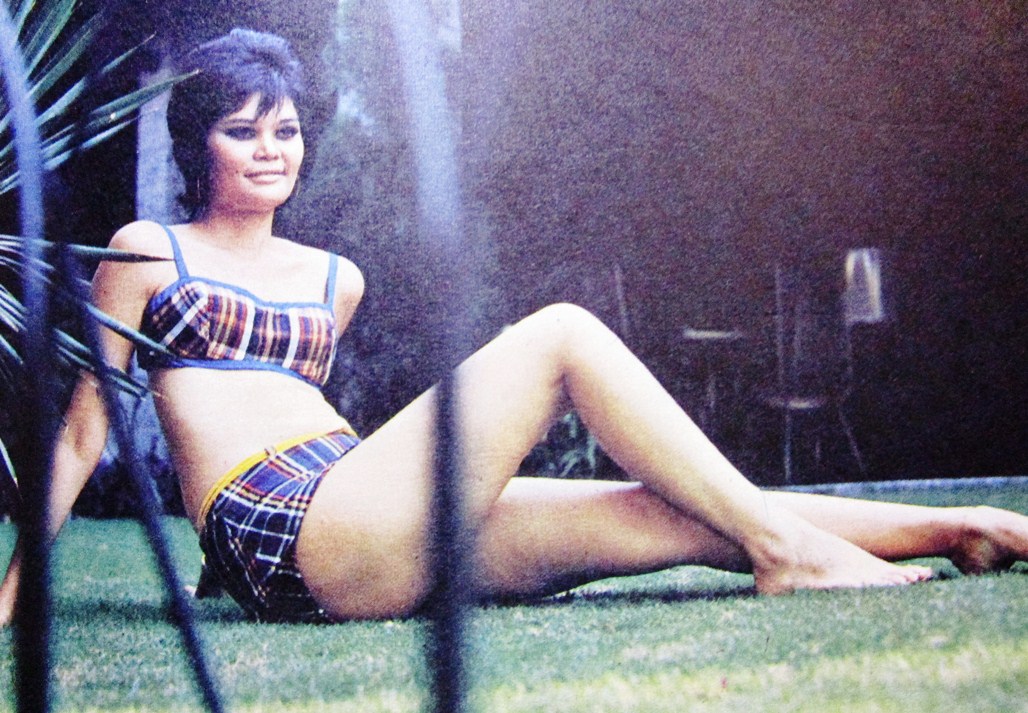
BIKINI WATCH: A
shapely model in a Madras print bikini, modest by today’s standards. 1971.
Image: PIC Magazine
The 70s decade saw much experimentation with swimsuit
fabrics, with designers working with leather, velvet, crocheted squares, fur
and metallic Lurex. A breaktrhough synthetic fiber fabric was developed in the
80s, that would give competitive swimming a big boost. Spandex (an acronym of
“expands’) and Lycra swimwear felt like second skin yet it also had superior
elasticity and strength.

STAR FOR ALL
SWIMWEAR. Vilma Santos vamps it up in a high-cut dance swimsuit in a TV show.
Image: Fashion Pulis
Style-wise, swimwear with high cut bottoms were all the
rage, as they give maximum exposure to a woman's legs and thighs to the max,
elongating the silhouette while showing off her natural contours. High cut leg
swimsuits would not only drive the popularity of tangas and thongs, but would
also spawn a new beauty service business: waxing. Media censors were mortified
to see cheek-baring tangas worn on TV by sexy dancing stars like “Tanga Queen” Alma Moreno
and Vilma Santos.

BARE AND BROWN IS
BEAUTIFUL. Tetchie Agbayani, simply bodacious on the pages of Playboy.
Image: Video 48
But a 21 year-old Filipina beauty queen would take the
display of feminine sensuality to the extreme in 1982—not in a swimsuit, but in
her birthday suit. Tetchie Agbayani made
history by becoming the first Filipina to pose nude for the German edition
of Hefner’s famous Playboy Magazine. By so doing, she showed us how to be
comfortable in our own skin, though hounded no end by moral crusader Polly
Cayetano. Agbayani also proved that swimsuits don’t make a woman, but the
confidence to do what she believes in. Which
is why the world has never lost sight of the beautiful Filipina, not even for for a second, ever since.
SOURCES:
Timeline of Art History The Bikini:
Carl Jantzen: https://en.wikipedia.org/wiki/Jantzen
Hollander, Anne. “Swimsuit Illustrated”, American
Heritage, July/August 1990.pp. 58-65.
“A Smalltown Parades its Beauties”, Sunday Times
Magazine, January 13, 1957
“The Bathing Suit in Asia”, Sunday Times Magazine, April
19, 1959
PHOTO SOURCES
Photo, Bomber with Betty Grable: The Star, WWII bomber
visits Canada, along with 1940s pin-up icon: https://www.thestar.com/news/gta/2013/06/28/wwii_bomber_visits_canada_along_with_1940s_pinup_icon.html
Photo, U.P. Swimmers at the Far East Games trials: May
10, 1934 issue, p. 28
Photo, Rosa Rosal, Movie Song Literary Magazine, 1951
Photo, Teresita Sachez at Miss Universe 1952: George Silk
© LIFE Archives
Photo, Lucita Soriano: Agent 69: Video 48
Photo, Brigitte Bardot: Getty Images, https://www.wmagazine.com/gallery/brigitte-bardot-cannes-film-festival/all
Photo, Vilma Santos: http://www.fashionpulis.com/2013/08/blast-from-past-vilma-santos-recto.html
Photo,TetchieAgbayani: http://sensualdailyimages.blogspot.com/2011/07/tetchie-agbayani-eighties-movie-ads.html


